C3, C5 - Combining transformations
Stretch a shape, then rotate it: does reversing those instructions change the result? C3 connects successive transformations to ordered matrix products and shows how to undo them. C5 adds a geometric meaning to the determinant: its magnitude scales area or volume, while its sign records orientation.
Rightmost transformation acts first
Does “stretch, then rotate” mean the same as “rotate, then stretch”? Track a point through both instructions before deciding which matrix product to use.
Let have matrix , and have matrix . Applying first gives . Applying to that output gives
Associativity lets us replace two multiplications by their composite matrix. It does not let us swap the factors.
Composite transformation
If a column vector is transformed first by , then by , the composite matrix is . The rightmost matrix acts first. With three transformations, first , then , then gives .
Use a horizontal stretch and a quarter-turn to compare the two possible orders.
Worked example 1: stretch, then rotate
Question. A stretch parallel to the -axis with factor 2 is followed by an anticlockwise rotation through about the origin. Find the composite matrix and the image of .
Plan. Put the first transformation on the right, multiply the matrices, then apply the product.
Answer. The composite matrix is ; .
Check. Geometrically, by the stretch, then by the quarter-turn. This agrees with the product.
Reverse only the order. The same two matrices now multiply the other way round.
Worked example 2: rotate, then stretch
Question. The same rotation is followed by the same stretch. Find the composite matrix and the image of .
Plan. Put the rotation on the right because it now acts first.
Answer. The composite matrix is ; .
Check. The direct route is . Stretching horizontally after the turn changes a different original direction.
[DIAGRAM: asset_name: Reversing stretch and rotation; asset_slug: aqa7367-transformation-order; caption: The same point reaches different images when a horizontal stretch and a quarter-turn are reversed; description: Two coordinate plots trace P=(1,2) through a horizontal factor-two stretch then an anticlockwise quarter-turn, reaching (-2,2), and through the reverse sequence, reaching (-4,1). The original point is grey, intermediate point blue and final point clay, with labelled arrows and the order printed above each plot.]
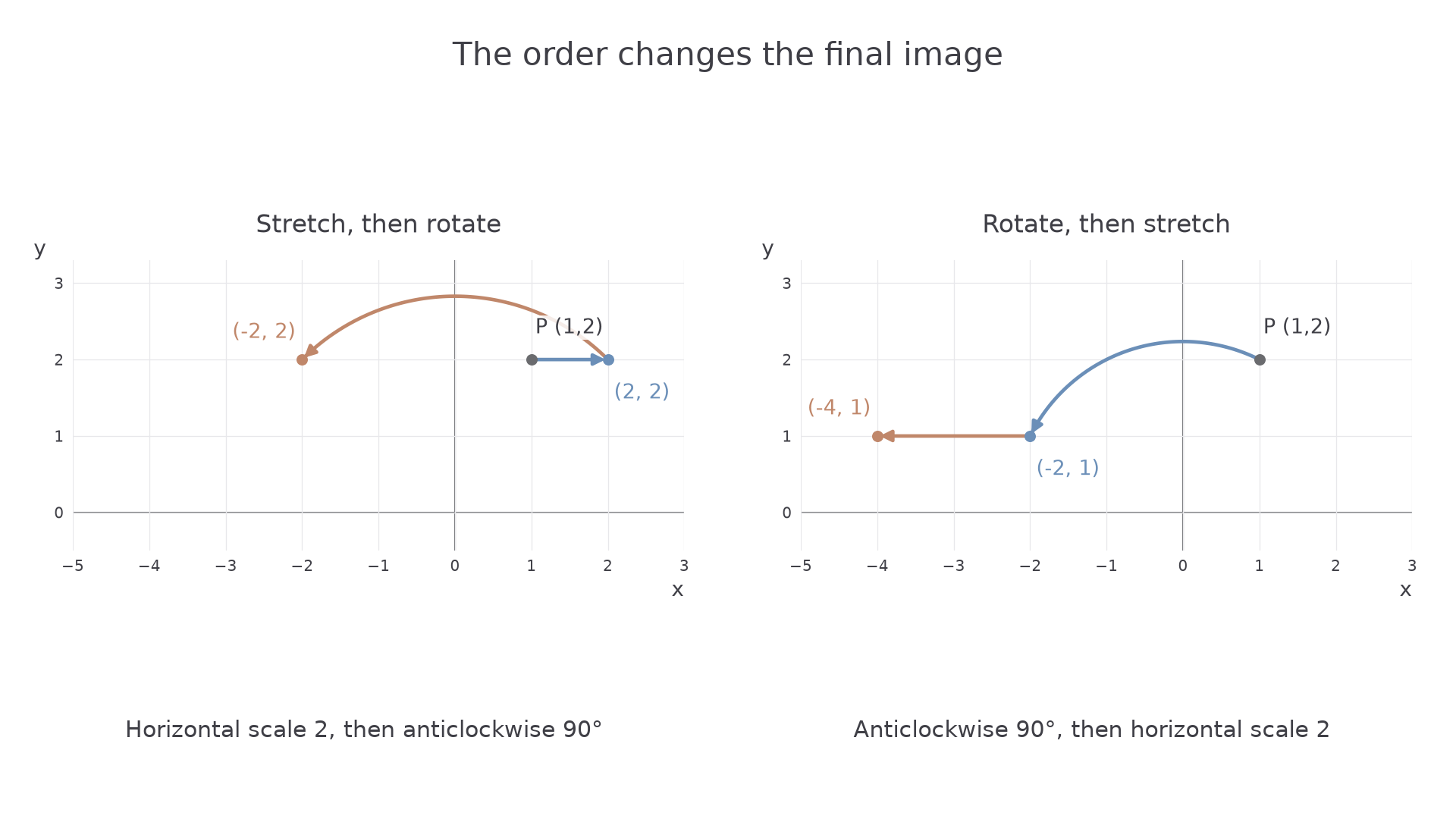
This answers the opening question: these instructions give different transformations. Some particular pairs do commute. An enlargement , for example, commutes with every matrix, because either product equals . Do not infer that all pairs behave the same way.
Watch out
“First , then ” gives , not . Write a nested expression if the wording is easy to misread.
Use another rotation with a fresh stretch factor.
Reversing a transformation
To undo “put on socks, then shoes”, undo the shoes first. A composite transformation reverses in the same way: undo the last action before the first.
The inverse transformation recovers every original input from its image. Its matrix satisfies . A rotation through is undone by a rotation through . A reflection is its own inverse. A non-zero coordinate scale is undone by its reciprocal.
If and both factors have inverses, then
Indeed, . The inverse of a product has the factors in reversed order. This product rule is not printed in the formula booklet.
Worked example 3: recovering an original point
Question. A point is stretched parallel to the -axis with factor 2, then rotated anticlockwise through about the origin. Its final image is . Find .
Plan. Undo the rotation first, then undo the stretch.
Answer. .
Check. The forward journey is , recovering the specified final image.
Change only the sign of the final image's first coordinate. The reverse instruction order stays the same.
Worked example 4: using the inverse composite matrix
Question. Under the same two transformations, has final image . Find using the inverse composite matrix.
Plan. Multiply the inverse factors in reverse order, then apply their product to .
Answer. .
Check. Multiply by the forward composite: . Also, the proposed inverse times the forward matrix is .
An inverse does not always exist. A zero horizontal scale sends every point to . Distinct inputs have the same image, so no rule can recover every original point. For a square matrix, an inverse exists exactly when its determinant is non-zero; zero determinant is the collapse you met earlier. Never use a reciprocal of a zero scale.
Signed area and volume factors
A determinant gives more than a test for collapse. The image of the unit square is a parallelogram formed by the two columns of a matrix. Its ordinary area is the magnitude of the determinant. The determinant's sign records whether the ordered directions turn the same way or the opposite way.
Orientation
In the plane, orientation distinguishes clockwise from anticlockwise order around a non-degenerate shape. In space, it distinguishes the two handednesses of an ordered set of three independent directions. For a non-singular matrix, a positive determinant preserves orientation and a negative determinant reverses it.
Use the magnitude for size and the sign for the orientation decision. These are separate conclusions.
Area and volume scale factors
For a matrix ,
For a matrix, the same rule holds for volume. A zero determinant gives zero image area or volume; the lower-dimensional image has no full-dimensional orientation. These interpretation rules are not printed in the formula booklet.
The word signed matters. A determinant of gives area factor 6 and reversed orientation, never an ordinary area of .
Worked example 5: positive signed area factor
Question. A triangle of area 5 is transformed by . Find its image area and describe the effect on orientation.
Plan. Calculate the determinant, use its magnitude for area and its sign for orientation.
Answer. The image area is 30; orientation is preserved.
Check. The columns form a parallelogram with base 2 and perpendicular height 3, so a unit area becomes area 6. Their order remains anticlockwise.
Change only the bottom-right entry from 3 to . The size of the area factor stays the same while the orientation changes.
Worked example 6: negative signed area factor
Question. The same triangle is instead transformed by . Find its image area and describe the effect on orientation.
Plan. Separate the sign of the determinant from its magnitude.
Answer. The image area is 30; orientation is reversed.
Check. The second column now ends below the horizontal axis. The column parallelogram still has base 2 and height 3, but the ordered columns turn clockwise.
[DIAGRAM: asset_name: Equal areas and opposite orientations; asset_slug: aqa7367-signed-area; caption: Changing one column's vertical sign preserves the area magnitude but reverses orientation; description: Two coordinate plots show the image parallelograms for columns (2,0),(1,3) and (2,0),(1,-3). The ordered boundary O,A,B,C is labelled in both. Each has area 6; the first has determinant plus 6 and anticlockwise order, and the second determinant minus 6 and clockwise order.]
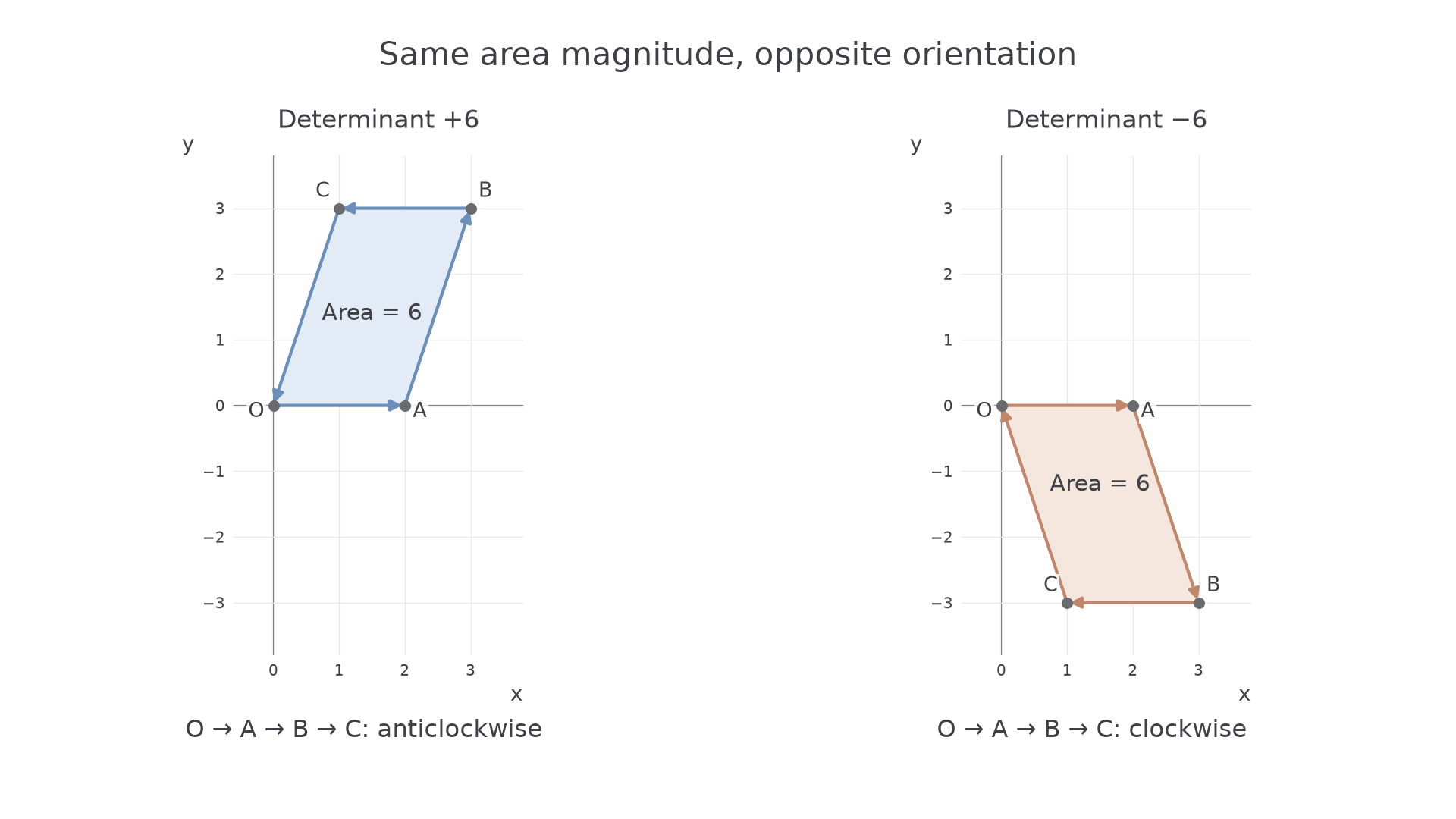
In three dimensions, reflection in has matrix and determinant . A solid keeps its volume but reverses handedness. A single rotation about a coordinate axis has determinant : it preserves both volume and handedness. These are the single 3D transformations developed next.
For successive square matrices of the same order,
Area or volume scale factors multiply; two orientation reversals restore orientation. If an inverse exists, , so . These determinant identities are not printed in the booklet.
There is a useful surprise for negative enlargements. In two dimensions, : both directions reverse, so orientation is preserved, and area multiplies by 4. In three dimensions, : three direction reversals reverse handedness. The sign of an individual length scale is not automatically the sign of the determinant.
Quick Recap
- For column vectors, the rightmost matrix acts first.
- Reverse a composite by undoing its actions in reverse order; collapse prevents an inverse.
- The magnitude of the determinant scales area or volume; its sign describes orientation.
- Determinants multiply for successive square matrices of the same order.
The opening stretch and rotation give different point images when their order changes, even though both orders have the same determinant.