D4 - The method of differences
Can a long sum of fractions collapse to just a few endpoint terms? The method of differences makes this possible when each term can be written as a difference that cancels with its neighbours. You will learn to display that cancellation, create it with partial fractions, and decide whether the finite sums approach an infinite total.
Telescoping cancellation
How much of a long sum can disappear? Consider
Each negative fraction except the last has an equal positive fraction in the next bracket. The total is . This is called telescoping: the written sum contracts as its interior terms cancel.
Method of differences
The method of differences sums a finite series by expressing its terms as differences and cancelling matching contributions. For integers ,
provided every term is defined. This identity is a cancellation method, not a separately printed formula in the formula booklet.
[DIAGRAM: asset_name: Telescoping fractions; asset_slug: aqa7367-telescoping; caption: Matching interior fractions cancel, leaving the two endpoints; description: Four consecutive rows show one minus one half, one half minus one third, one third minus one quarter, and one quarter minus one fifth. Matching positive and negative interior fractions have the same pale colour and connecting guides. The remaining first and last terms are outlined and the result one minus one fifth equals four fifths is shown.]
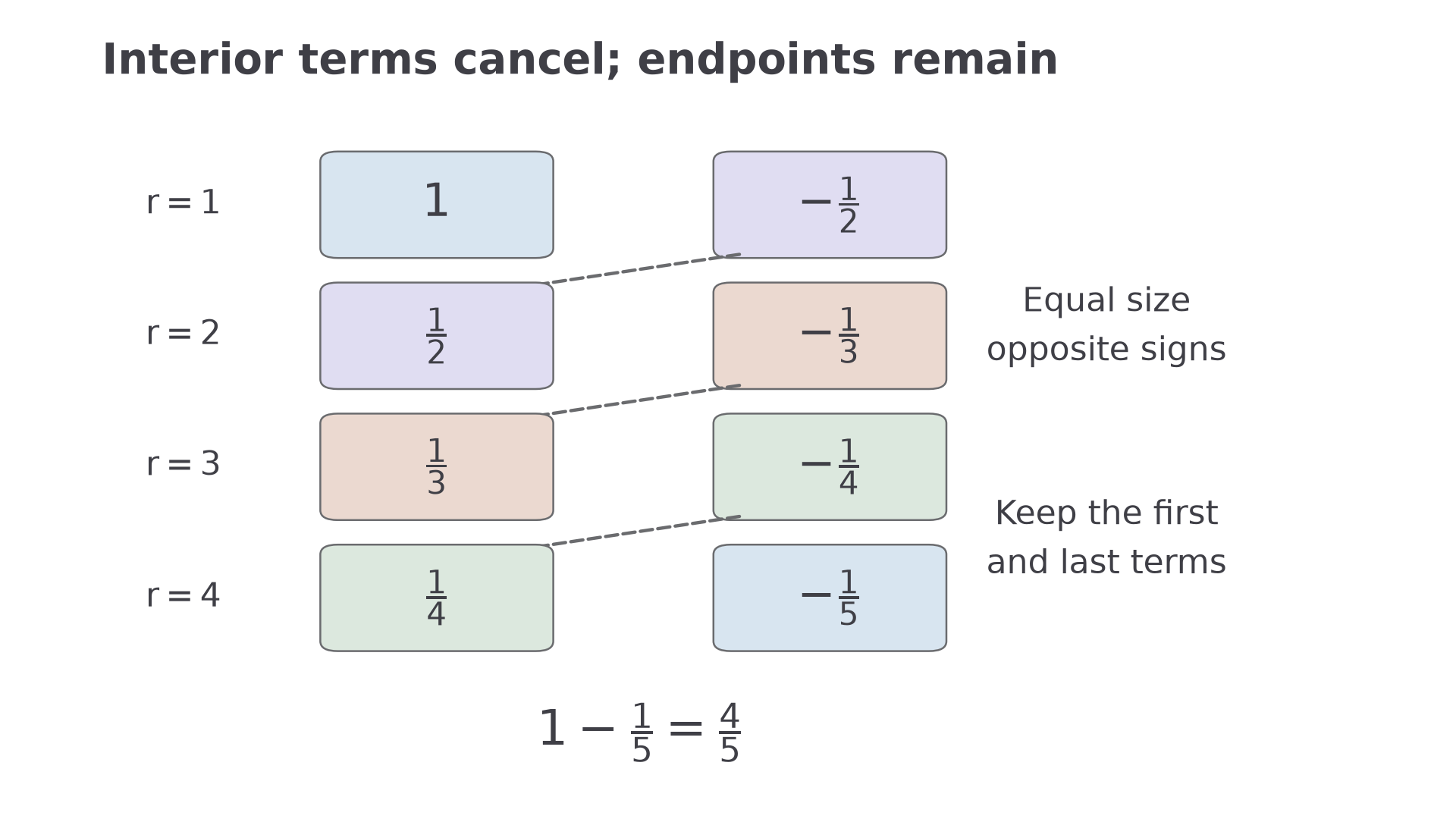
Write enough early and late terms to identify what cancels. The last negative term is , because the original index stops at .
Worked example 1: a one-step difference
Question. Find , where is a positive integer.
Plan. Display the endpoints and cancel the repeated interior fractions.
For very small , use only the brackets actually present; the displayed dots describe the general pattern.
Answer. .
Check. At , the original sum is , agreeing with the formula.
Now change only the shift in the negative denominator, from to . Cancellation skips a row, leaving two terms at each end.
Worked example 2: a two-step difference
Question. Find , where is a positive integer.
Plan. Align matching denominators and retain the two initial and two final contributions.
For , the pattern is
The same expression is valid at , as direct substitution confirms; any apparent overlap cancels within the endpoint expression.
Answer. .
Check. At , direct addition gives . The formula gives .
The shift determines the number of surviving boundary contributions.
Watch out
Do not cross out all fractions with a similar appearance. Cancel only equal terms with opposite signs, and retain every unmatched term at both ends.
Practise the same two-step cancellation with a different starting index.
Creating differences with partial fractions
Cancellation may be hidden inside a single rational term. Partial fractions split that term into simpler fractions whose denominators can line up across successive rows.
For instance,
because recombining the right side gives . This equality is valid where the denominators are nonzero. Checking the decomposition before summing catches a sign or coefficient error early.
Worked example 3: exposing a one-step cancellation
Question. Use the method of differences to find , for a positive integer .
Plan. Find the partial fractions, check them, then display the cancellation.
Hence
Answer. .
Check. Recombine the partial fractions to recover the original term. Independently, the proposed totals have difference , the correct last term, and the total at is .
Now add one more consecutive factor, , to the denominator. There will be three partial fractions. Cancellation still works, but matching contributions may come from three rows.
Worked example 4: three-part cancellation
Question. Use the method of differences to find , for a positive integer .
Plan. Decompose into three fractions, then combine coefficients of equal denominators.
Clearing the denominators gives an identity:
Setting in this polynomial identity gives , , . These substitutions find coefficients in the cleared identity; they are not allowed values in the original fractions.
Thus, for ,
For , the cancellation pattern is
An interior denominator has total coefficient . At the beginning, the surviving contributions are . At the far end, they are . Therefore
Answer. . Direct evaluation confirms the same formula for .
Check. Recombining the partial fractions gives the original numerator . Independently, subtracting the proposed total at from that at gives , the correct new term; at , the total is .
Writing the three fractions in the same order in every row makes the coefficient cancellation easier to follow.
Exam tip
For “use the method of differences” or “show that”, display the cancellation and the endpoint algebra. A stated final formula does not demonstrate the requested argument.
Use a new constant multiple with the same three-factor denominator.
Finite sums and infinite limits
An infinite series is handled through its finite partial sums. You first sum the first terms exactly, then investigate the result as increases without bound.
Convergence of a series
If the partial sums approach a finite real number as , the series converges and its sum is . If they do not approach a finite limit, the series diverges. Terms tending to zero are necessary for convergence, but this alone does not prove that the partial sums have a finite limit.
For a telescoping series, the uncancelled last terms determine the limit. Work with finite sums first: an expression such as “infinity minus infinity” is not a cancellation rule.
Worked example 5: taking a finite limit
Question. Find .
Plan. Use the finite sum, then take its limit.
Answer. The series converges to .
Check. The exact unadded tail after terms is . At , the first nine terms total , leaving ; both are positive and add to .
Change only the starting index from to . The convergence mechanism is unchanged, but the infinite total loses the first term .
Worked example 6: changing the first index
Question. Find .
Plan. Find the finite sum from the new lower limit before taking a limit.
Answer. The series converges to .
Check. Subtract the omitted first term from the previous infinite total: .
Telescoping does not guarantee convergence. For example, , so its partial sums grow without bound. By contrast, our opening sum of reciprocal differences has a finite limit because its last reciprocal tends to zero. Infinitely many positive terms can therefore have a finite total: that is a statement about the partial sums, not about ever reaching a final term.
Watch out
Only boundary terms that actually tend to zero disappear in the limit. State the limiting value of the finite sum and whether it is finite.
Use the same starting-index change once more.
Quick Recap
- Find differences whose matching interior contributions cancel.
- Use partial fractions to expose hidden cancellation, and recombine them to check the coefficients.
- Keep every surviving endpoint term, especially when cancellation skips a row.
- Find a finite partial sum before taking an infinite limit.
A long sum can collapse to a few boundary terms; their behaviour decides whether the infinite total exists.