D13 - Quadratic rational functions
A rational graph can have several branches, a sloping asymptote or a single missing point. Learn to identify these features from its numerator and denominator, keeping the original domain visible whenever factors cancel.
Quadratic ratios and zero coefficients
Does cancelling a factor always remove a vertical asymptote? Compare the numerator and denominator carefully: sometimes cancellation leaves a hole, and sometimes the graph still goes to infinity.
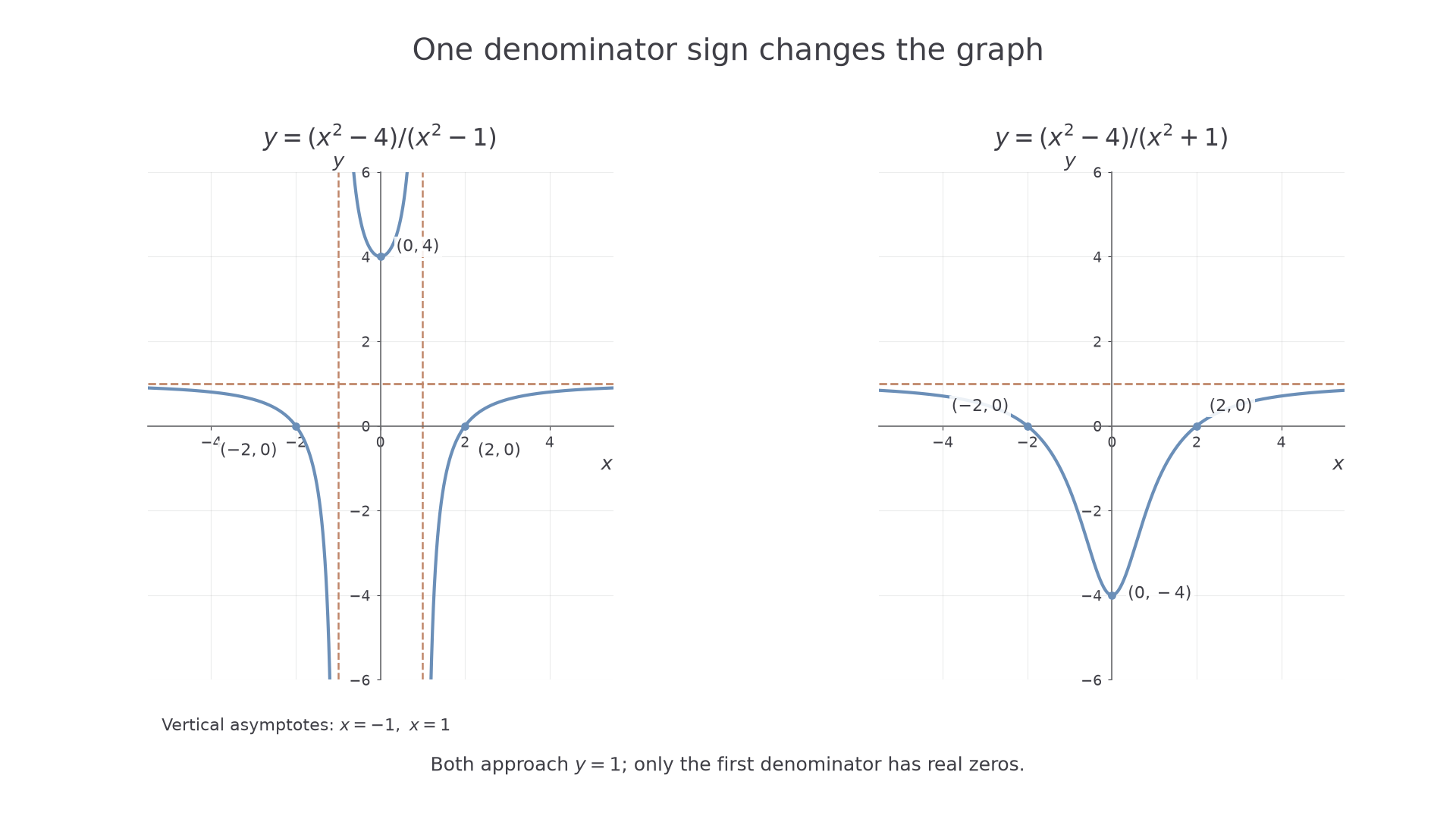
First consider . The numerator is zero at , so those are horizontal-axis intercepts. The denominator is zero at , so those inputs are excluded. Near either excluded value, the numerator stays nonzero while the denominator becomes arbitrarily small, producing a vertical asymptote.
Rational function
A rational function is a ratio of polynomials. In , coefficients may be zero, but the denominator must not be the zero polynomial. Unless a smaller domain is stated, use every real input for which the original denominator is nonzero.
To find an -intercept, set the numerator to zero and check that the input is permitted. To find the -intercept, evaluate at zero, if zero is in the domain. A constant nonzero denominator leaves an ordinary polynomial graph; a genuinely quadratic numerator then gives a parabola with no straight-line asymptotes. An identically zero numerator gives at every allowed input, retaining any original exclusions.
Worked example 1: two excluded inputs
Question. For , find the domain exclusions, axis intercepts and horizontal asymptote.
Plan. Factor the denominator, solve the numerator equation, and compare the leading terms for large .
Answer. Domain ; intercepts ; horizontal asymptote . The excluded inputs are also vertical asymptotes.
Check. At , , close to from below, as the rewritten expression predicts.
Change only the sign of the denominator's constant. The numerator and its zeros stay fixed, but the denominator now has no real zeros.
Worked example 2: a denominator with no real zeros
Question. Find the corresponding features of .
Plan. Use for every real , then repeat the intercept and large-input calculations.
Answer. Domain ; intercepts ; horizontal asymptote ; no vertical asymptotes.
Check. At , , again approaching . At , the value is the finite number , unlike Worked example 1.
Both graphs are even: replacing by leaves the value unchanged, so the vertical axis is a line of symmetry.
[DIAGRAM: asset_name: A denominator sign changes the branches; asset_slug: aqa7367-quadratic-ratios; caption: The same numerator gives poles with x squared minus one, and a continuous curve with x squared plus one; description: Two equal-scale coordinate panels compare (x squared minus four) divided by (x squared minus one) and (x squared minus four) divided by (x squared plus one). Both have x intercepts minus two and two and horizontal asymptote y equals one. The left has vertical asymptotes x equals minus one and one and y intercept four. The right has no vertical asymptotes and y intercept minus four.]
Watch out
Wrong: every quadratic denominator gives two vertical asymptotes. The equation has no real solution. Find real denominator zeros before deciding whether vertical asymptotes exist.
Use the same feature checks on a fresh ratio.
Horizontal, vertical and oblique asymptotes
An asymptote describes limiting behaviour. A vertical asymptote concerns inputs approaching a finite excluded value; a horizontal or oblique asymptote concerns inputs growing without bound. A curve can cross a horizontal or oblique asymptote at a finite input.
After cancellation, a remaining real denominator zero produces a pole and hence a vertical asymptote. For end behaviour, divide the numerator by the denominator. If the remainder term tends to zero, the quotient gives the asymptote.
End behaviour by division
After reducing the ratio and comparing its actual degrees:
- Numerator degree smaller than denominator degree: horizontal asymptote .
- Equal degrees: horizontal asymptote equal to the ratio of leading coefficients.
- Numerator degree one greater: divide to obtain , where ; the oblique asymptote is .
If the remainder is identically zero, the graph is that polynomial on its original domain; it is not a separate branch approaching a different line. These rational-graph rules are not in the formula booklet: learn the division method.
Zero coefficients can lower the denominator's degree. A quadratic numerator over a linear denominator is therefore included in the same family.
Worked example 3: equal degrees
Question. Find every asymptote of .
Plan. Check denominator roots against the numerator, then divide.
Answer. Vertical asymptotes and ; horizontal asymptote .
Check. At , the remainder vanishes and . The graph crosses its horizontal asymptote there; this does not change the limiting behaviour.
Keep the numerator fixed but make the denominator linear. The quotient now contains a linear term, giving a sloping line.
Worked example 4: an oblique asymptote
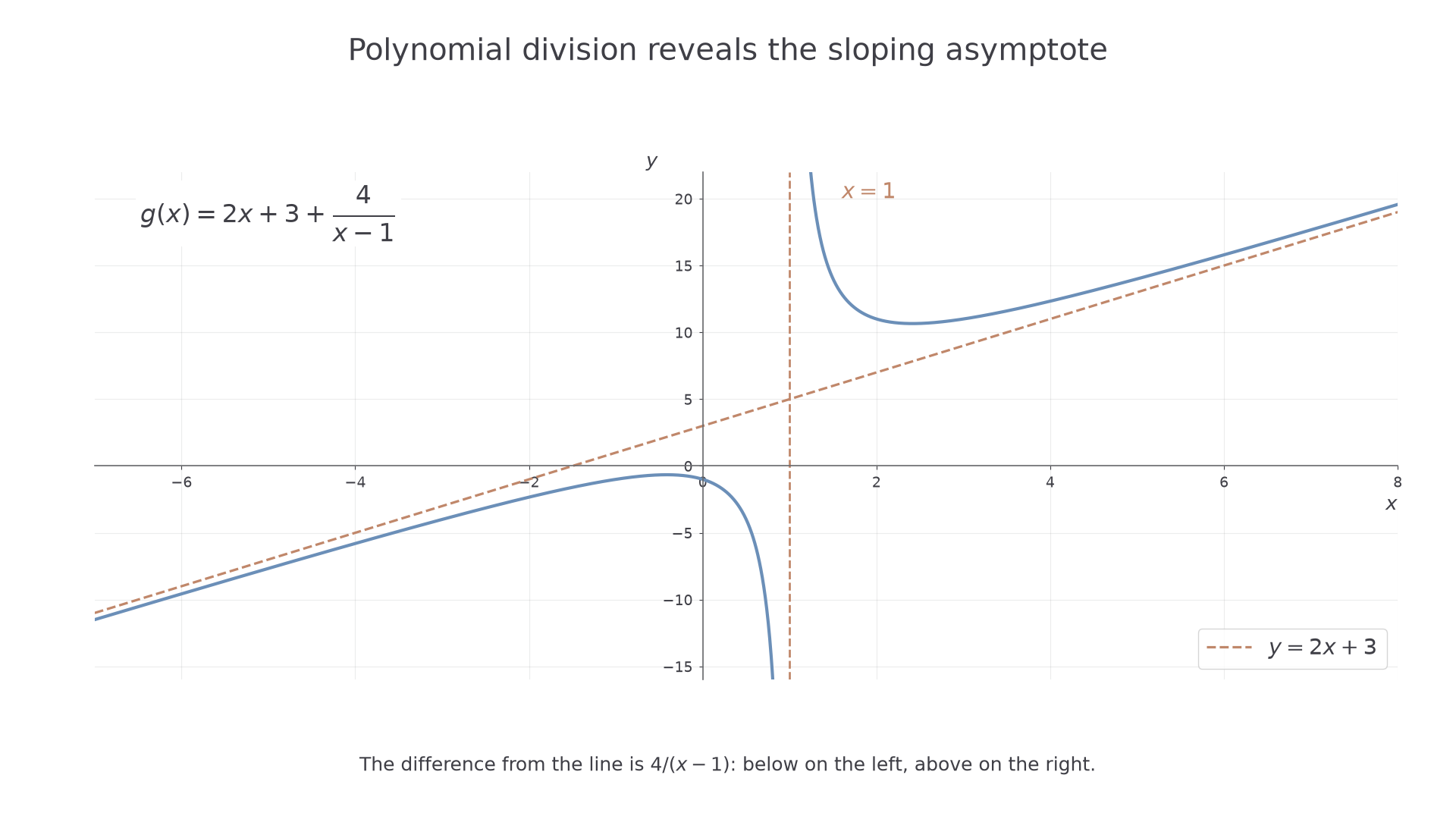
Question. Find every asymptote of .
Plan. Divide by , checking the remainder by multiplication.
Answer. Vertical asymptote ; oblique asymptote . There is no horizontal asymptote.
Check. At , the graph is above the oblique line; at , it is below. Also reproduces the numerator.
The sign of the remainder term tells you which side of the asymptote a branch occupies.
[DIAGRAM: asset_name: A sloping asymptote from polynomial division; asset_slug: aqa7367-oblique-asymptote; caption: The two branches approach y equals two x plus three, with a vertical asymptote at x equals one; description: A coordinate plot of (two x squared plus x plus one) divided by (x minus one), with a dashed oblique line y equals two x plus three and dashed vertical line x equals one. The left branch lies below the oblique line, and the right branch lies above it. A side note gives the exact difference four divided by (x minus one).]
Watch out
Wrong: the oblique asymptote is just , from dividing leading terms. Polynomial division gives both its gradient and its intercept: .
Find both asymptotes for another linear denominator.
Cancellation and holes
Cancellation simplifies values only at inputs where the original expression exists. Keep those original exclusions written beside the simplified formula.
Hole or pole
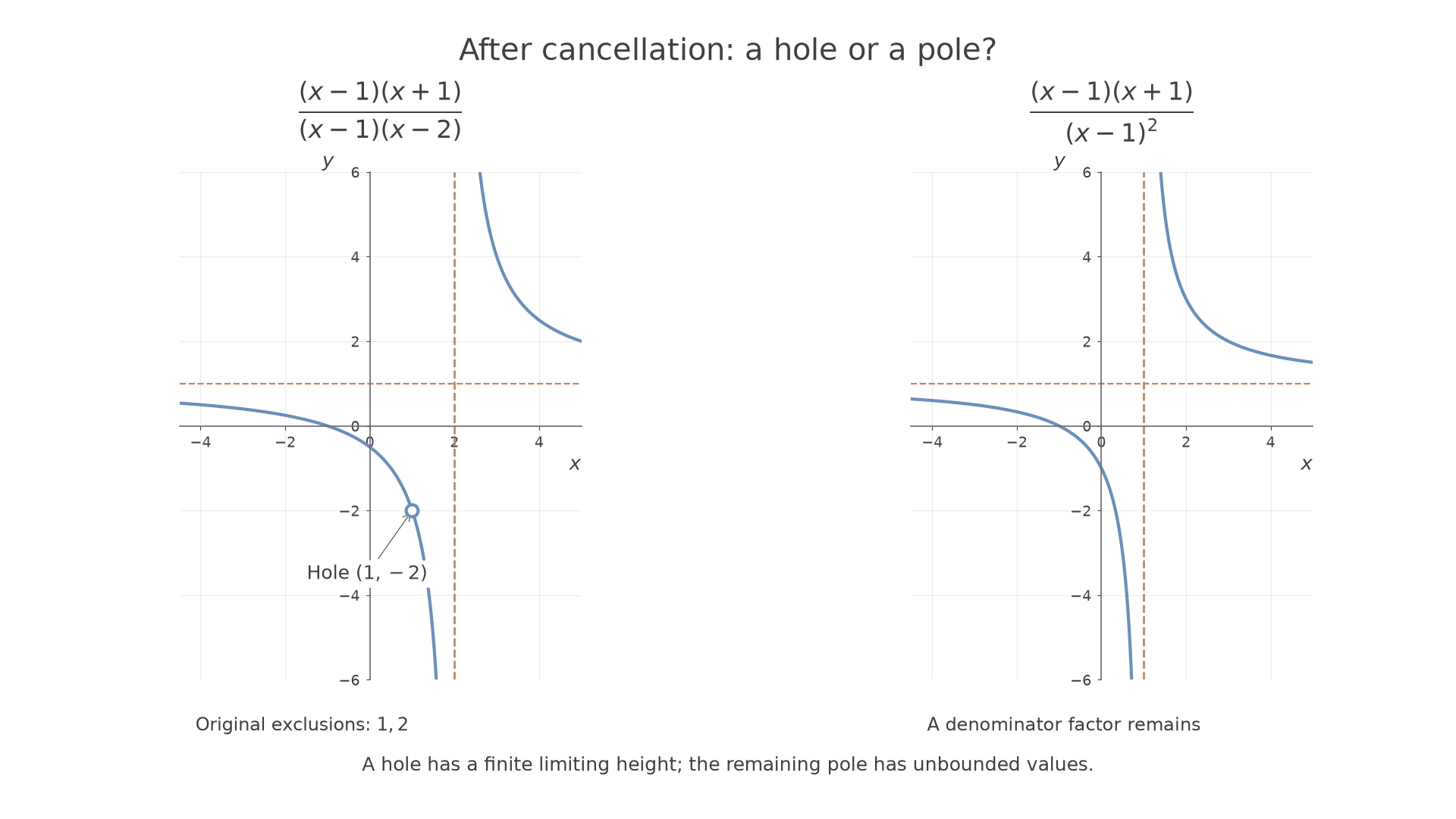
A hole occurs at an excluded input where the reduced expression has a finite limit. Draw an open circle at that limiting coordinate. If the reduced denominator still vanishes and the reduced numerator does not, the values become unbounded: there is a pole, not a hole.
The number of factors matters. Cancelling one copy of does not remove a second copy that remains in the denominator.
Worked example 5: cancellation leaves a hole
Question. Simplify , and identify its domain exclusions, hole and vertical asymptote.
Plan. Factor both polynomials, record the old exclusions and examine the reduced ratio.
Answer. Exclude and ; the hole is , and the vertical asymptote is .
Check. At , both formulae give . At , the original is undefined even though the reduced formula would give .
Move the second denominator root from to . One cancellation now leaves a denominator factor at the same excluded input.
Worked example 6: cancellation still leaves a pole
Question. Make the same analysis for .
Plan. Cancel one common factor, retaining the remaining denominator.
Answer. The only excluded input is . It gives the vertical asymptote ; there is no hole.
Check. and , consistent with opposite unbounded one-sided behaviour.
A useful connection follows: two expressions can agree at every common allowed input yet define different functions because their domains differ. Simplification is not permission to restore a deleted point.
[DIAGRAM: asset_name: Cancellation can leave a hole or a pole; asset_slug: aqa7367-holes-and-poles; caption: Cancelling one common factor leaves a hole only when the remaining expression has a finite limit; description: Two coordinate panels compare (x squared minus one) divided by (x squared minus three x plus two), which simplifies to (x plus one) divided by (x minus two) with a hole at (one,minus two), and (x squared minus one) divided by (x minus one) squared, which simplifies to (x plus one) divided by (x minus one) and still has a vertical asymptote at x equals one. The left hole is drawn as an open circle and the left vertical asymptote is x equals two.]
Watch out
Wrong: “A common factor always gives a hole.” Cancel fully and inspect the remaining denominator. A hole needs a finite limiting value; Worked example 6 still has a pole.
Preserve both restrictions when doing your own cancellation.
Quick Recap
- Find numerator zeros, denominator zeros and intercepts, preserving the original domain.
- Use actual polynomial degrees and division to find horizontal or oblique asymptotes.
- A finite crossing of a horizontal or oblique asymptote is possible.
- Cancelled factors may leave holes; remaining denominator factors can still give poles.
No: cancelling a factor does not always remove a vertical asymptote. In , one denominator factor remains, so is still a vertical asymptote.