C5 - Determinants in two and three dimensions
A determinant turns a square matrix into one number that detects whether its columns retain all their dimensions. You will calculate determinants of order 2 and 3 by expansion, then see why a zero determinant signals a collapse onto a line, a plane or a point. This gives a useful warning before you try to reverse a matrix calculation.
Expanding determinants
Can a matrix send two different inputs to the same output? For , the inputs and both give . A single number, the determinant, will detect this loss of information.
Determinant
The determinant of a square matrix is a scalar, written , or . Determinant bars are not matrix brackets. For a matrix,
The products run along the two diagonals, with a subtraction between them. This rule is not in the formula booklet.
For the opening matrix the determinant is . First practise the calculation before interpreting it.
Worked example 1: a determinant of order 2
Question. Find for .
Plan. Multiply down the main diagonal, then subtract the other diagonal product.
Answer. , a number rather than a matrix.
Check. The columns end at and . The parallelogram they form has horizontal base 2 and perpendicular height 3, so its area is , agreeing with the determinant's magnitude.
Change only the bottom-right entry from 3 to . The second diagonal product stays the same, but the first changes sign.
Worked example 2: a negative determinant
Question. Find for .
Plan. Keep both signed diagonal products separate before subtracting.
Answer. . A determinant can be negative; it is not an ordinary unsigned area.
Check. The columns end at and . The parallelogram still has base 2 and height 3, so its area is 6. The second column now points below the first, reversing their orientation compared with the first example.
For order 3, reduce the calculation to determinants of order 2. The minor of an entry is the determinant left after deleting its row and column. Its cofactor is that minor multiplied by the sign in this pattern:
Multiply each entry of one row by its cofactor and add. This is cofactor expansion. Along the top row,
You may instead expand down any column or along any row, using its own cofactor signs. Choose a row or column containing zeros to reduce the work. The expansion rule is not in the formula booklet.
Worked example 3: expanding across the first row
Question. Find , where .
Plan. Expand across row 1; its zero makes the third contribution vanish.
Answer. .
Check. Expanding down column 1 gives , the same scalar using different minors.
Keep the matrix unchanged and change only the expansion row. This isolates the cofactor sign attached to a different position.
Worked example 4: expanding across the second row
Question. Find the determinant of the same by expanding across row 2.
Plan. Use the signs ; the first entry is zero.
Answer. .
Check. Direct expansion down column 3 gives . Changing the expansion route cannot change the determinant.
AQA's matrix questions often embed determinant work inside an inverse calculation. Keeping the minor, its cofactor sign and its multiplying entry separate makes errors easier to find.
Watch out
A minor can itself be negative. In Worked example 3 the second contribution is , not . The alternating sign and the value of the minor are separate pieces of information.
Use a fresh matrix and choose an efficient expansion.
Zero determinant and collapse
Think of as a rule sending an input point to an output point. Its two columns are the outputs of and , and every output is a linear combination of those columns.
For , the second column is twice the first. Every output is therefore
All outputs lie on the line . A whole square of inputs collapses onto a line; its image has area zero. The two distinct inputs in the opening question share one output because their contributions combine to the same value of .
[DIAGRAM: asset_name: A square collapses onto a line; asset_slug: aqa7367-zero-determinant; caption: The matrix with columns (1,2) and (2,4) sends a unit square onto a line segment; description: Two coordinate plots show the unit square with vertices (0,0), (1,0), (1,1), (0,1), and its four labelled images (0,0), (1,2), (3,6), (2,4). The image points all lie on Y equals 2X, so the image has zero area.]
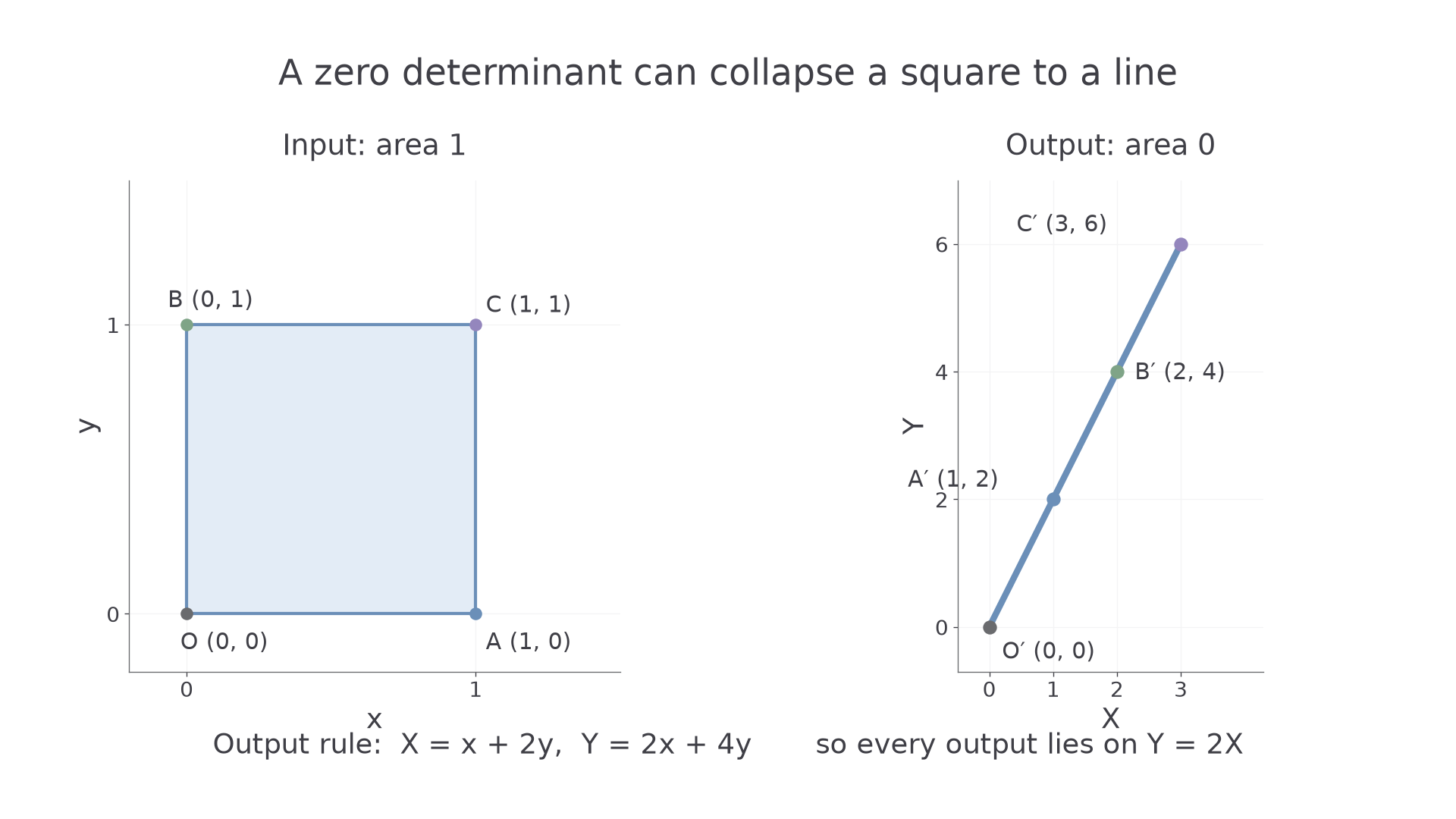
For a matrix, a zero determinant means its columns lie along a single line, or are both zero. The image has at most one independent direction: a line or a point. A non-zero determinant means the two columns retain two independent directions.
In three dimensions, three independent column directions span space. If a matrix has determinant zero, those directions are dependent, so a solid can collapse into a plane, a line or a point. For example,
This matrix has determinant zero and sends every point to the plane . Changing the input's third coordinate no longer changes the output. The zero matrix collapses everything to the origin.
The magnitude of a determinant gives the area factor in two dimensions or volume factor in three dimensions. At zero, that area or volume vanishes. A non-zero determinant also carries orientation information; you will develop signed scale factors with successive transformations.
Key idea
Zero determinant means lost dimensional information. It does not mean that the matrix is the zero matrix, or that every output is the zero vector.
Distinguish a collapse into a plane from a collapse to the origin.
Quick Recap
- A determinant is a scalar associated with a square matrix; for order 2 it is .
- For order 3, expand along one row or column, multiplying entries by signed minors.
- A zero determinant signals collapse into fewer independent dimensions, rather than requiring every output to be zero.
Yes: distinct inputs can give the same output. The opening matrix loses the distinction between inputs whose value of is the same.