C10 - Eigenvalues and eigenvectors
A matrix usually changes both the length and direction of a vector. Eigenvectors identify the special directions in which it acts as a simple scale. You will find eigenvalues from a characteristic equation, find their corresponding vectors in two and three dimensions, and interpret the results geometrically.
Characteristic equation in 2D and 3D
Which directions does stretch without turning them away from their original line? Try two vectors:
Each output is a scalar multiple of its input. The scale depends on the direction: 4 along one line and 2 along the other.
Eigenvalue and eigenvector
A nonzero vector is an eigenvector of a square matrix if
The scalar is its corresponding eigenvalue. The zero vector is excluded because holds for every scalar and identifies no special direction. An eigenvalue itself may be zero.
How can you find the scales without guessing vectors? Rearrange to . If were invertible, multiplying by its inverse would force . A nonzero solution therefore requires this matrix to be singular. Conversely, a singular square matrix has a nonzero solution to its homogeneous equations.
Characteristic equation
The eigenvalues of a square matrix are the roots of
This is the characteristic equation. Subtract from each diagonal entry only. For a matrix it is quadratic; for a matrix it is cubic. Using gives the same roots.
Not in the formula booklet: learn it.
Use the determinant methods you already know. A row with zeros can make the three-dimensional calculation much shorter.
Worked example 1: two-dimensional eigenvalues
Question. Find the eigenvalues of .
Plan. Form the determinant, expand it and solve the resulting quadratic.
Hence .
Answer. The eigenvalues are and .
Check. The two direct vector products at the start give scale factors 4 and 2, independently confirming both roots.
Keep that two-dimensional block and add a third coordinate scaled by . The extra direction adds one factor to the determinant.
Worked example 2: extending the same block to 3D
Question. Find the eigenvalues of .
Plan. Expand along the last row, where two entries are zero.
Set the complete product equal to zero.
Answer. The eigenvalues are , and .
Check. Direct multiplication gives scales 4, 2 and on , and , respectively. All three vectors are nonzero.
Real matrices need not have only real eigenvalues. For example, a quarter-turn matrix has characteristic equation , with roots . These are valid complex eigenvalues, but they do not describe real directions in the plane. For a real matrix, non-real roots occur in conjugate pairs because its characteristic polynomial has real coefficients. Geometrical directions below use real eigenvectors and real eigenvalues.
Watch out
Wrong: subtracting from every entry. The expression is , so off-diagonal entries stay unchanged. If , use ; dropping the factor changes the eigenvalues.
Find the characteristic equation for a fresh matrix.
Finding corresponding eigenspaces
An eigenvalue tells you the scale; solving tells you which vectors receive that scale. These are homogeneous equations, so choose a convenient free variable rather than seeking a unique vector.
Eigenspace
For an eigenvalue , its eigenspace is the set of all solutions of , including . Its eigenvectors are exactly the nonzero vectors in that set. Every nonzero scalar multiple of an eigenvector is another eigenvector for the same eigenvalue.
The equations are dependent when is an eigenvalue. An equation reducing to adds no restriction; it does not require a free variable to be zero.
Worked example 3: matching each vector with its scale
Question. Find the eigenspaces of , whose eigenvalues are 4 and 2.
Plan. Substitute one eigenvalue at a time and solve for .
The second row repeats the restriction from the first in each case.
Answer. The eigenspaces are for 4 and for 2. Restrict to when listing eigenvectors.
Check. and for every real , checking the whole sets rather than just one representative.
Use the same eigenvalues and vectors in the first two coordinates, but now retain all three equations. The extra coordinate cannot simply be left arbitrary.
Worked example 4: the corresponding three-dimensional spaces
Question. Find the eigenspaces of , whose eigenvalues are 4, 2 and .
Plan. For each eigenvalue, solve .
For the last case, in gives ; only is free.
Answer. The eigenspaces are all real multiples of , and , paired with 4, 2 and , respectively. Nonzero multiples are eigenvectors.
Check. Substituting each general solution into gives , and , the required scalar multiples.
An eigenspace can be a plane. For , the repeated root 2 gives only , so every lies in its eigenspace. All except are eigenvectors. The two free variables provide two independent directions. A repeated root does not automatically provide that many independent eigenvectors: you must solve the equations.
If complex vectors are allowed, the quarter-turn matrix from part 1 has eigenvectors too. Its equations give for , so works; conjugating gives for . Directly, . These are complex vectors, not arrows representing real points of the plane.
Watch out
From , a convenient eigenvector is , not . Read the coordinate ratio in the right order, keep the eigenvalue paired with its vector, and check .
Find a two-dimensional eigenspace inside three-dimensional space.
Geometrical meaning of eigenvalues
For a real eigenvector, the equation describes motion along its original line. Length is multiplied by ; the sign tells you what happens to the direction.
| Real eigenvalue | Effect on a nonzero eigenvector |
|---|---|
| Same ray, with length multiplied by | |
| Opposite ray, with length multiplied by $ | |
| Collapses to the zero vector | |
| Endpoint stays fixed | |
| Length stays the same and direction reverses |
For instance, sends to , but sends to . The same transformation stretches one direction and reverses the other without changing its length. Eigenvalues reveal that mixture far more clearly than the four entries alone.
[DIAGRAM: asset_name: Two directions under one matrix; asset_slug: aqa7367-eigen-directions; caption: One matrix stretches vectors on y equals x by three and reverses vectors on y equals minus x; description: Two equal-scale coordinate panels show the matrix with rows one two and two one. In the left panel a blue arrow from the origin to (1,1) and a clay arrow to (3,3) lie on the dashed line y equals x. In the right panel a blue arrow to (1,minus 1) and a clay arrow to (minus 1,1) lie on the dashed line y equals minus x. Labels identify the original and image and eigenvalues three and minus one.]
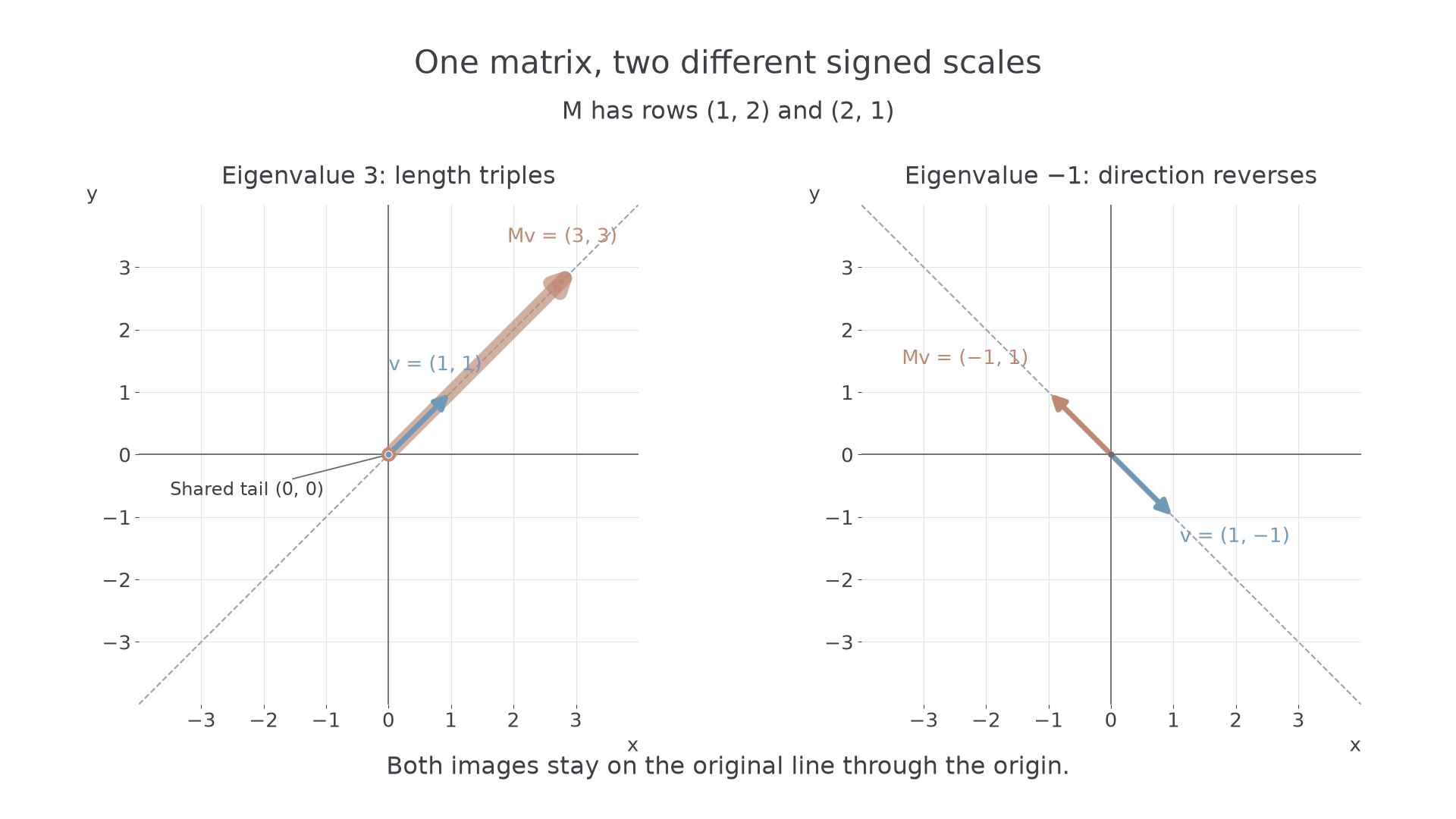
Linearity extends this description to every point : its image is . If , the whole line is mapped onto itself. When , the line collapses to the origin instead, so its image is contained in the original line but is not the whole line. Eigenvalue 1 gives a line of invariant points; another nonzero eigenvalue gives an invariant line on which nonzero points move.
Not every vector is an eigenvector. For the same , , which is not a scalar multiple of . A quarter-turn has no real eigenvector at all: every nonzero real arrow is turned off its original line. Its complex eigenvalues are consistent with that geometry.
The opening matrix has eigenvectors along and . These directions receive scales 4 and 2. Any nonzero multiple of either displayed vector therefore answers the opening question.
Key idea
A real eigenvector identifies a line direction, and its real eigenvalue gives the signed scale along it. Negative eigenvalues reverse the ray; zero collapses the direction; only eigenvalue 1 fixes every point along it.
Distinguish a fixed direction from fixed points.
Quick Recap
- An eigenvector is nonzero and satisfies ; an eigenvalue may be zero.
- Solve , then solve the homogeneous equations separately for each root.
- An eigenspace includes zero; its nonzero members are the corresponding eigenvectors.
- For real vectors, gives the length scale and a negative sign reverses direction. Complex eigenvectors do not represent real line directions.
The opening matrix stretches directions and by 4 and 2, respectively, without turning them off their original lines.