C1, C2 - Matrix multiplication
Multiplying matrices combines whole rows with whole columns, rather than multiplying entries in matching positions. C1 develops that rule, its size conditions and the importance of order; C2 explains how zero and identity matrices behave in products. You will use the same rule for rectangular products and powers of square matrices.
Row-column multiplication
Can reversing two factors change a product? With ordinary numbers it cannot, but matrices will give a different answer. First, we need the multiplication rule.
Suppose two quantities produce and . A new output is
Each coefficient in the final output comes from multiplying a row of coefficients by a column of coefficients and adding. This is why matrix multiplication uses rows and columns: it captures the substitution of one set of linear expressions into another.
Row-column rule
The entry in row , column of is the sum of the products of corresponding entries in row of and column of . For matrices,
Not in the formula booklet.
Keep the first matrix on the left throughout the calculation.
Worked example 1: four row-column sums
Question. Find , where
Plan. Use each row of with each column of .
Answer. .
Check. The first output column is times the first column of plus times its second column: . The second is , confirming the whole result.
Change only the bottom-right entry of from 4 to . This affects its second column, so only the second column of the product should change.
Worked example 2: changing one entry
Question. Find , where and .
Plan. Retain the first output column and recalculate the row-column sums for the second.
Answer. .
Check. The change in was . Therefore the output changes by , exactly .
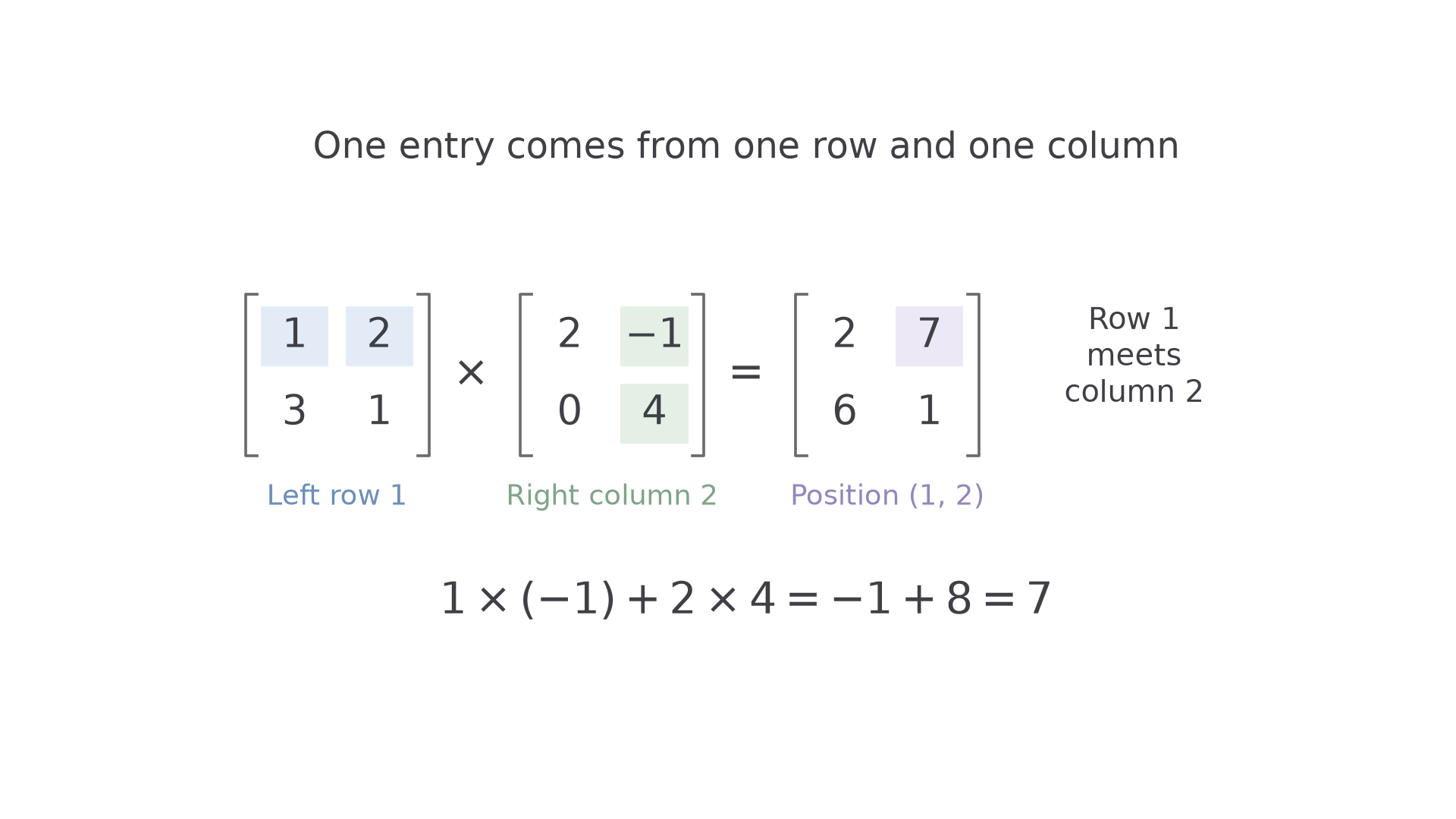
The diagram tracks the top-right entry: left row 1 meets right column 2, and their sum lands in position .
[DIAGRAM: asset_name: A row meets a column; asset_slug: aqa7367-row-column; caption: Row 1 of the left matrix and column 2 of the right matrix produce the top-right entry 7; description: Three matrices show (1 2; 3 1) times (2 minus 1; 0 4) equals (2 7; 6 1). Pale blue highlights the first row of the left matrix, pale sage the second column of the right matrix and pale lavender the entry 7. Below is the calculation 1 times minus 1 plus 2 times 4 equals 7.]
Watch out
Multiplying corresponding entries would give in Worked example 1. That is not the matrix product: every output entry needs a whole row-column sum.
Use that rule on a new pair.
Conformability for products
A row with three entries needs a column with three entries: otherwise there is no way to pair all the entries. This gives a different conformability rule from addition.
Conformable product
If is and is , then is defined and has dimensions . The inner dimensions must agree; the outer dimensions give the result. The factors need not be square or have the same dimensions.
For instance, gives , whereas is undefined. Check the sizes before doing arithmetic.
Worked example 3: a rectangular matrix times a column
Question. Find , where
Plan. Check , then use the two rows with the single column.
Answer. A column, .
Check. Combine the columns of : .
Now add one extra column to the right-hand factor. The matching inner dimension remains 3, while the output acquires a second column.
Worked example 4: two output columns
Question. Find , where and .
Plan. Use to predict a result; calculate each output column.
Answer. .
Check. The first column agrees with Worked example 3. The second is the first column of minus twice its third: .
Reversing these factors would produce a matrix. With other sizes, reversing a valid product may make it undefined altogether.
Why order matters
Even when both products exist and have the same dimensions, they need not be equal. Multiplication of matrices is not commutative in general. Two particular matrices are called commutative under multiplication when .
Worked example 5: reversing the factors
Question. Determine whether and are commutative under multiplication.
Plan. Calculate both products and compare corresponding entries.
In the first product, the top-right entry is . In the reverse product it is .
Answer. They are not commutative, because .
Check. Apply the two products to . They give and ; one input is enough to distinguish them.
Change only the bottom-right entry of to a parameter. This lets you find the special case in which order ceases to matter.
Worked example 6: finding when matrices commute
Question. Find the real value of for which and are commutative under multiplication. Fully justify your answer.
Plan. Set and compare the entries that differ.
Commutativity requires equality of every corresponding entry. Three entries already agree; the top-right entries agree exactly when .
Answer. .
Check. For , , so both products equal . For any other , their top-right entries differ.
A second surprise is that two non-zero matrices can have a zero product:
Every row-column sum is zero, although neither factor is zero. You cannot import all the cancellation rules of ordinary numbers into matrix algebra.
Exam tip
When asked to fully justify commutativity, write the condition , show the products and explain which entry conditions are needed. A numerical answer alone does not supply the requested argument.
Now find a fresh special case.
Powers and identity
For a square matrix, a power means repeated matrix multiplication: , not squaring each entry. Square dimensions ensure that every repeated product is defined.
The identity really does act like 1. For any matrix,
In a row-column sum, the single 1 selects the corresponding entry and the other entries contribute zero. The sizes of the left and right identities may differ. Multiplying a conformable matrix by a zero matrix gives a zero matrix of the output dimensions.
Non-negative integer powers
For a square matrix , define . For non-negative integers ,
The order of the copies of is unchanged. Not in the formula booklet.
Matrix multiplication is associative: when the dimensions fit. Brackets may move, but factors may not be reordered. It is also distributive over addition.
Worked example 7: squaring a matrix
Question. Find , where .
Plan. Multiply the matrix by itself using row-column sums.
Answer. .
Check. The matrix sends to . Applying it twice gives , matching the product for every input.
Increase only the exponent from 2 to 3. The previous result can be reused, but it must be multiplied by another whole matrix.
Worked example 8: one more factor
Question. For the same , find .
Plan. Multiply by .
Answer. .
Check. Applying three times adds three times to the first component and leaves the second unchanged: .
For different matrices, familiar identities need care. Distributing gives . The middle terms become only if the matrices commute. This answers the opening question: reversing factors can change a matrix product, even when both orders exist.
Quick Recap
- A left row and a right column produce one entry through a sum of products.
- gives ; check dimensions before multiplying.
- Reversing factors can change the product. Non-zero factors can even have a zero product.
- Powers repeat whole matrix multiplication, and the correctly sized identity leaves a matrix unchanged.
Order matters because each output combines a different left row with a different right column.