D12 - Linear rational functions
A fraction of two linear expressions often hides a translated reciprocal graph. You will expose that structure, find asymptotes and intersections, and solve the associated inequalities while distinguishing genuine vertical asymptotes from removable holes.
Graphs of linear rational functions
Can changing one constant turn a two-branch curve into a straight line with a missing point? Start with . Since ,
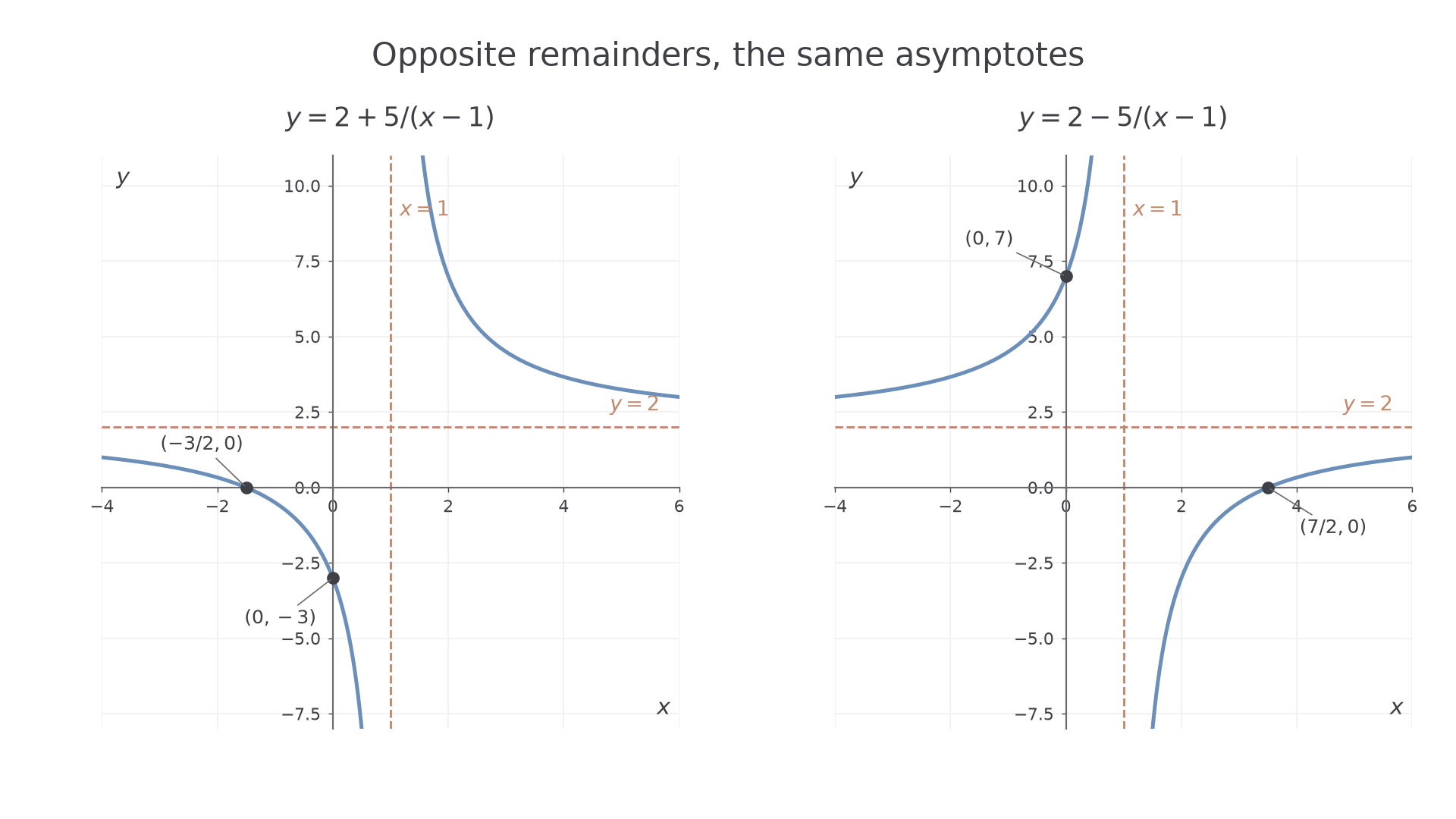
You can now recognise the reciprocal shape: move the missing vertical line to , multiply reciprocal outputs by 5, and move the horizontal limiting level to .
An asymptote describes limiting behaviour. A vertical asymptote occurs when the function becomes unbounded as approaches from at least one side. A horizontal asymptote describes a finite limiting level as tends to an infinite end. A denominator zero by itself is insufficient to prove a vertical asymptote: cancellation may instead leave a finite hole.
Linear rational form
For ,
If , the graph has asymptotes and . If , it is the constant with the original denominator zero removed. Not in the formula booklet: learn it.
The identity follows by writing . For a specific question, a short division like the opening example is usually easier than substituting into the general expression.
Worked example 1: a translated reciprocal
Question. Write in the form . State its domain, asymptotes and branch positions relative to the horizontal asymptote.
Plan. Express the numerator as twice the denominator plus a remainder.
For , the remaining fraction is positive, so the right branch lies above . For , it is negative, so the left branch lies below . As approaches 1, the nonzero numerator remainder 5 divided by an arbitrarily small signed denominator becomes unbounded.
Answer. , , ; domain ; asymptotes , . The right branch is above 2 and the left branch below 2.
Check. Multiplying the rewritten expression by gives , the original numerator. Also and , checking one point on each branch.
Change only the numerator's constant, from 3 to . The remainder changes sign, so the branches change sides of the same horizontal asymptote.
Worked example 2: reversing the reciprocal part
Question. Write in the form . State its domain, asymptotes and branch positions.
Plan. Use the same quotient 2 and calculate the new remainder.
For , the remaining term is negative, so the right branch lies below 2. For , it is positive, so the left branch lies above 2. The nonzero remainder again ensures a vertical asymptote at the excluded input.
Answer. , , ; domain ; asymptotes , . The branch positions are reversed from Worked example 1.
Check. For every allowed , , so their outputs are equally far on opposite sides of level 2. At , the outputs 7 and verify this reflection directly.
The two graphs make that controlled sign change visible.
[DIAGRAM: asset_name: Opposite reciprocal remainders; asset_slug: aqa7367-linear-rational-branches; caption: The same asymptotes support opposite branch positions when the remainder changes sign; description: Two coordinate panels show (2x plus 3) divided by (x minus 1) and (2x minus 7) divided by (x minus 1). Both have dashed asymptotes x equals 1 and y equals 2. The first has its right branch above 2 and its left branch below 2, with intercepts (minus three halves,0) and (0,minus 3). The second has its right branch below 2 and its left branch above 2, with intercepts (seven halves,0) and (0,7).]
If and , the expression is a straight line, possibly constant: there is no denominator zero. If , the expression is nowhere defined. Those cases are outside the division by in the formula box.
Watch out
Wrong: . The remainder comes from subtraction of , so it is 5, not 3. Multiply back to verify every decomposition.
Use the quotient-and-remainder form on a fresh function.
Intercepts and intersections with straight lines
An axis intersection is a special case of intersecting the curve with a straight line. For a horizontal-axis intercept, set the numerator equal to zero and check the denominator is nonzero. For a vertical-axis intercept, substitute , if that input is allowed.
To intersect with , solve
Multiplying an equation by a nonzero denominator is valid regardless of its sign. The resulting equation is at most quadratic. Check its roots against the original domain, then substitute each valid input into the line to obtain the full coordinates.
You already know
A line of gradient through can be written , or rearranged to . For a quadratic , , the discriminant distinguishes two, one or no real roots. Domain checks may still remove algebraic roots.
The next pair keeps the curve and line intercept unchanged and reverses only the line's gradient.
Worked example 3: two line intersections
Question. For , find both axis intercepts and all intersections with .
Plan. Find axis intercepts directly, then equate the two outputs on .
Both lie in the original domain. Substituting into the line gives , using matching signs.
Answer. Axis intercepts and ; line intersections and .
Check. For either root with , , so the curve and line agree exactly after division by the allowed nonzero denominator.
The line has the same vertical-axis intercept but slopes in the opposite direction. It need not meet this curve at all.
Worked example 4: no real intersection
Question. Find all intersections of and .
Plan. Equate outputs and inspect the resulting quadratic rather than assuming two intersections.
Answer. There are no real points of intersection.
Check. Completing the square gives for every real input, so the equation cannot be satisfied. This confirms the discriminant decision independently.
A zero discriminant can give a tangent intersection when its input is allowed. A horizontal line can instead produce a linear equation or a contradiction: for example, this curve cannot meet , because would require a nonzero reciprocal term to be zero.
Watch out
Wrong: an intersection is just . A point of intersection needs both coordinates. After checking the input is allowed, use the straight line to find its output.
Find the coordinates for a fresh curve and line.
Associated inequalities and removable points
An intersection gives an equality boundary. To decide where the rational curve lies below a line, compare their difference with zero and use a sign chart. Include original denominator zeros among the critical values: a vertical asymptote can separate two solution regions without being an equality point.
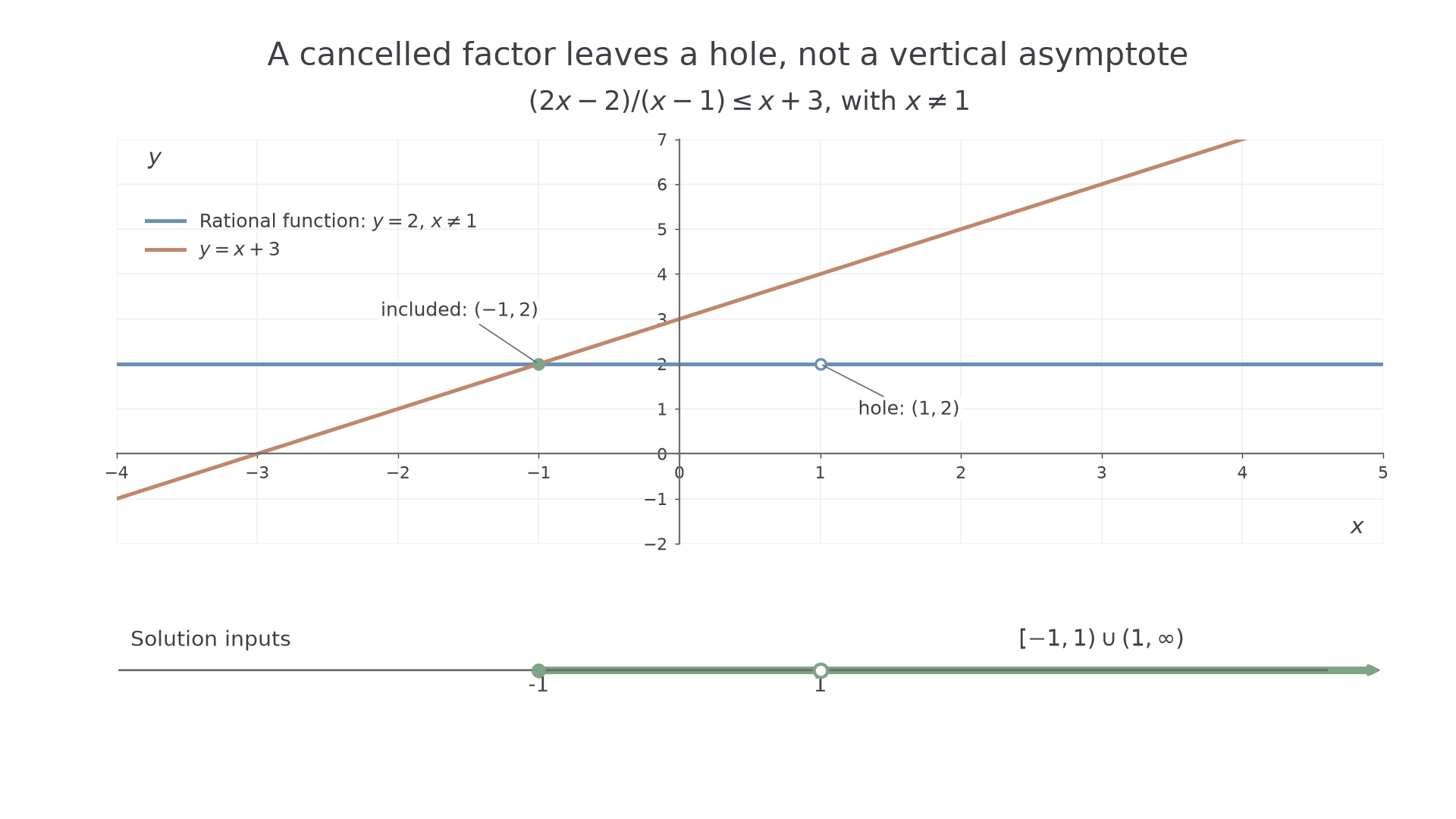
The opening question has a special answer. If the numerator is an exact multiple of the denominator, the reciprocal remainder vanishes. The function becomes a constant on its original domain, with a removable point or hole where the original denominator was zero. Its limiting output there is finite, so that excluded input is not a vertical asymptote.
Worked example 5: comparing the curve with a line
Question. Solve , giving an exact solution set.
Plan. Form the difference, order its zeros and exclusion, then use signs.
The critical values are , in that order. The numerator is positive between its roots and negative outside.
Select the negative intervals, include the two numerator zeros for equality, and exclude 1.
Answer. .
Check. In the original comparison, gives , true, while gives , false. The two equality inputs are exactly the valid line-intersection inputs from Part 2. The denominator's zero cannot be included.
Now change only the numerator's constant from 3 to . The remaining fraction disappears, replacing the two-branch graph with a punctured horizontal line.
Worked example 6: preserving a removable exclusion
Question. Solve , and describe the graph of the rational function.
Plan. Retain the original exclusion before cancelling the common factor.
The allowed solution must still omit 1. At the missing input the function approaches 2 rather than becoming unbounded.
Answer. . The graph is the line with the point removed; it has no vertical asymptote.
Check. At , the original fraction is , equal to the line's output 2, so the left boundary belongs. At , it is , so the hole remains excluded. Every other input satisfies the reduced comparison exactly when .
The graph below makes the cancelled factor's surviving restriction visible.
[DIAGRAM: asset_name: A constant rational function with a removable point; asset_slug: aqa7367-removable-point; caption: Cancelling the common factor leaves y equals 2 with a hole at (1,2); description: A coordinate graph shows the horizontal blue line y equals 2 with an open circle at (1,2), representing (2x minus 2) divided by (x minus 1). The clay line y equals x plus 3 intersects it at the filled point (minus 1,2). A number-line strip below marks the inequality solution from minus 1 included to infinity with 1 excluded. There is no dashed vertical asymptote through the hole.]
There is a useful general lesson here: cancellation can remove a discontinuity from a formula, but it does not add an input to the original function's domain. The same issue affects graphs, equations and inequalities.
Watch out
Wrong: denominator zero means a vertical asymptote in every case. First check cancellation and the limiting output. A nonzero reciprocal remainder gives a pole; a cancelled common factor can leave a finite hole.
Finish with a fresh function whose numerator is a multiple of its denominator.
Quick Recap
- Rewrite a non-degenerate linear rational function as .
- Find intercepts and line intersections on the original domain.
- Solve associated inequalities by signs, keeping numerator zeros distinct from exclusions.
- If the remainder is zero, the graph is constant with a hole, rather than a two-branch curve.
Yes: changing the numerator constant can make it a multiple of the denominator, leaving a straight line with one missing point.