B6 - Multiplication as rotation and scaling
What does multiplying by do to a point? You will multiply and divide complex numbers in modulus-argument form, explain why their angles combine, and interpret the result as rotation and scaling. You will also adjust angles into a required principal interval.
Multiply and divide modulus-argument forms
Why does multiplying by turn into , and into ? Each step moves a quarter-turn anticlockwise around the origin. Modulus-argument form exposes the angle that Cartesian brackets hide.
For example, . Its modulus is 1 and its angle is . Multiplication by it keeps distances unchanged and adds to directions. More generally, multiplication combines distances by multiplication and directions by addition; division reverses those operations.
Products and quotients
Let
with . Then
and
These product and quotient rules are not separately supplied in the formula booklet: learn them.
These angles are arguments, but they may need adjustment by a multiple of to become principal arguments. The angle rules require nonzero inputs. A zero factor still gives a zero product, but that product has no argument; a zero numerator gives zero when the denominator is nonzero. Division by zero is undefined.
Worked example 1: one product and one quotient
Question. Let and . Find and in modulus-argument form.
Plan. Multiply or divide the moduli; add or subtract the angles in the same order as the numbers.
Answer. and .
Check. Cartesian forms are , . Their product is , agreeing with angle ; multiplying the proposed quotient by recovers .
Change only the sign of 's angle. Adding that negative angle reduces the product's angle, whereas subtracting it increases the quotient's angle.
Worked example 2: a negative denominator angle
Question. Keep , but take . Find and in modulus-argument form.
Plan. Keep the moduli and use the new signed angle in each rule.
Answer. and .
Check. Here . The proposed quotient is , and . Direct multiplication also gives , matching the proposed product.
The quotient's angle is a difference, rather than a quotient of angles. A quick boundary check is : its argument is .
Watch out
Wrong: divide the moduli and divide the arguments. Correct: divide the moduli and subtract the denominator's angle from the numerator's angle.
Try another quotient with a negative denominator angle.
Angle addition and subtraction
The angle rules follow from familiar compound-angle identities, rather than a separate coincidence about complex numbers. Expand the two unit-modulus factors:
The real coefficient is the cosine addition identity, and the imaginary coefficient is the sine addition identity. Multiplying by the real factor gives the general product rule.
For division, the unit factor's conjugate is its reciprocal, because
Thus division by multiplies by . Angle addition now gives .
You can use the same link in reverse to obtain exact trigonometric values from simple complex products.
Worked example 3: an exact tangent from a product
Question. Let and . By evaluating , find exactly.
Plan. Evaluate the product in Cartesian and modulus-argument forms, then divide its imaginary component by its nonzero real component.
Answer. .
Check. The angle is in quadrant II, so tangent must be negative. The independent tangent-addition formula gives .
Keep the same numbers and change multiplication to division. The angle becomes a difference, and the result moves into quadrant I.
Worked example 4: an exact tangent from a quotient
Question. For the same , evaluate to find exactly.
Plan. Multiply by , since , then compare the components with the angle difference.
Answer. .
Check. This is positive and less than 1, as expected for an angle between 0 and . Independently, the tangent-subtraction formula gives .
A required argument must show both links: the product or quotient gives the angle, and the evaluated components give the exact trigonometric value. A decimal agreement alone does not explain why the exact value follows.
Key idea
Complex multiplication packages the cosine and sine addition identities into one equation. Real and imaginary parts let you recover either identity afterwards.
Use a fresh pair of angles to extract a sine value.
Rotation, scaling and principal arguments
Multiplying every point by the same nonzero complex number applies one rotation and one scale factor about the origin. If the multiplier has modulus and argument , distances from the origin scale by and directions increase by .
Division by that number is the inverse: scale by and rotate by . A negative rotation angle means clockwise. Multiplication by zero instead sends every point to the origin; it has no rotation angle and cannot be undone by division.
[DIAGRAM: asset_name: Multiplication by two i; asset_slug: aqa7367-multiply-two-i; caption: Multiplication by two i doubles each distance and turns each arrow a quarter-turn anticlockwise; description: Two equal-scale Argand panels compare z equals 1 plus i with 2iz equals minus 2 plus 2i, and z equals minus 1 plus i with 2iz equals minus 2 minus 2i. Blue arrows represent z and clay arrows represent 2iz. Curved arrows indicate anticlockwise rotation by pi over 2. The second panel labels the raw angle 5 pi over 4 and its principal equivalent minus 3 pi over 4.]
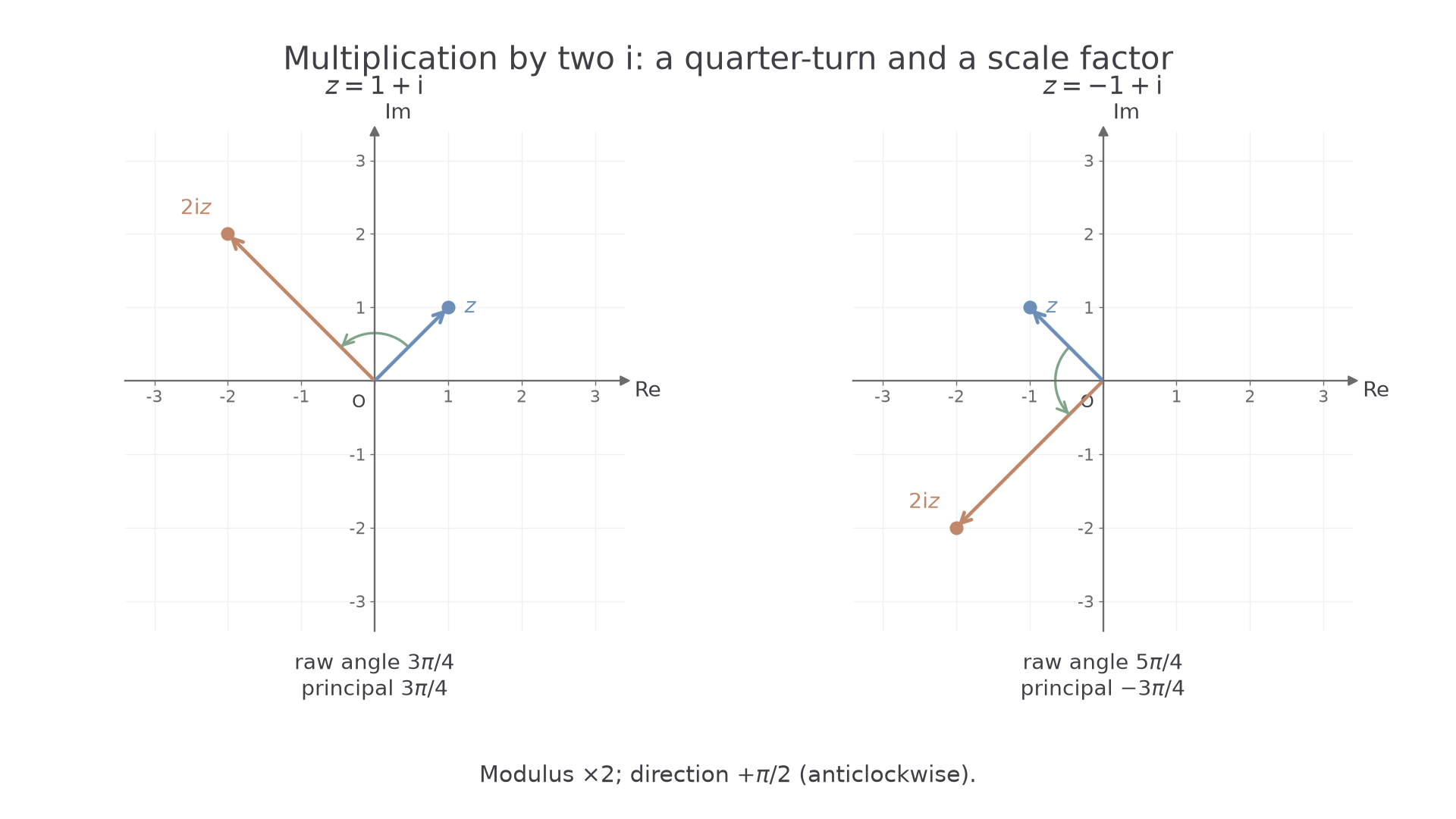
An argument obtained by adding or subtracting may lie outside . Subtract from an angle greater than ; add to an angle at most , repeating if needed. In particular, a raw angle becomes , because the lower endpoint is excluded.
Worked example 5: rotating and undoing the rotation
Question. Let . Describe multiplication and division by , and find the modulus and principal argument of each result.
Plan. Use and , starting from , .
Answer. Multiplication doubles distance and turns anticlockwise by , giving modulus and argument . Division halves distance and turns clockwise by , giving modulus and argument .
Check. Cartesian algebra gives and . Their distances and quadrants agree with both predictions.
Change only the real sign of the starting point. The same rotation now carries the product across the principal-argument boundary.
Worked example 6: crossing the branch boundary
Question. Let . Find the modulus and principal argument of and .
Plan. Start with modulus , argument ; apply the same scale and angle changes, then adjust the principal angle.
Answer. The product has modulus and principal argument ; the quotient has modulus and principal argument .
Check. Directly, is in quadrant III, and is in quadrant I. These fix the signs of the principal arguments independently.
The direction has not changed when you replace by . You have changed the name of the angle by one full turn. This is why principal-argument equations for products and quotients hold after branch adjustment, rather than as unrestricted equalities of real angles.
Watch out
A raw angle belongs to a quotient's direction, but it is not automatically its principal argument. Check the interval, including whether or is admitted.
Try another product that crosses the boundary.
Quick Recap
- Multiply moduli and add angles; divide moduli and subtract angles.
- The rules follow from the compound-angle identities.
- A fixed nonzero multiplier rotates and scales about the origin.
- Adjust a resulting angle into the requested principal interval.
Multiplication by is a quarter-turn anticlockwise with scale factor 1. Thus , , , , and trace four equal turns back to the starting point.