H3, H4 - Inverse hyperbolic functions
An inverse must return one input for each output. Cosh and sech need chosen branches; the other four hyperbolic functions already give unique inputs throughout their ranges. You will define all six inverses, derive their logarithmic forms, and solve equations while keeping the original domain and every valid solution.
Restricted domains and ranges
If , which input should return? Both inputs fit the original equation, but an inverse function must select just one.
Sinh needs no such selection. The equation has exactly one real solution because sinh is strictly increasing and reaches every real output. We call that solution . Inverse hyperbolic notation reverses the function; it does not mean a reciprocal.
Inverse hyperbolic functions
For inverse cosh, restrict the original cosh function to :
For the reciprocal functions,
For inverse sech, choose the nonnegative-input branch:
The domain of each inverse is the range of its original function. The inverse range is the domain of the original branch being reversed. Cosech and coth keep both of their original signed branches: each branch is strictly decreasing, and the two branches have outputs of opposite signs, so no output comes from two different inputs.
| Inverse function | Domain | Range |
|---|---|---|
For example, . An unrestricted inverse would have to return both inputs, so it would not be a function. The chosen inverse returns the nonnegative input: . By contrast, the equation still has both solutions .
[DIAGRAM: asset_name: Choosing the nonnegative cosh branch; asset_slug: aqa7367-inverse-cosh-branch; caption: Reflecting the nonnegative-input cosh branch gives inverse cosh with nonnegative outputs; description: A square coordinate graph shows cosh x for x at least zero as a blue solid curve, its negative-input branch as a grey dotted curve, the inverse cosh curve as a sage solid curve for x at least one, and the dashed line y equals x. Points zero comma one and one comma zero are labelled as reflections. The inverse graph has no negative-output branch.]
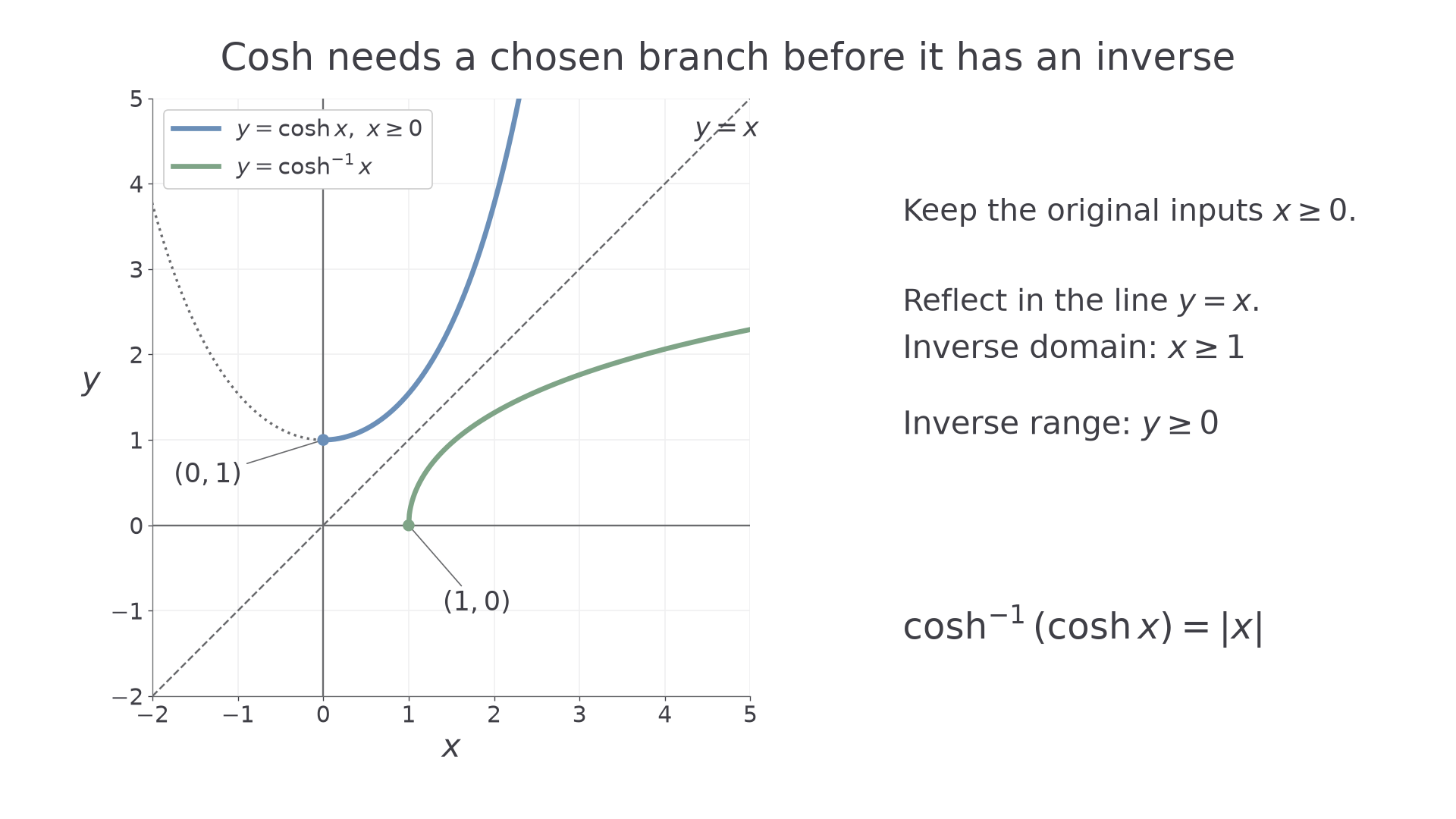
Useful compositions include for real , and . For cosh,
because the inverse selects the nonnegative member of the pair. Similarly, requires . Domain conditions belong to the composition, not just to its simplified expression. The notations arcsinh, arcosh and artanh are alternative inverse names; here we use AQA's , , .
Sech is even too, so . Its inverse reaches zero at input 1 but has no value at input zero: sech approaches zero without attaining it. In contrast, and for . Neither inverse has output zero. AQA also uses the names arccosech, arcsech and arccoth for these inverses.
Key idea
The chosen inverses of cosh and sech return nonnegative outputs. Their original equations can still require both opposite inputs; a named inverse and the equation's complete solution set are different objects.
Use the inverse's range to choose the output here.
Deriving logarithmic forms
To invert sinh, turn its exponential definition into a quadratic. Let and put . Then
Since , the minus choice is negative and impossible for ; the plus choice is positive even when . Taking logarithms gives
For cosh, let , so , and . Its definition instead gives
For , the plus root is greater than 1 and the minus root is its reciprocal, below 1. Only the plus root gives the chosen . At , both roots coincide at 1. Thus
For tanh, let , with . Starting from sinh divided by cosh gives
Rearranging, , so
Both numerator and denominator are positive on this domain. At the endpoints, the original inverse has no value; a logarithmic rearrangement does not admit them.
These three logarithmic forms are in the formula booklet. The derivations explain which root to choose and why the stated domains remain necessary.
Worked example 1: using the sinh logarithm
Question. Express as a single logarithm.
Plan. Use the plus-root formula, simplifying the surd exactly.
Answer. .
Check. The exponential definition gives .
Change the inverse function and the input to the matching cosh value. The sign inside the surd changes, but the chosen nonnegative output stays the same.
Worked example 2: using the cosh logarithm
Question. Express as a single logarithm.
Plan. Check , then use the positive-branch logarithmic formula.
Answer. , which is nonnegative.
Check. , and lies in the inverse's range.
The logarithms show an unexpected connection: reversing hyperbolic functions needs only algebra and logarithms, rather than a new kind of numerical operation. For example, , matching the same input parameter in the two examples.
Logarithms for the reciprocal inverses
Taking a reciprocal before using a familiar inverse gives the three relationships
For example, means ; applying inverse sinh gives the first relationship. These expressions are not reciprocals of the inverse functions: does not mean .
Substituting in the sinh logarithm immediately gives the inverse-cosech form below. For inverse sech, substituting in the cosh logarithm gives
Here is positive, which justifies taking outside the square root. The result is nonnegative, as the selected inverse range requires.
Continue this lesson.
You’re previewing NovaLearn without an account. Create a free account to read the rest.
Create free account