E7 - Arc length
A curve's length can be found by adding tiny straight segments. You will derive the short-element formula, use Cartesian and parametric descriptions, and choose bounds and square-root signs that measure the required arc exactly once.
Derive the short-element formula
How long is a cable following from to ? Its horizontal extent is 3, but the cable also rises. Adding horizontal distance alone misses that extra length.
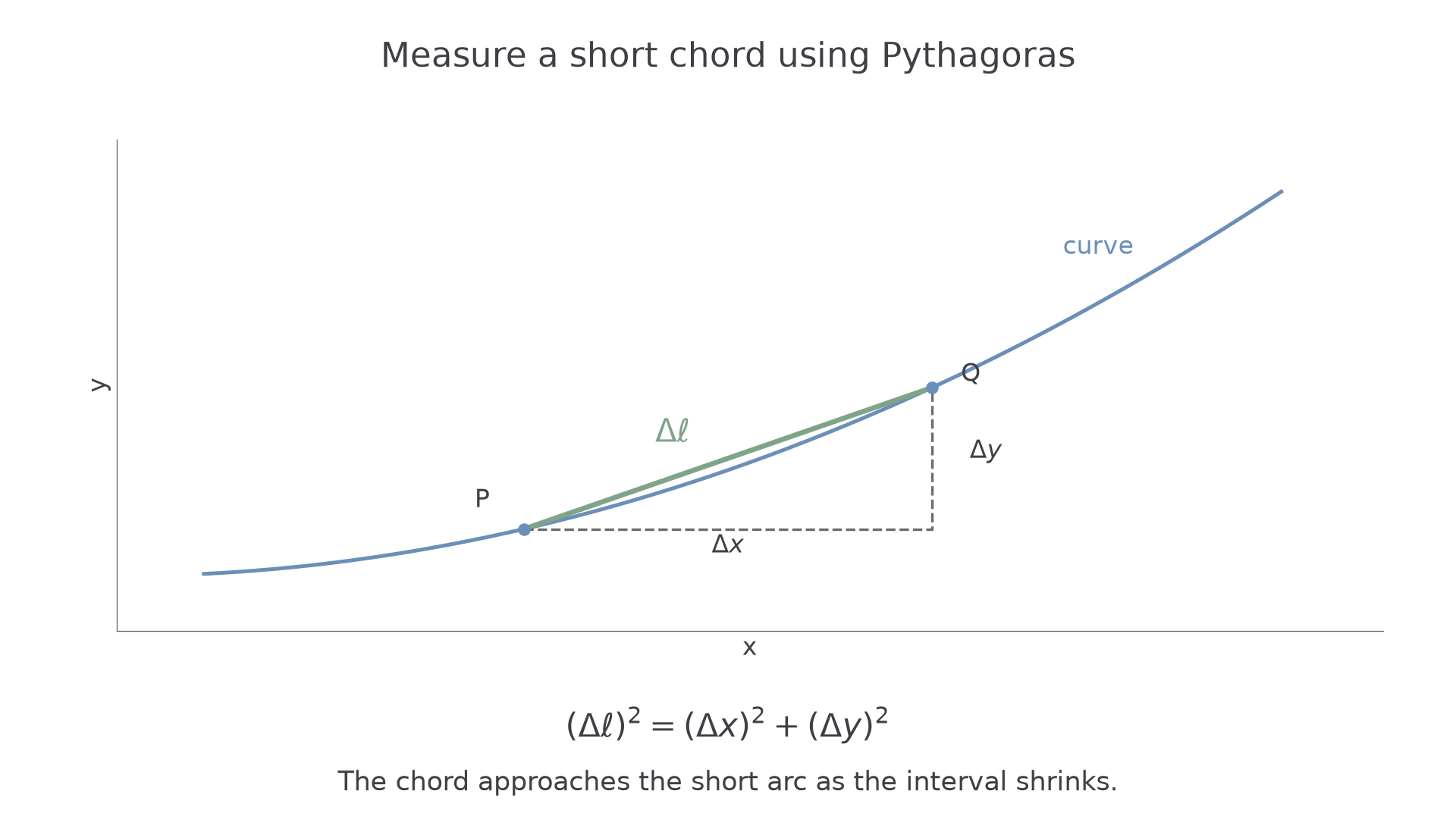
Approximate a short piece of the curve by its straight chord. If the coordinate changes are and , Pythagoras gives the chord length . For smaller pieces, the polygonal path approaches the curve's length. Dividing by positive and taking the limit gives the short-length element.
[DIAGRAM: asset_name: A short chord and its right triangle; asset_slug: aqa7367-arc-element; caption: Pythagoras measures a short chord; summing increasingly short chords gives the arc length; description: A smooth increasing curve joins nearby points P and Q. A dashed horizontal then vertical path forms a right triangle with the straight chord PQ. The horizontal change delta x, vertical change delta y and chord length delta ell are labelled. A separate displayed relation states delta ell squared equals delta x squared plus delta y squared; text explains that the chord approximates the short arc.]
Cartesian arc length
For a continuously differentiable curve on , with ,
Use the nonnegative square root. The arc-length integral is in the formula booklet.
Test the formula on straight lines, where the ordinary distance formula supplies an independent check.
Worked example 1: a rising straight segment
Question. Find the length of from to .
Plan. Its constant gradient makes the short-length factor constant.
Answer. The segment has length 5 units.
Check. Its endpoints are and ; their distance is .
Change only the gradient's sign. Descending does not create a negative length.
Worked example 2: a falling straight segment
Question. Find the length of from to .
Plan. Square the gradient before taking the root.
Answer. The segment again has length 5 units.
Check. Its endpoints are and , whose distance is also . Reflection preserves length.
Since the integrand is at least 1, a graph over has length at least . Its length must also be at least the straight-line distance between its endpoints.
Watch out
Wrong: . The gradient is squared: . Negative slopes still contribute positive length.
Use the same idea with a new gradient.
Cartesian and parametric curves
For a parametric curve, both coordinates change with . The same Pythagorean argument gives
and hence the integral of a nonnegative speed.
Parametric arc length
For a continuously differentiable parameterisation , with ,
This measures distance along the parameterised path. For the geometric arc's length, choose a parameter interval tracing that arc once. In the formula booklet.
The derivatives are the horizontal and vertical components of motion along the curve. Their squared sum gives speed, even when one coordinate decreases. A parameter value at which both derivatives vanish can still be harmless if the integral remains well defined.
Worked example 3: a Cartesian curve
Question. Find the length of from to .
Plan. Differentiate first; its square makes the root simple.
Answer. The cable in the opening question has length units.
Check. Its endpoints differ horizontally by 3 and vertically by . Their distance is , below , as required. Differentiating the length primitive recovers .
Continue this lesson.
You’re previewing NovaLearn without an account. Create a free account to read the rest.
Create free account