DE1 - Activity-on-node networks
A project can contain jobs that run together and jobs that must wait. You will turn a list of dependencies into an activity-on-node network, read the information in each node and recognise whether the network represents the intended project.
Translate dependencies
A display needs a frame, printed panels and a final assembly. Must printing wait for the frame? A list of jobs alone does not answer that: you need to know which jobs depend on which others.
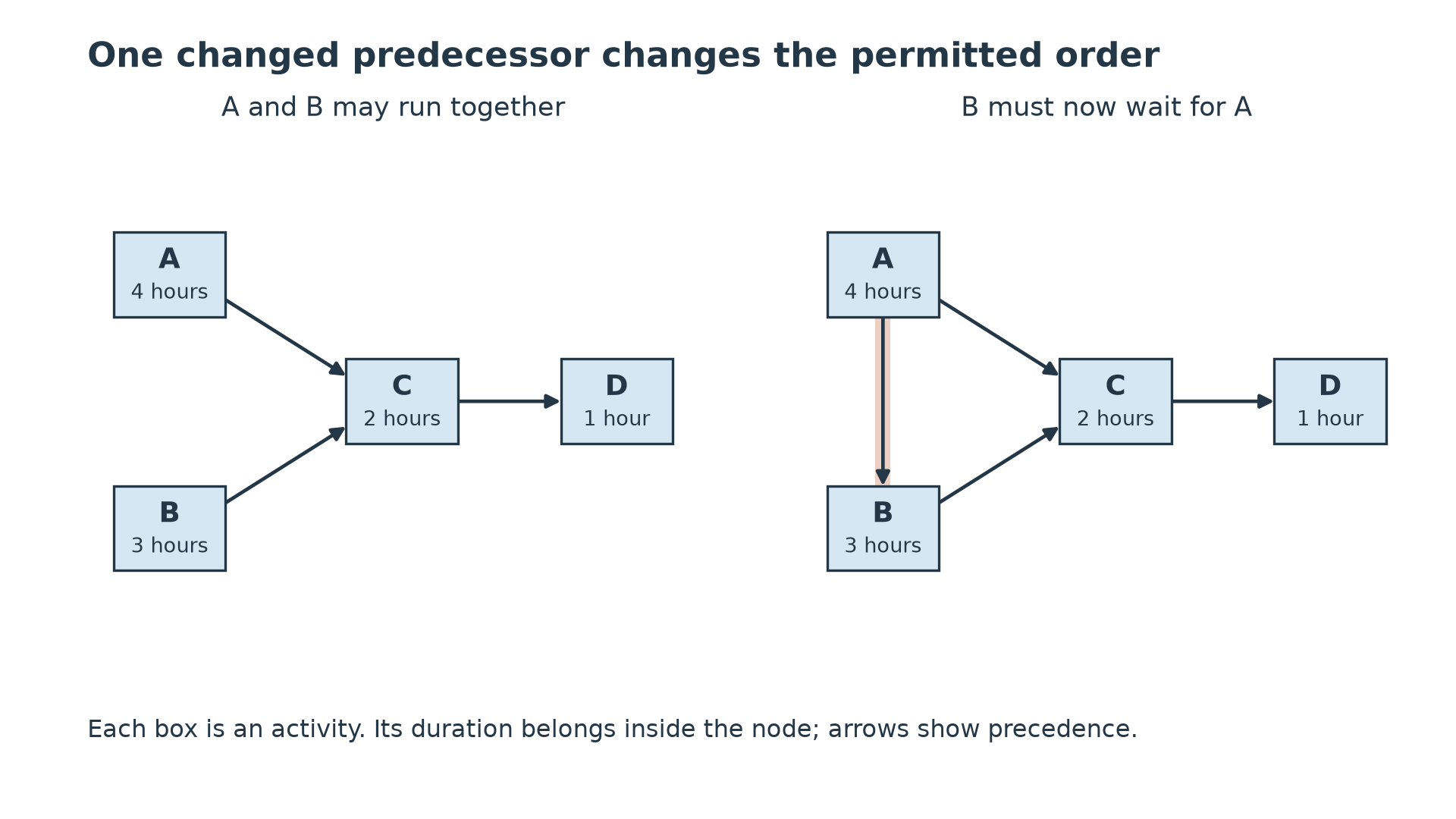
Suppose A builds the frame in 4 hours, B prints panels in 3 hours, and C assembles them in 2 hours after both A and B. A and B may run together. C must wait for both. Draw a box for each activity and arrows , .
Activity-on-node network
An activity-on-node network is a directed graph whose nodes represent activities and whose arrows represent precedence requirements. An arrow means that Y cannot start until X has finished. It does not mean that Y must start immediately.
An immediate predecessor is an activity listed as directly required before another. If , A is also a predecessor of D, but its requirement is already enforced through C. A precedence network for a project must be acyclic: no directed route may lead back to its starting activity. Otherwise an activity would have to wait for itself.
Worked example 1: two independent starting jobs
Question. Construct the activity-on-node network for this project. Durations are in hours.
| Activity | Duration | Immediate predecessors |
|---|---|---|
| A | 4 | None |
| B | 3 | None |
| C | 2 | A, B |
| D | 1 | C |
Plan. Make one labelled node per row, then draw an arrow from every listed predecessor.
Put A and B at the left. Draw and , because C needs both. Draw , because D needs C. Write the durations inside their respective nodes.
Answer. Nodes A(4), B(3), C(2), D(1), with arrows , , .
Check. Read each node's incoming arrows back as a table: none, none, A and B, C. This reproduces every row and imposes no order between A and B.
Change only B's predecessor. This tests whether the picture can distinguish “can run together” from “must wait”.
Worked example 2: one added dependency
Question. Use the same durations A(4), B(3), C(2), D(1), but now B requires A, C requires A and B, and D requires C. Construct a network.
Plan. Keep the original requirements and add the new arrow into B.
Draw , , , . The arrow is redundant for timing, because the route through B already makes C wait for A; retaining it faithfully records the supplied table. No arrow returns towards A, so there is no cycle.
Answer. The four arrows above represent the revised table. B can no longer run alongside A.
Check. The order A, B, C, D respects every arrow. In particular, the new network rules out starting B before A finishes.
[DIAGRAM: asset_name: One changed predecessor; asset_slug: aqa7367-activity-precedence; caption: Adding A to B changes parallel starting activities into a forced order; description: Two activity-on-node networks show boxes A duration 4, B duration 3, C duration 2 and D duration 1. Left has arrows A to C, B to C and C to D. Right has the same arrows plus A to B, highlighted in clay. Arrows carry no activity durations.]
Watch out
“C requires A and B” means two incoming arrows. Joining A to B instead invents an order between jobs which may be independent.
Build the next network directly from its predecessor column.
Start, finish and duration fields
An activity taking 4 hours and starting at time 3 finishes at time 7. A time is a position on the clock; a duration is a length of time. We measure from time zero, when the project is released. A job occupying uses the interval from time 3 up to time 7. Another job may start exactly at 7.
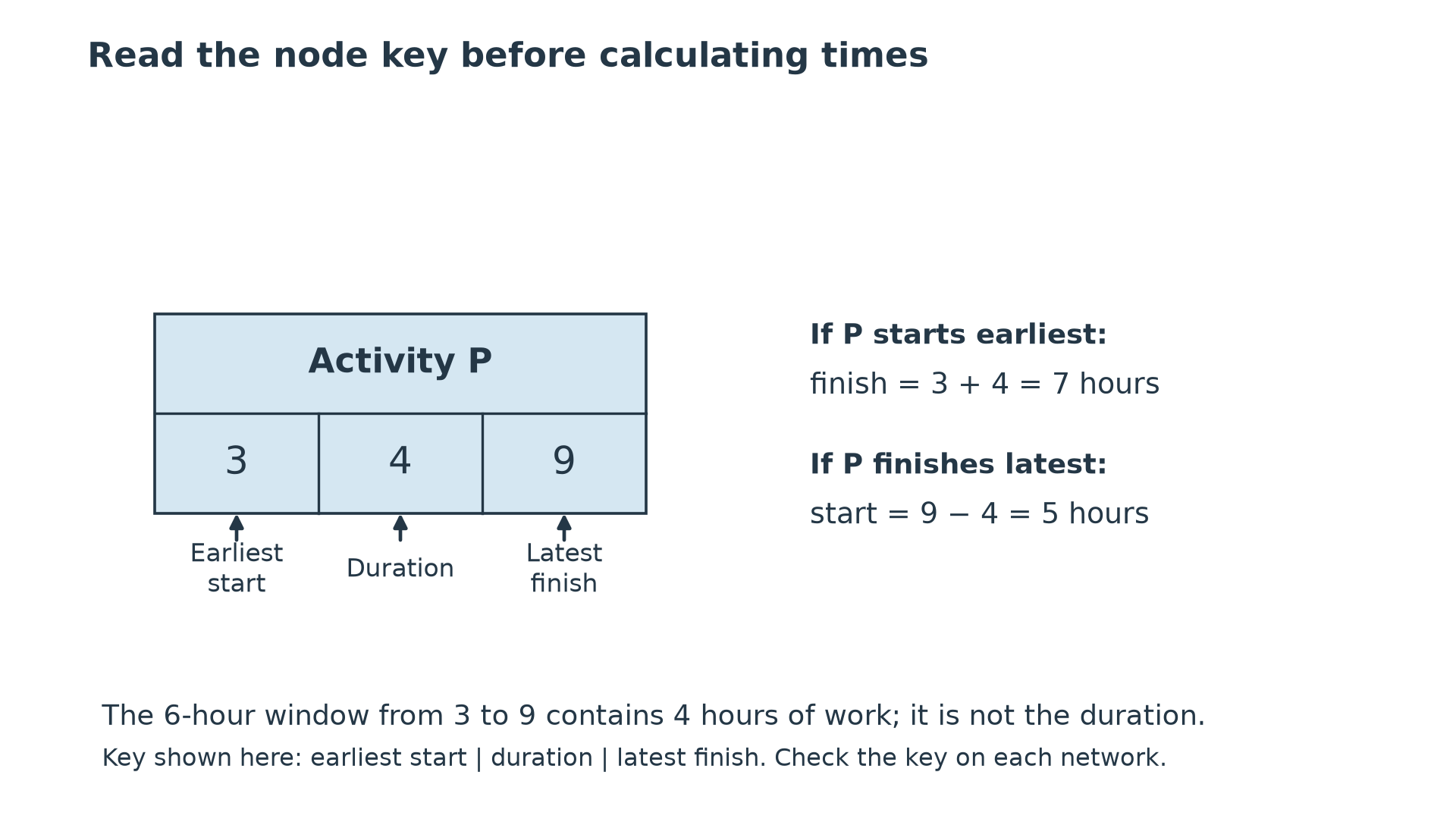
A node's layout needs a key. One useful layout has the activity name above three fields: earliest start, duration, latest finish. A resource requirement may appear on an extra row. Do not assume that every printed network uses your preferred arrangement.
Node information
For an activity of fixed duration , its finish time is its start time plus . An earliest start is the first permitted start under the precedence model. A latest finish is a deadline compatible with the specified project completion target. The two fields describe different bounds; they need not describe the same scheduled execution.
Read an early placement and a late placement separately, keeping the duration fixed.
[DIAGRAM: asset_name: Reading a keyed activity node; asset_slug: aqa7367-activity-node-fields; caption: The node gives earliest start 3 duration 4 and latest finish 9 hours; description: A rectangular activity-on-node box has Activity P in its upper row and three lower fields containing 3, 4 and 9, keyed respectively as earliest start, duration and latest finish. Beside it, an earliest placement gives finish 3 plus 4 equals 7 hours and a latest placement gives start 9 minus 4 equals 5 hours. A note distinguishes the six-hour early-to-late window from the four-hour working duration.]
Worked example 3: reading a labelled node
Question. A node for activity P has earliest start 3 hours, duration 4 hours and latest finish 9 hours. Find its finish if it starts earliest, and its start if it finishes latest.
Plan. Add duration to the early start; subtract duration from the late finish.
These are two possible placements, and , rather than a six-hour execution.
Answer. Early finish 7 hours; late start 5 hours.
Check. Each placement has length 4: .
Now increase only the duration, keeping the two stated bounds. Notice which window shrinks.
Continue this lesson.
You’re previewing NovaLearn without an account. Create a free account to read the rest.
Create free account