C7, C8 - Three simultaneous equations
Three linear equations can determine one point, leave a whole family of solutions or contradict one another. C7 uses an inverse matrix to solve the equations when the coefficient matrix is non-singular. C8 connects each algebraic outcome to the way three planes intersect, including what a zero determinant can and cannot tell you.
Solving with an inverse matrix
If a coefficient matrix has determinant zero, must the equations have no solution? We will return to that question after solving the case in which an inverse does exist.
Write the coefficients of each equation in the same variable order, placing a zero wherever a variable is missing. For example,
Each row-column sum reproduces one original equation. The equation is a compact version of the whole system, not a new condition.
Inverse solution
If the square coefficient matrix is non-singular, then
Multiply on the left, giving . This gives a unique solution for every right-hand column . Not in the formula booklet.
Multiplying on the right would not cancel the leftmost factor. In this system, is not even conformable: its dimensions would be .
Worked example 1: solving three equations
Question. Use an inverse matrix to solve , , .
Plan. Form the coefficient matrix, check its determinant and multiply its inverse by the constants column.
The cofactor method gives
For instance, its numerator's first row comes from the cofactors in the first column. Hence
Answer. .
Check. Substitute into all three equations: , , . All hold, and the non-zero determinant guarantees uniqueness.
Keep all coefficients fixed and change only the third constant from 4 to 6. The inverse is unchanged, so one calculation can solve a new system.
Worked example 2: changing the constants
Question. Use an inverse matrix to solve , , .
Plan. Reuse the coefficient matrix's inverse and replace the constants column.
Answer. .
Check. , and . The solution changes with the constants, but uniqueness does not: still holds.
Use the inverse method explicitly when it is requested. Keep the variable order fixed in all three rows and in the unknown column. A consistent column order matters as much as a correct multiplication.
Unique, inconsistent and dependent systems
A system is consistent if at least one solution satisfies every equation. It is inconsistent if there is no common solution. A non-zero determinant guarantees one solution. A zero determinant rules out a unique solution, but leaves two possibilities: inconsistency or infinitely many solutions.
For a singular matrix, an equation is lost when you combine coefficient rows. The constants must obey the same relationship if the system is to be consistent. Use elimination on the whole equations, including their right-hand sides, to find out what happens.
Worked example 3: a dependent equation
Question. Determine the solution set of
Plan. Check the dependence of the coefficient rows, then compare the corresponding constants.
The third coefficient row is the sum of the first two. Its determinant is therefore zero. Adding equations (1) and (2) gives , exactly equation (3), so the third equation adds no new restriction.
Let , where is any real number. Then .
Answer. Infinitely many solutions: , .
Check. Substitution gives , , and , for every real . The free parameter is real freedom, not an uncalculated fixed value.
Change only the last constant from 4 to 5. The coefficient matrix and its zero determinant stay fixed, but the consistency changes.
Worked example 4: a contradiction
Question. Determine the solution set of
Plan. Compare the third equation with the sum of the first two.
The same left-hand expression cannot equal both 4 and 5.
Answer. The system is inconsistent: it has no solution.
Check. Any solution of the first two has the form . Its third left-hand side is always 4, so no choice of can satisfy the last equation.
An identity such as means an equation has added no restriction. It does not itself specify all the remaining solutions: solve the independent equations and describe any free variables. A contradiction such as means no solution can satisfy the full system.
For parameterised coefficients, first use to identify the values giving a unique solution. For each exceptional value where the determinant vanishes, substitute that value into the original equations and test consistency by elimination. A zero denominator in an inverse formula is a signal to change method, not proof of inconsistency.
Key idea
A singular coefficient matrix has either no solution or infinitely many solutions. The right-hand column decides which. A zero determinant alone cannot distinguish them.
Test that distinction with new constants.
Three planes and their common intersection
Each non-trivial linear equation describes a plane, provided . A simultaneous solution is a point lying on all three planes. Pairwise intersections are not enough: the same point must satisfy the whole system.
A non-singular coefficient matrix gives exactly one solution. The three planes meet at one common point, as with , , , whose only common point is the origin.
For a singular but consistent system, the planes share infinitely many points. There are two possible shapes for the common solution set when all three equations represent planes:
- A common line, if two independent plane equations remain. For example, , , share the entire -axis. The third plane contains the intersection line of the first two.
- A common plane, if only one independent plane equation remains. For example, , , are three descriptions of the same plane.
The dependent system in Worked example 3 has a line of solutions: as varies, moves along that line. You can recognise a line from one free parameter without needing any extra vector notation.
[DIAGRAM: asset_name: Three geometric outcomes for three planes; asset_slug: aqa7367-three-planes; caption: Three planes may meet at a point, share a line or have pairwise intersections with no common point; description: Three exact three-dimensional panels show the planes x equals 0, y equals 0 and z equals 0 meeting at the origin; the planes x equals 0, y equals 0 and x plus y equals 0 sharing the z-axis; and x equals 0, y equals 0 and x plus y equals 1 with pairwise intersection lines but no common point. The last arrangement is a triangular-prism arrangement, with no parallel pair required.]
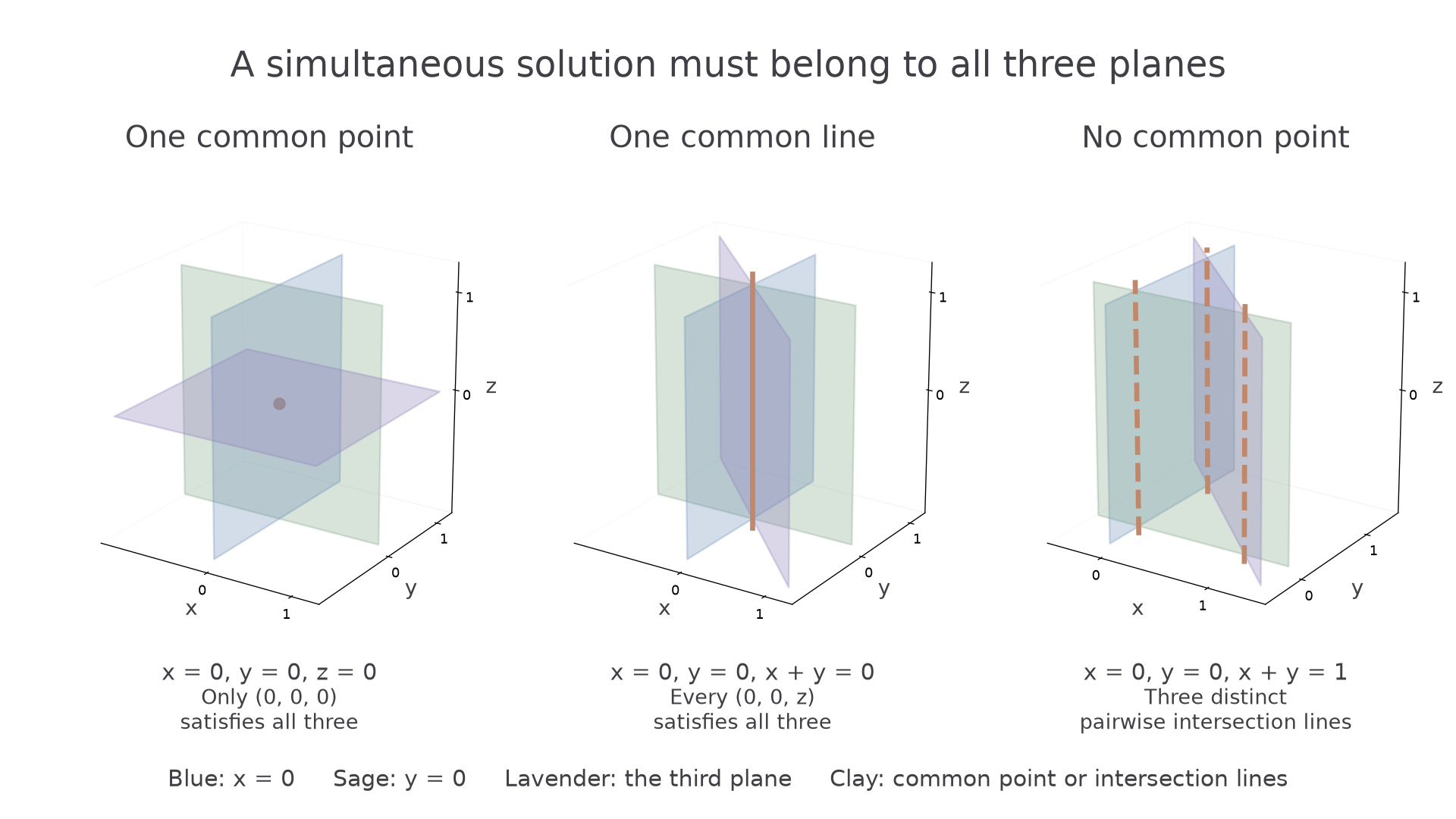
An inconsistent system has no common intersection. Two distinct parallel planes already prevent a common solution: , and any third plane cannot share a point. But parallel planes are not necessary for inconsistency. The three planes
intersect in pairs along three parallel lines. The first two force , so the third cannot contain any point on their common line. The arrangement has the shape of the sides of a triangular prism, with no point common to all three planes.
This answers the opening question. A zero determinant signals failure of uniqueness; it does not tell you whether the planes have no common point, a common line or a common plane. Use the constants and the equations to decide. If an equation reduces to , it represents no restriction rather than a genuine plane; if it reduces to with , it represents an impossible condition.
Quick Recap
- Write with one consistent variable order; if , use .
- For , eliminate in the full equations to distinguish dependence from contradiction.
- The solution set is the common intersection of all three planes: a point, a line, a plane or no common points.
No: determinant zero does not force no solution. The same singular coefficient matrix can describe either a consistent family or an inconsistent system, depending on its constants.