G1 - Polar coordinates
A distance and a direction can locate a point just as well as horizontal and vertical coordinates. You will use polar coordinates, explain why their labels are not unique, convert points and equations into Cartesian form, and connect this geometry to complex numbers.
Radius-angle coordinates
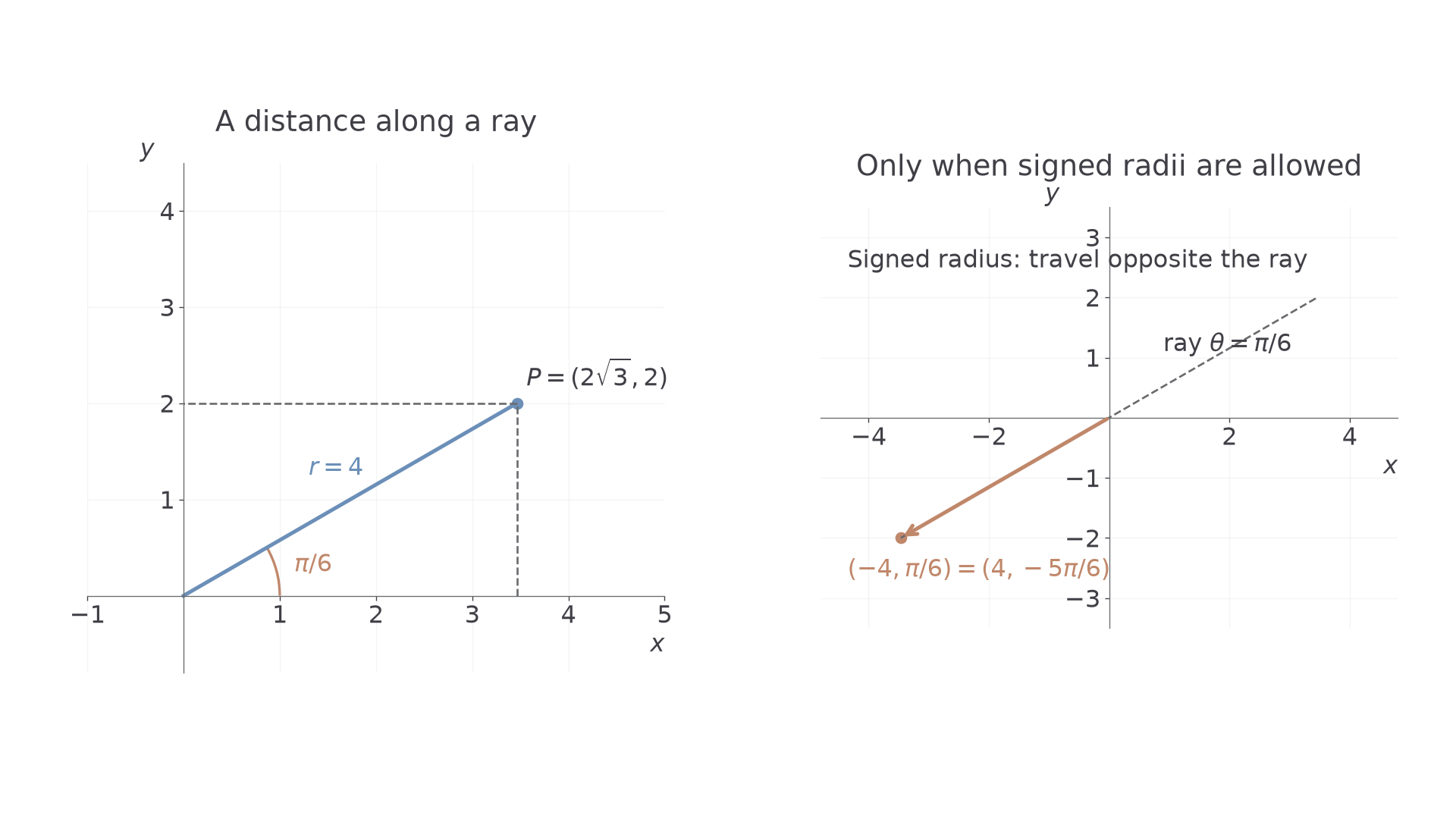
Can the pairs and locate the same point? First decide what a radius means. Start at an origin , turn through from the positive horizontal direction, then travel 4 units along that ray.
Polar coordinates
The pole is the origin. The initial line is the ray from the pole in the positive horizontal direction. A point has polar coordinates : is its distance from the pole and is the angle measured anticlockwise from the initial line, in radians. Clockwise angles are negative.
Unless a different convention is explicitly stated, use . The angle interval is part of the description; use the interval given in the question.
This is the same distance-and-direction geometry you met for a complex number. The coordinate order matters: the first entry is a length, the second an angle. Polar does not mean Cartesian , .
Recall the circle relations: circumference , area , and, for a sector of angle in radians, arc length and area . The sector occupies the fraction of the full circle. These familiar length and area relations will help you check polar curves and their areas.
[DIAGRAM: asset_name: Radius and direction in polar coordinates; asset_slug: aqa7367-polar-radius; caption: A positive radius follows its ray and an explicitly signed negative radius reverses it; description: The left panel shows a length four at angle pi over six, reaching Cartesian point (two root three, two), with horizontal and vertical guides. The right panel separately illustrates a signed-radius convention: a radius minus four along angle pi over six reaches the opposite point, equivalently positive radius four at angle minus five pi over six.]
To begin, locate points on the axes without doing any trigonometry.
Worked example 1: a quarter-turn
Question. Describe the position of the point with polar coordinates , and give its Cartesian coordinates.
Plan. Turn anticlockwise through a right angle, then travel the positive radius.
Answer. The point is 5 units directly above the pole, with Cartesian coordinates .
Check. Its distance is , and its direction is a positive quarter-turn.
Change only the sign of the angle. The length stays positive, so the turn changes rather than the direction of travel along the chosen ray.
Worked example 2: a clockwise quarter-turn
Question. Describe the position of the point with polar coordinates , and give its Cartesian coordinates.
Plan. Turn clockwise through a right angle, then travel 5 units.
Answer. The point is 5 units directly below the pole, at .
Check. Reflecting Worked example 1 in the initial line reverses the vertical coordinate and angle, while preserving distance.
The signs of the two entries play different roles.
Watch out
A negative angle is allowed with a positive radius: it means a clockwise turn. A negative radius needs an explicitly stated signed-radius convention; it is not a negative distance.
Try a different axis direction.
Nonuniqueness and the pole
Turning one full revolution before travelling does not change the point you reach. For , the pairs and describe the same point for every integer .
To choose one angle, use a half-open interval of length , such as or . “Half-open” means that exactly one endpoint is included: including both would duplicate the initial direction. For the latter interval the negative horizontal ray uses , not .
Some questions or software explicitly allow a signed radius. Then means travelling units opposite to the ray at angle . The same point therefore has positive-radius coordinates
after adjusting the new angle into the requested interval. This extends the coordinate convention; it does not make a distance negative.
Worked example 3: choosing one angle
Question. Write with a positive radius and angle in .
Plan. Keep the radius and subtract a full turn from the angle.
Answer. .
Check. The angles differ by , so their sine and cosine agree. Both rays point left and down.
Now change only the sign of the first entry and explicitly allow signed radii. The point moves to the opposite ray.
Worked example 4: removing a signed negative radius
Question. Under a signed-radius convention, write with a positive radius and angle in .
Plan. Reverse the ray by adding , then remove a full turn.
Answer. . This is the point in the opening question.
Check. Both descriptions give horizontal component and vertical component : the two sign reversals cancel.
At the pole, , so every pair reaches the same point. An assigned coordinate angle is only a label there. The pole has no geometrically determined direction, just as the complex number zero has no argument. Restricting the angle interval does not give the pole a direction.
Watch out
Wrong: . With signed radii, change the angle by a half-turn when changing the radius sign. With the usual nonnegative-radius convention, reject a negative radius rather than silently plotting it.
Use the explicitly stated convention in this new case.
Continue this lesson.
You’re previewing NovaLearn without an account. Create a free account to read the rest.
Create free account