MB2 - Direct collisions
A collision law describes how rapidly two bodies separate compared with how rapidly they approached. You will combine this law with momentum, model rebounds from a fixed wall and check that calculated velocities fit the physical collision.
Relative approach and separation
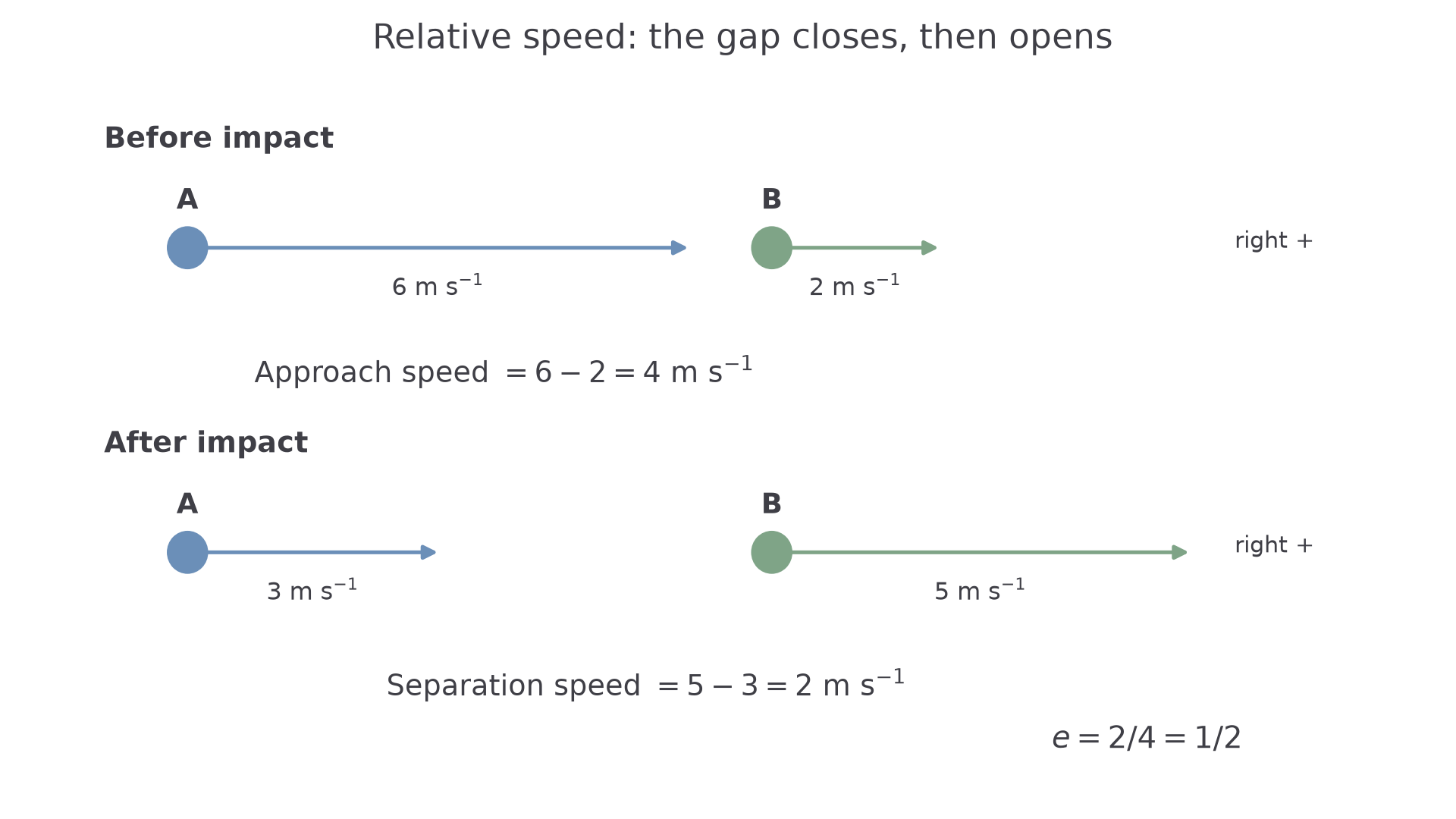
A faster ball catches a slower ball from behind. Must one reverse direction for them to separate afterwards? No: the front ball can simply move away faster. The collision law measures relative motion, not whether an individual velocity changes sign.
In a direct collision, the velocities lie along the line of impact. For smooth spheres this is the line joining their centres at contact. Put left of , take right as positive and let their initial velocities be . They approach if , because the gap closes at speed . Afterwards, the gap opens at speed .
Coefficient of restitution
For an approaching pair, the coefficient of restitution is the speed of separation divided by the speed of approach, measured along the line of impact. Newton's experimental law for the usual passive collision model is
The approach speed must be positive for this ratio to define . The case has equal approach and separation speeds; has zero immediate relative separation speed along the line of impact.
This law is not separately supplied in the formula booklet. It describes the collision pair and conditions being modelled; it need not be one universal constant for every impact involving those materials.
[DIAGRAM: asset_name: Relative speeds in a catching collision; asset_slug: aqa7367-relative-collision; caption: Both balls can move right before and after a collision while their gap changes from closing to opening; description: Two before-and-after panels show A left of B with right positive. Before, A moves right at 6 metres per second and B right at 2, so approach speed is 4. After, A moves right at 3 and B right at 5, so separation speed is 2. Arrows begin on the balls and use one common velocity scale. The coefficient is 2 divided by 4 equals one half.]
Worked example 1: catching up
Question. is left of . Before collision, ; afterwards, , all in with right positive. Find .
Plan. Calculate the gap's closing speed before and opening speed after.
Answer. , a dimensionless ratio.
Check. The gap decreases by per second before impact and increases by per second afterwards. Neither ball needs to reverse.
Change only 's incoming velocity to , leaving the listed outgoing velocities unchanged. Opposing velocities add to the approach speed through signed subtraction.
Worked example 2: approaching head-on
Question. With still left of , now , in . Find the restitution coefficient represented by these relative speeds.
Plan. Retain the negative sign in .
Answer. .
Check. In of incoming uniform motion the gap would shrink by ; with the outgoing velocities it grows by . Their ratio is again . This checks the relative-motion calculation; masses would also be needed to test momentum for a particular isolated pair.
Restitution is one collision equation. It cannot by itself decide whether an arbitrary set of velocities conserves momentum.
Watch out
Wrong: for two moving bodies. Use relative speeds along the line of impact: with the stated ordering and positive approach speed.
Check the relative speeds for a fresh pair.
Rebounds from a fixed smooth wall
For a direct impact on a fixed wall, the wall's velocity is zero before and after. If positive points towards the wall and incoming velocity is , separation requires outgoing velocity . The relative-speed law becomes .
Direct impact with a fixed wall
For a direct impact with incoming velocity towards a fixed smooth wall,
The outgoing speed is ; the minus sign in velocity records reversal. This is an instantaneous impact model with other impulses negligible.
Not in the formula booklet: learn it.
The ball alone does not conserve momentum: the wall exerts an external impulse. Smoothness means no tangential contact impulse; in direct impact there is no tangential incoming component.
Worked example 3: a direct rebound
Question. A ball hits a fixed smooth wall directly at . Taking towards the wall as positive, find its outgoing velocity when .
Plan. Reverse the normal direction and multiply the incoming speed by .
Answer. Velocity is , a speed of away from the wall.
Check. Relative separation speed divided by approach speed is . The ball moves into the accessible region, not through the wall.
Change only , keeping the incoming velocity and wall fixed.
Worked example 4: a more elastic rebound
Question. The same ball hits the same fixed smooth wall at , but now the model uses . Find its outgoing velocity.
Plan. Apply the wall law with the new restitution coefficient.
Answer. , directed away from the wall.
Check. The ratio of outgoing to incoming speeds is , and the greater coefficient gives a greater rebound speed than example 3 while still not exceeding .
At , the outgoing normal velocity is zero; the model does not predict a rebound with positive normal speed. At , speed is preserved but velocity still reverses.
Watch out
Wrong: in the same positive direction before and after. For a direct wall rebound, . A positive outgoing speed must still be accompanied by an “away from the wall” direction.
Keep that direction in your answer.
Continue this lesson.
You’re previewing NovaLearn without an account. Create a free account to read the rest.
Create free account