B8 - Sums of trigonometric series
A sum of sines can be hidden inside a much simpler geometric series of complex numbers. You will sum finite complex geometric series, extract their real or imaginary parts, and handle the special cases where the common ratio is one. The distinction between a finite sum and a sum to infinity will stay explicit throughout.
Finite complex geometric series
How can four nonzero complex terms add to zero? Consider . Consecutive terms are multiplied by , and their directions make four successive quarter-turns. The terms are , which cancel.
A geometric series has a constant multiplier, called its common ratio. The familiar finite-sum argument uses only addition and multiplication, so it works for complex ratios too. For , subtracting cancels the middle terms:
Finite geometric sum
For a positive integer , complex first term and complex ratio ,
There is no restriction on for this finite sum. The formula is in the formula booklet.
The denominator is the only obstruction in this formula: when , calculate copies of directly. We will return to this case in the last part.
At , read the original terms as , so every nonempty finite sum is . The first term is directly; there is no need to evaluate .
Worked example 1: a unit-modulus ratio
Question. Find using a geometric-sum formula.
Plan. Use first term , ratio , and four terms.
Answer. .
Check. Direct summation gives . The four term-vectors form a closed square when placed head to tail.
[DIAGRAM: asset_name: Four terms make a closed path; asset_slug: aqa7367-geometric-square; caption: Adding 1, i, minus 1 and minus i head to tail returns to zero; description: An equal-scale Argand diagram shows a head-to-tail square path from zero to 1, then to 1 plus i, then to i, and back to zero. Four arrows are labelled 1, i, minus 1 and minus i. A note distinguishes the four nonzero terms from their zero sum and states that consecutive term directions turn through pi over two.]
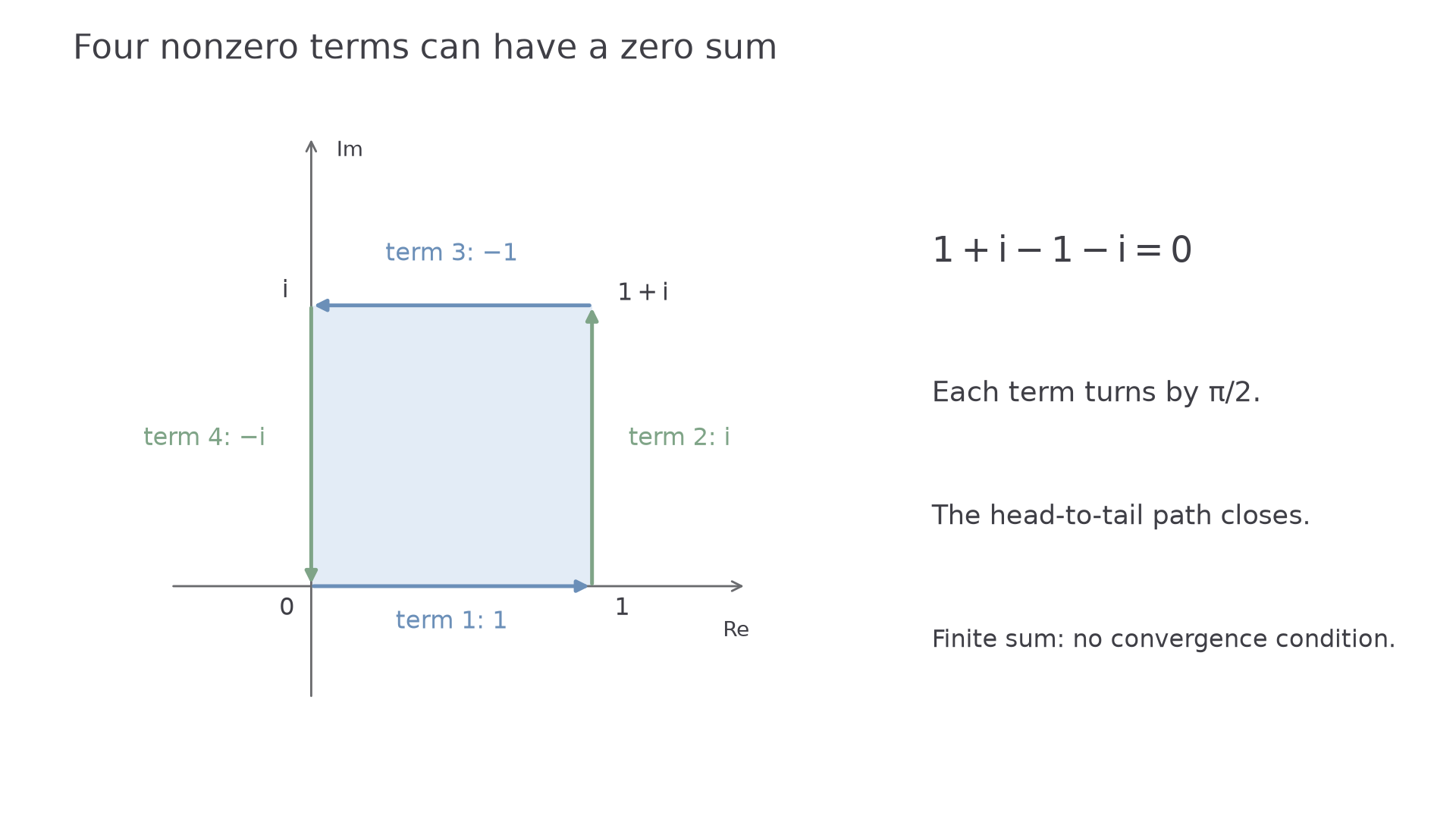
Now change only the magnitude of the ratio, from to . The finite-sum formula still works even though the terms grow.
Worked example 2: a ratio larger than one in modulus
Question. Find .
Plan. Apply the same four-term formula, then simplify the complex quotient.
Answer. .
Check. The actual terms are . Their real and imaginary parts sum to and .
An infinite geometric series is a different question: it asks whether the partial sums approach a finite limit. For a nonzero first term, this happens exactly when . The booklet then gives . If , the nonzero terms do not even tend to zero, so the series cannot converge. If , every term is zero for any ratio; that is a trivial exception. In particular, a finite series with ratio can be summed even though its corresponding nonzero infinite series does not converge.
Watch out
Do not reject a finite geometric sum because . The condition belongs to the nontrivial sum to infinity, not the finite-sum formula.
Change the ratio’s magnitude once more.
Extracting real and imaginary parts
Euler’s definition turns the real part of an exponential into a cosine and its imaginary part into a sine. Adding complex numbers adds each component separately, so one complex geometric sum can give two trigonometric sums.
For example,
For the odd-angle sums, use
There are terms, the first term is , and the ratio is . This ratio equals one exactly when is an integer multiple of . For now assume .
To simplify the quotient, pair opposite angles:
The last equality follows from . These rearrangements are derived identities, not separately supplied trigonometric-sum formulae.
There is another useful way to extract a sine sum. Put . De Moivre gives . Summing these equalities gives
The brackets are geometric series with ratios and . This difference is the algebraic version of taking the imaginary part; it also shows how to express a trigonometric sum as two geometric series.
Worked example 3: the cosine sum
Question. For positive integer and , show that
Plan. Sum geometrically, simplify the exponential quotient, then take its real part.
The sine quotient is real, so the real part is .
Answer. The required cosine sum is .
Check. For , the addition identity gives . The derived expression gives the same result because .
Keep the same series and change only the component you read. No new geometric summation is necessary.
Worked example 4: the matching sine sum
Question. For positive integer and , show that
Plan. Use the imaginary part of the same geometric sum .
Answer. The required sine sum is .
Check. For , the addition identity gives . The derived expression simplifies to the same form.
This explains the useful surprise: a long trigonometric sum can be the shadow of a short complex fraction. For angles with another constant step, identify that step in the exponential ratio instead of automatically using .
Watch out
For , the ratio is and there are terms. The final exponent is not the number of terms.
Use the sine result with fresh angles.
The ratio-one case
A denominator of zero in a derived formula does not mean that the original finite sum is undefined. It means that the division used in deriving that formula is unavailable.
For , the original geometric series is simply , so . For the odd-angle complex sum, when , with an integer. Each term is then
There are copies of this same real number. Consequently the cosine sum is , while the sine sum is zero. This directly handles every angle excluded by .
Worked example 5: all angles are zero
Question. Find and when .
Plan. Return to the five actual terms instead of dividing by .
Answer. and .
Check. The complex first term and ratio are both , so . Its real and imaginary parts are and .
Change only , from zero to . The ratio is still one, but the first term changes sign.
Worked example 6: all cosine terms are minus one
Question. Find the same five-term sums when .
Plan. Evaluate the sines and cosines of odd multiples of .
Answer. and .
Check. The complex series has first term , ratio , and five terms, so .
The opening sum was a different case: its ratio was , so the finite geometric formula applied and gave zero. Cancellation and an invalid denominator are separate issues.
Watch out
is not zero. If a trigonometric-sum formula gives , return to the original finite terms and evaluate the excluded case directly.
Keep the ratio-one situation and change the angle and term count.
Quick Recap
- A finite complex GP has sum when , with no modulus restriction.
- For a nonzero first term, the infinite geometric series converges only when .
- Real and imaginary parts of exponential sums give cosine and sine sums.
- When , sum the repeated terms directly: .
Four nonzero terms can sum to zero because their directions cancel: .