E2 - Volumes of revolution
Rotating a plane region creates a solid whose circular cross-sections can be added by integration. You will derive the disc formula, choose radii about either coordinate axis, subtract holes using washers, and change variables for parametric curves.
Derive the disc formula
A right cone has height 2 and base radius 2: why is its volume only one-third of the surrounding cylinder's volume? Rotate the triangular region , , about the -axis. At position , the solid's radius is , not the full base radius 2.
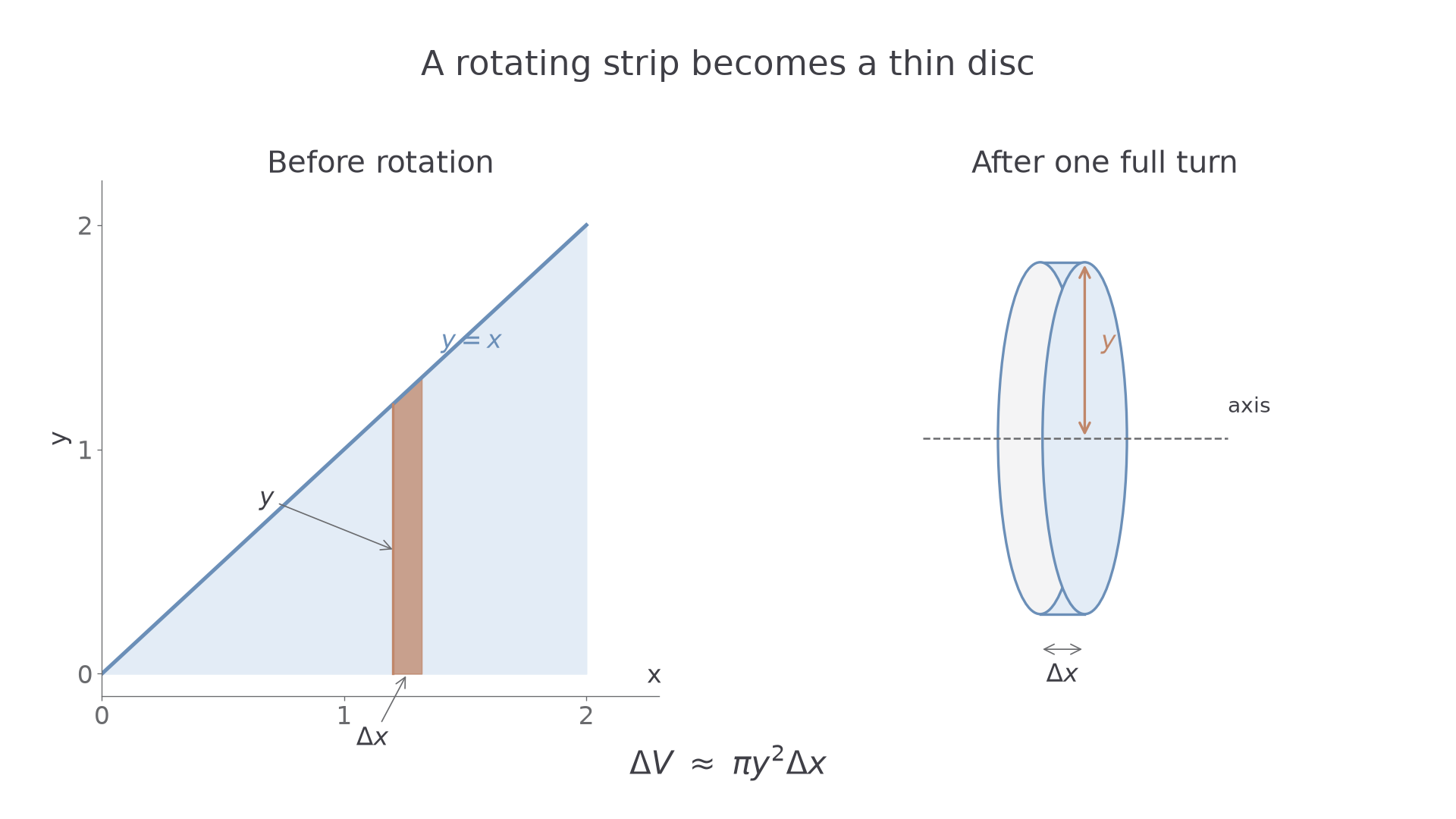
Cut a region perpendicular to the rotation axis into thin strips. A strip of radius and width rotates into a thin disc, approximately a cylinder of volume . Adding the discs and taking the limit as their widths tend to zero gives an integral.
[DIAGRAM: asset_name: From a strip to a disc; asset_slug: aqa7367-volume-disc; caption: A vertical strip rotates into a disc with radius y and thickness delta x; description: A left coordinate graph shades the triangle under y equals x from zero to two and highlights a thin vertical strip. Its height y and width delta x are labelled. A right schematic shows the corresponding thin circular disc viewed obliquely, with its radius y, axial thickness delta x and volume approximately pi y squared delta x labelled.]
Volume by discs about the x-axis
For the region between a nonnegative continuous curve and the -axis on , rotated through a full turn,
The same square gives the disc radius squared for a region on the other side of the axis. Check the actual region if it crosses the axis. Not in the formula booklet: learn it.
Worked example 1: a cone from thin discs
Question. Find the volume when , , rotates about the -axis.
Plan. At each , integrate disc area .
Answer. The volume is cubic units.
Check. The surrounding cylinder has volume . The ratio is , agreeing with the cone formula .
Keep and extend the upper bound from 2 to 3. The solid is enlarged in every direction, so volume should scale by the cube of the length factor.
Worked example 2: changing the cone's size
Question. Find the volume when , , rotates about the -axis.
Plan. Use the same disc area with the new upper endpoint.
Answer. cubic units.
Check. Multiplying the previous answer by gives , independently checking the scaling.
The square is essential: the integral adds areas of circular cross-sections, not their circumferences.
Watch out
Wrong: . A disc's area is , so use .
Use a fresh upper endpoint for the same process.
Rotate about either coordinate axis
Choose the direction of slicing from the axis. Discs perpendicular to the -axis have thickness and radius measured vertically. Discs perpendicular to the -axis have thickness and radius measured horizontally.
Swapping the coordinate roles in the derivation gives the second formula.
Volume by discs about the y-axis
For a region between and the -axis on ,
Express the radius in terms of the integration variable and use that variable's bounds. Not in the formula booklet: learn it.
Use the first-quadrant region inside . Its horizontal extent is 2 and its vertical extent is 1. The same region makes different solids about the two axes.
Worked example 3: rotating about the x-axis
Question. Rotate the first-quadrant region about the -axis. Find its volume.
Plan. Use vertical discs, with and .
Answer. cubic units.
Check. This is half a unit sphere stretched by factor 2 along the rotation axis. Its volume is .
Change only the rotation axis. The radius and integration bounds must both change.
Worked example 4: rotating about the y-axis
Question. Rotate the same first-quadrant elliptical region about the -axis. Find its volume.
Plan. Use horizontal discs, with and .
Answer. cubic units.
Check. A half unit sphere is now stretched by factor 2 in both horizontal directions. Volume scales by 4, giving .
Neither radius can remain an unexplained mixture of and . For a integral, rearrange the curve to give , or , in terms of .
Watch out
Wrong: “About the -axis, just replace by .” The axis determines the radius and thickness: horizontal radius , thickness .
Use horizontal discs in this new region.
Washers: subtract the inner disc
A region that does not touch the rotation axis leaves a hole. A perpendicular cross-section is then an annulus, often called a washer, rather than a full disc.
Continue this lesson.
You’re previewing NovaLearn without an account. Create a free account to read the rest.
Create free account