F5 - The vector product
Two vectors can determine a third vector perpendicular to both. You will calculate this vector product, explain its size and direction, use it to find triangle areas, and express a line without a parameter. The same product will later measure shortest distances in space.
Cross-product components
Given two directions in space, how can you find a direction perpendicular to both? For example, a vector along the positive horizontal axis and one along the positive vertical axis in a flat page have a common perpendicular pointing out of the page.
You already know that a scalar product produces a number. The vector product, also called the cross product, produces a vector. For the standard unit vectors in a right-handed coordinate system, . Its direction and size are both important.
Vector product in components
For and ,
In the formula booklet.
The first component uses the second and third coordinates; the second uses the third and first; the third uses the first and second. Each is a difference of two products. A determinant-style memory aid is
The minus sign before the middle minor is essential. The column-vector formula has already incorporated it.
Worked example 1: finding a common perpendicular
Question. Find for and .
Plan. Calculate the three components, then check perpendicularity with two scalar products.
Answer. .
Check. , and . The result is perpendicular to both given vectors.
Now change only the last component of . Notice which components of the product respond to that change.
Worked example 2: changing one component
Question. Find for and .
Plan. Keep the same component order and substitute the new negative coordinate carefully.
Answer. . The third component is unchanged because it uses no third coordinates.
Check. , and .
These scalar-product checks detect many slips. They do not distinguish a correct cross product from its negative; the order in the component rule determines the sign.
Watch out
Wrong middle component: . Correct middle component: . If using a determinant expansion, keep the minus sign before the term.
Use the same calculation with a fresh pair.
Orientation, magnitude and noncommutativity
The size of a cross product measures the area spanned by two vectors, while its direction records their order.
Take and . They span a parallelogram of base and perpendicular height , so its area is . Their cross product is , perpendicular to the parallelogram. Swapping the order gives : the area stays the same, but the normal reverses.
[DIAGRAM: asset_name: Area and orientation of the vector product; asset_slug: aqa7367-cross-orientation; caption: The parallelogram has area six while reversing the vector order reverses the normal; description: Two equal-scale views of the same xy-plane parallelogram spanned by a equals (2,0,0) and b equals (1,3,0). Blue a points right and clay b points up and right. The base is two and perpendicular height three. The left panel labels a cross b as six k pointing out of the page with a circle-dot symbol; the right labels b cross a as minus six k pointing into the page with a circle-cross symbol. A note explains the two normal symbols.]
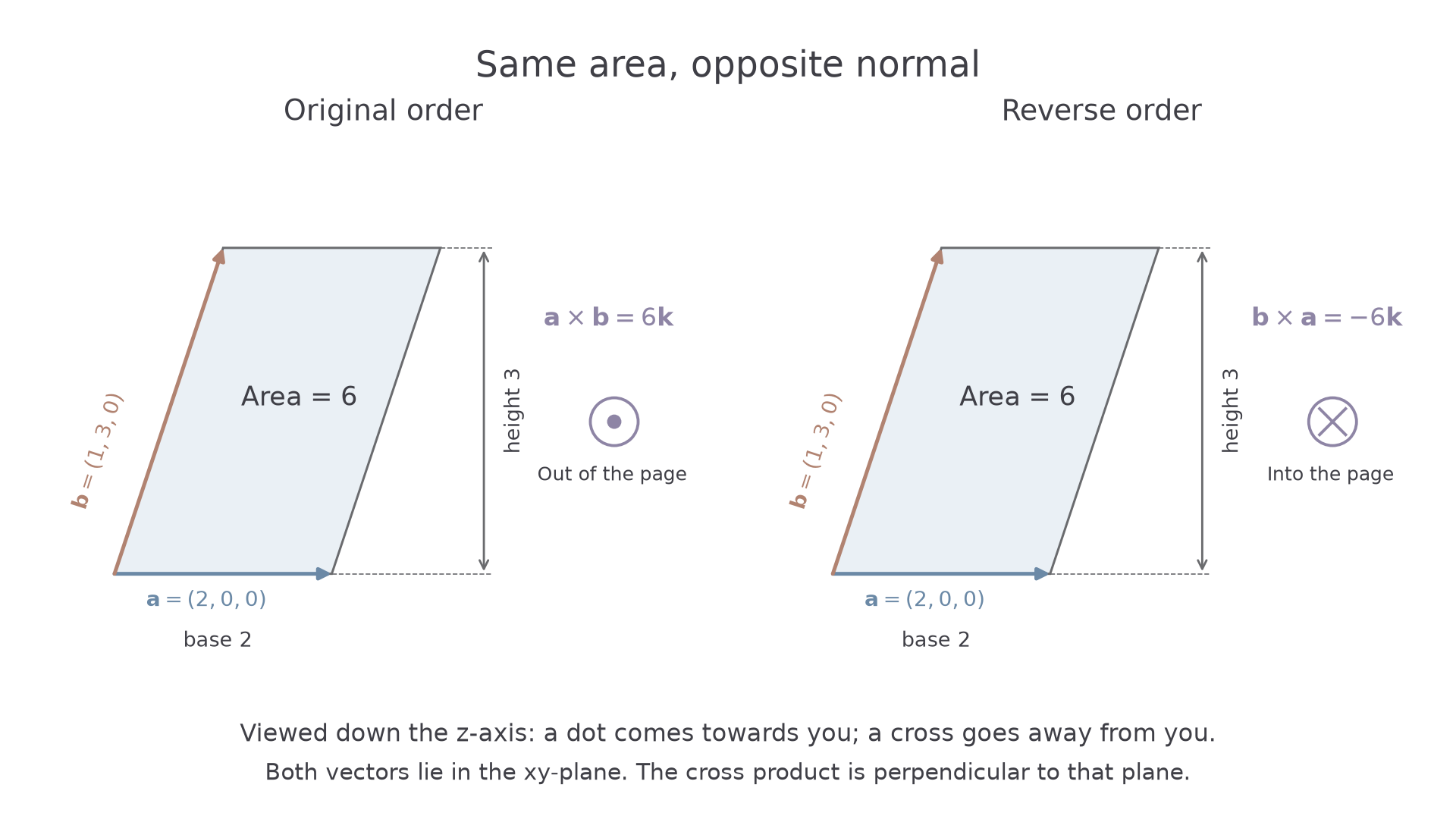
Direction of the vector product
For nonzero, nonparallel vectors and , is perpendicular to both. Curl the fingers of your right hand from towards through their angle between and ; your thumb gives its direction. This is the right-hand rule.
The component rule fixes this orientation, rather than allowing either perpendicular direction.
Magnitude and order
For nonzero vectors with angle ,
The magnitude formula is in the formula booklet. Reversing the order gives
This order rule is not separately printed in the booklet: learn it.
The magnitude follows from base times height: the perpendicular height of the parallelogram is . Since sine is nonnegative on this angle interval, the magnitude is nonnegative. Parallel or antiparallel vectors give zero; if either input is zero, the component rule also gives zero. A zero cross product has no direction. For two nonzero vectors, a zero cross product therefore tests whether they are parallel.
Worked example 3: perpendicular vectors
Question. Vectors and have lengths and , with angle . Find .
Plan. Use the sine magnitude formula with the given angle.
Answer. .
Check. Perpendicular sides form a rectangle with area . This is also the largest possible cross-product magnitude for these fixed lengths.
Keep the lengths fixed and change only the angle. An obtuse angle remains a valid vector angle.
Worked example 4: an obtuse angle
Question. Vectors and have lengths and , with angle . Find .
Plan. Use sine, retaining the given obtuse angle.
Answer. .
Check. The perpendicular height is , so base times height is . The supplementary angle gives the same area.
There is a useful connection to the scalar product. Squaring its cosine formula and the cross-product sine formula gives
because . Thus dot and cross products together recover the product of the lengths without finding the angle. The identity also holds when an input is zero.
Cross products distribute over addition, and scalar factors can be taken outside:
Each rule follows by expanding the component formula. They hold for real scalars, including negative numbers and zero. Also, . These properties simplify expressions even when you are not given the original vector components. Cross products are not generally associative: keep the brackets in a product of three vectors.
Worked example 5: using properties without the original vectors
Question. Given and , find .
Plan. Distribute, remove the self-product, then reverse products to match the given order.
Answer. .
Check. Independently rewrite the first factor as . Its product with is , giving .
Continue this lesson.
You’re previewing NovaLearn without an account. Create a free account to read the rest.
Create free account