C3 - Transformations in three dimensions
A mirror plane changes one coordinate, while a rotation about an axis leaves that axis coordinate unchanged. You will represent a single reflection in a coordinate plane or a single rotation about a coordinate axis using a matrix. Choosing the unchanged coordinate and checking the turning direction makes the matrices easier to understand.
Single reflections and rotations in 3D
What must change when a point crosses a coordinate mirror plane? Take . Its reflection in , the -plane, is : the perpendicular coordinate changes sign, and the two coordinates along the plane stay the same.
In three dimensions, the columns of a transformation matrix are the images of , and . The matrix acts on the position column . Reflection in keeps the first two unit vectors and reverses the third, giving the diagonal entries .
Reflections in coordinate planes
The coordinate-plane reflection matrices are not separately printed in the formula booklet: derive them by changing the perpendicular coordinate's sign.
Every point in the mirror plane remains fixed. Points off the plane lie at equal perpendicular distances on opposite sides. Each of these matrices has determinant : volume is preserved and orientation reversed.
Worked example 1: reflection in the horizontal coordinate plane
Question. Find the matrix of reflection in , and hence the image of .
Plan. Keep the coordinates parallel to the plane and reverse the perpendicular coordinate.
Answer. The matrix is above; .
Check. The midpoint lies in . The joining segment is parallel to the -axis and has endpoints at equal distance 3 from the plane.
Change only the mirror plane to . A different coordinate must now reverse; the point stays the same.
Worked example 2: changing the mirror plane
Question. Find the matrix of reflection in , and hence the image of .
Plan. Reverse the second coordinate and keep the first and third.
Answer. The matrix is above; .
Check. The midpoint lies in , and the segment is parallel to its perpendicular -axis. Both endpoints are distance 1 from the plane.
Now turn around an axis instead of reflecting across a plane. The axis coordinate stays unchanged; the two perpendicular coordinates undergo an ordinary plane rotation.
We use the positive rotation convention: a positive angle is anticlockwise when viewed from the positive end of the named axis towards the origin. For a positive quarter-turn, the cyclic directions are
Looking from the other end reverses the apparent clockwise/anticlockwise direction, so state the viewpoint when describing a turn.
Rotations about coordinate axes
With the positive convention above,
These three matrices are in the formula booklet. Use a negative angle for the reverse rotation.
For , the pair rotates; for , the pair rotates. The -axis formula looks different because the positively ordered pair is . In that order,
Writing the coordinates back in order produces the booklet matrix. Do not move the minus sign just to make it resemble the -axis matrix.
Worked example 3: a quarter-turn about the z-axis
Question. Find the matrix of rotation through about the -axis in the positive convention, and the image of .
Plan. Leave unchanged and rotate the pair, using and .
Answer. The matrix is above; .
Check. The height stays 3. In the perpendicular plane, turns anticlockwise to , with dot product and unchanged squared radius 5.
Change only the rotation axis from to . Keep the point and positive quarter-turn angle unchanged.
Worked example 4: a quarter-turn about the y-axis
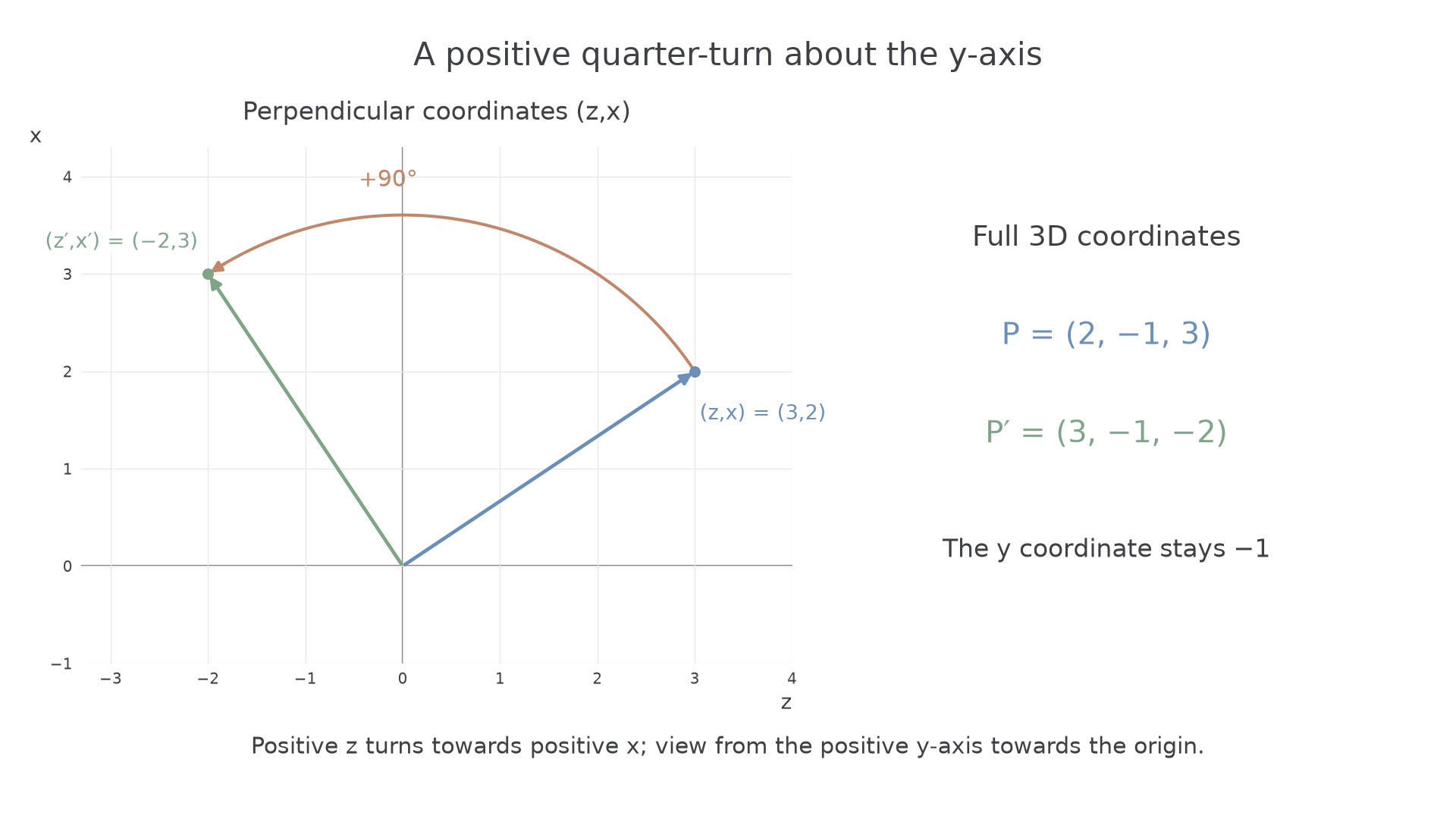
Question. Find the matrix of rotation through about the -axis in the positive convention, and the image of .
Plan. Use the -axis formula, which leaves the middle coordinate unchanged.
Answer. The matrix is above; .
Check. The coordinate along the axis remains . The perpendicular pair becomes , a positive quarter-turn with unchanged squared radius 13. In particular, positive turns towards positive , confirming the sign convention.
[DIAGRAM: asset_name: A 3D rotation becomes a plane rotation; asset_slug: aqa7367-coordinate-axis-rotation; caption: A positive quarter-turn about the y-axis rotates the ordered pair (z,x) and leaves y unchanged; description: A left coordinate diagram in the plane y=-1 shows axes labelled z horizontally and x vertically, with the perpendicular pair (3,2) rotating anticlockwise to (-2,3) along a quarter-circle about the origin of that plane. A right panel records the corresponding 3D coordinates P=(2,-1,3) and P prime=(3,-1,-2), highlights the unchanged y coordinate, and states that positive z turns towards positive x.]
Rotations preserve lengths and have determinant . A coordinate-plane reflection reverses one basis direction; a half-turn about a coordinate axis reverses the other two. For example, is rotation through about the -axis, not reflection in . At angle zero, each rotation matrix is the identity; it need not identify a unique axis.
The matrices here each describe one reflection in , or , or one rotation about a coordinate axis. Use the appropriate single matrix directly.
Watch out
A rotation about the -axis keeps fixed; reflection in the plane reverses . An axis and a plane with the same coordinate letter play different roles.
Try the remaining coordinate axis with a reversed angle.
Quick Recap
- Reflecting in a coordinate plane reverses its perpendicular coordinate.
- Rotating about a coordinate axis keeps its axis coordinate and rotates the perpendicular pair.
- For the booklet matrices, view a positive angle from the positive end of the axis towards the origin.
- A single reflection reverses orientation; a single rotation preserves it.
The opening reflection in changes exactly the third coordinate because that is the direction perpendicular to the mirror plane.