C4 - Invariant points and lines
A line can stay in the same place even while its individual points move along it. You will find fixed points, distinguish a line of fixed points from an invariant line, and find invariant lines through or away from the origin. Keeping the original and image coordinates separate is the key to the distinction.
Finding fixed points
Can a line remain unchanged while most points on it move? First find what it means for a single point to stay exactly where it is. A point is fixed when its image is the same point, so both coordinates must be unchanged.
Invariant point
An invariant point, or fixed point, of a matrix transformation satisfies
The identity matrix has the same order as . The zero vector is always fixed by a linear transformation. This fixed-point condition is not printed in the formula booklet.
Solve the resulting simultaneous equations without assuming the point is non-zero. You may obtain only the origin, a whole line, or every point in the plane. The origin cannot be discarded merely because it has no direction.
Worked example 1: a whole line of fixed points
Question. Find all invariant points of .
Plan. Set each output coordinate equal to its original coordinate.
The second equation imposes no extra restriction; the first says .
Answer. Every point on the line , including the origin, is invariant.
Check. An arbitrary point on that line is . Its image is for every real , so the complete line is fixed point by point.
Change only the bottom-right entry from 1 to 2. One formerly automatic equation now adds a restriction.
Worked example 2: only the origin remains fixed
Question. Find all invariant points of .
Plan. Solve the two coordinate equations together.
The second equation gives ; substituting into the first gives .
Answer. The only invariant point is .
Check. has determinant 1, so its homogeneous equations have only the zero solution, agreeing with the coordinate calculation.
At the opposite boundary, if , both equations reduce to , so every point is invariant. Also, does not itself tell you which points are fixed: the relevant equations use .
Watch out
For a fixed point, require , not merely for some scalar . Multiplying a non-zero position vector by 2 keeps its direction but moves its endpoint.
Find a fresh fixed-point set.
Fixed points and invariant lines
An invariant line is a statement about a set of points, rather than the location of each individual point. Under , the vertical axis stays the vertical axis even though moves to .
Two meanings of unchanged
A line of invariant points is fixed point by point: every point on it satisfies .
A setwise invariant line is mapped onto itself. Points may move along it. A line of invariant points is therefore an invariant line, but an invariant line need not consist of invariant points.
For a line through the origin with non-zero direction vector , all its points have position vectors . If
then . When , this covers the whole same line as varies over all real numbers. If , every point is fixed. If , only the origin on that line is fixed. A negative moves non-zero points to the opposite ray without changing the line.
The case is different: the whole line collapses to the origin. Its image is contained in the original line but is no longer a line, so it is not mapped onto itself. Keeping “onto itself” in the definition avoids treating a collapsed line as an unchanged line.
Worked example 3: a line fixed point by point
Question. For , determine whether is invariant and whether its points are fixed.
Plan. Transform a general point on the line, rather than checking just the origin.
Answer. The -axis is invariant and every point on it is fixed.
Check. The fixed-point equations are and , giving with arbitrary. They recover exactly this line.
Change only the chosen line from the horizontal to the vertical axis. The matrix stays the same.
Worked example 4: an invariant line whose points move
Question. For the same , determine whether is invariant and whether its points are fixed.
Plan. Transform a general point on the vertical axis and check the whole image set.
Every output lies on . Every target on that line is reached by choosing , so the image is the whole line.
Answer. The vertical axis is setwise invariant, but only its origin is fixed, since requires .
Check. The specific point moves to , disproving pointwise fixation; applying the reciprocal vertical scale reaches every original point on the axis.
[DIAGRAM: asset_name: A fixed line and a setwise invariant line; asset_slug: aqa7367-fixed-versus-invariant; caption: Under (x,y) maps to (x,2y), the horizontal axis is fixed point by point while points move along the invariant vertical axis; description: Two side-by-side coordinate plots show the same matrix diag(1,2). The left highlights y=0 and a point (2,0) that remains at (2,0). The right highlights x=0 and arrows from (0,1) to (0,2) and from (0,-1) to (0,-2), showing movement within the unchanged line. The origin is marked fixed in both.]
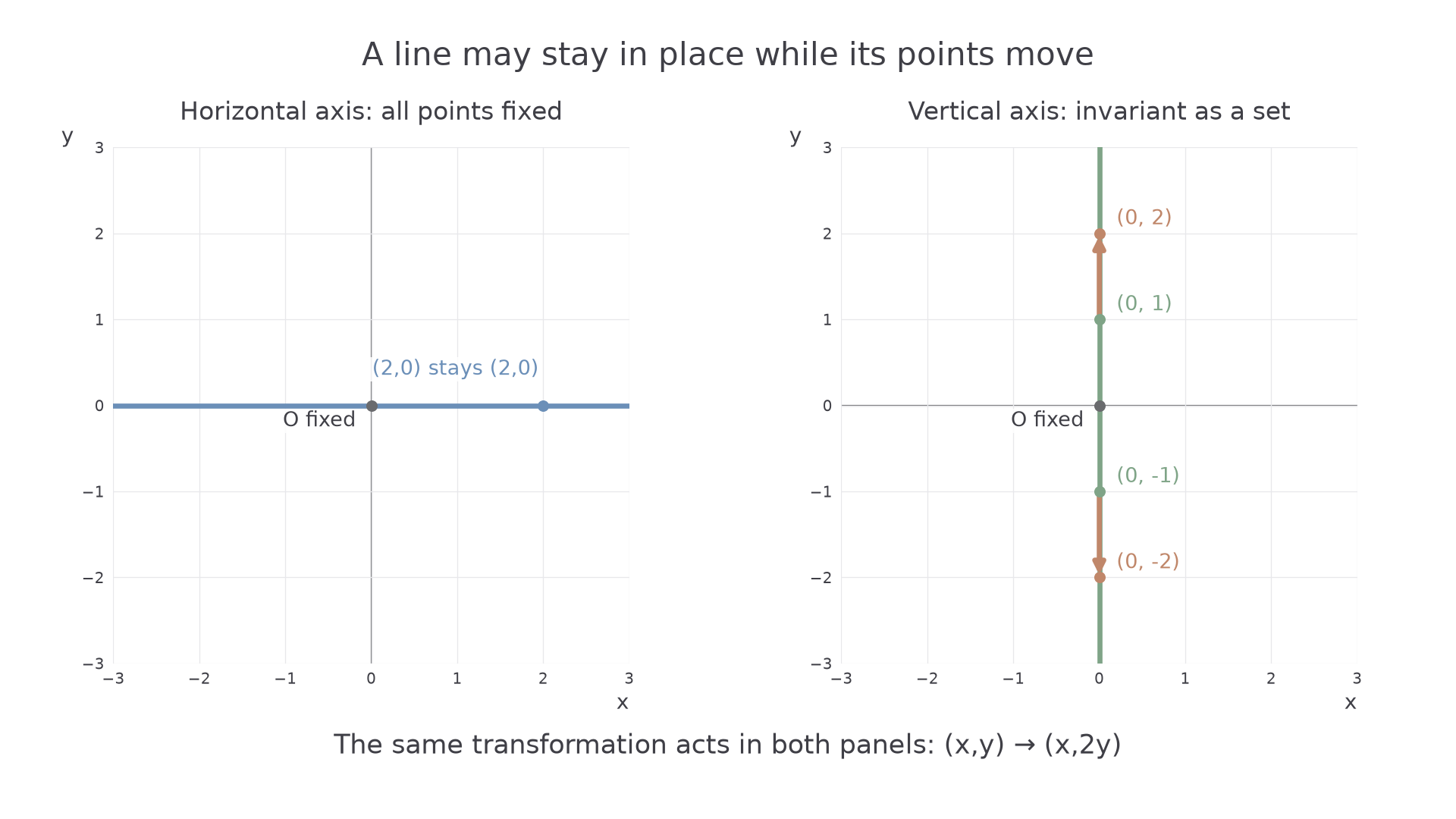
This answers the opening question: a set can keep its position while its members move. For a line away from the origin, its direction behaving correctly is necessary but insufficient; its position must also be checked. The next part handles both conditions.
Finding every invariant line
To find all invariant lines, test both a general non-vertical line and the vertical family. Writing only misses every vertical line.
Suppose and take an input point . Its image is
An invariant line requires the output to satisfy the same line equation, . It does not require and . Comparing the coefficient of and the constant term gives
For the image to cover the whole line, also require ; otherwise is constant and the line collapses to a point. For a non-singular matrix, such a collapse cannot occur, but with a singular matrix check it explicitly.
For a vertical line , transform a general point :
Keeping for every requires and . Also require to cover the whole vertical line. These conditions come from substitution; they are not printed in the formula booklet.
Worked example 5: invariant lines away from the origin
Question. Find every invariant line for .
Plan. Test , compare coefficients, then test separately.
A point on a non-vertical line has image . Requiring gives
There is no restriction on . Each horizontal line maps onto itself because ranges over all real numbers.
For a vertical line , its image has , so
On , the image coordinate covers the whole line.
Answer. Every horizontal line , where , and the vertical line .
Check. A general maps to , with any desired first coordinate reached by halving it. A general stays fixed. These substitutions verify both families and their different pointwise behaviour.
Change only the vertical scale from 1 to 3. Lines away from the origin now change their height.
Worked example 6: when the intercept must vanish
Question. Find every invariant line for .
Plan. Keep the intercept until coefficient comparison shows whether it is allowed.
For the image to lie on the original line,
Thus the only non-vertical invariant line is . For , the condition gives , and the output covers that vertical line.
Answer. Exactly the two coordinate axes, and .
Check. The axes are multiplied along themselves by 2 and 3. Any horizontal line instead goes to the different line . On either invariant axis, only the origin is fixed.
For a non-diagonal matrix, coefficient comparison can produce a quadratic in the slope. A lack of real roots excludes non-vertical invariant lines; you must still check the vertical case before claiming there are no invariant lines at all.
Worked example 7: proving there are no invariant lines
Question. Prove that has no invariant lines.
Plan. Show no real slope is possible, then rule out vertical lines.
For ,
The coefficient condition in would require
There is no real solution for , whatever is. A vertical input line has , which varies with ; it cannot remain the line .
Answer. There are no non-vertical or vertical invariant lines, hence no invariant lines at all.
Check. is times a rotation through . Every direction turns through , so no line direction can remain the same. This geometrical check agrees with the algebra.
A direction condition alone cannot locate a line away from the origin. For a general line , with , its image is . It maps onto the same line exactly when for some and is parallel to . The first condition preserves direction; the second preserves the line's position. This is the vector version of the coefficient and constant-term checks above.
Watch out
Use for image coordinates. Setting them equal to finds fixed points and can miss invariant lines whose points move. Also, dividing by too early can hide the vertical family; test separately.
Finish with a matrix that has both a family away from the origin and an oblique fixed line.
Quick Recap
- Fixed points solve , including the origin.
- A line of fixed points is stronger than a setwise invariant line: points on an invariant line may move.
- For , require its image coordinates to satisfy for every input point.
- Test vertical lines separately and exclude a collapse to a point when asking for a line mapped onto itself.
Yes: a line can stay unchanged while its points move along it, as the vertical axis does under .