B7 - Loci and regions in the complex plane
What shape is hidden in an equation such as ? You will read moduli as distances and arguments as directions, then use them to describe circles, regions, perpendicular bisectors and rays. Combining conditions will let you select just the points that satisfy them all.
Distance circles and inequalities
Which points are exactly 3 units from ? Their positions form a circle centred at . The complex expression is the displacement from that centre to the point for .
Locus
A locus is the set of points satisfying a stated condition. If is fixed and , then
is the distance from to .
For , is the circumference of the circle with centre and radius . The inequality gives its interior; gives its exterior. Use or to include the circumference. A shaded region shows the points satisfying the condition; a dashed boundary means those boundary points are excluded.
[DIAGRAM: asset_name: A circle and its exterior; asset_slug: aqa7367-loci-circle; caption: Equality selects the circumference while a strict greater-than inequality selects the exterior; description: Two equal-scale Argand panels show a circle centred at (2,1) with radius 3. The left panel has a solid circumference for modulus of z minus (2 plus i) equals 3. The right panel shades the exterior in pale blue and uses a dashed circumference for modulus of z minus (2 plus i) greater than 3. Both centre and a horizontal radius are labelled.]
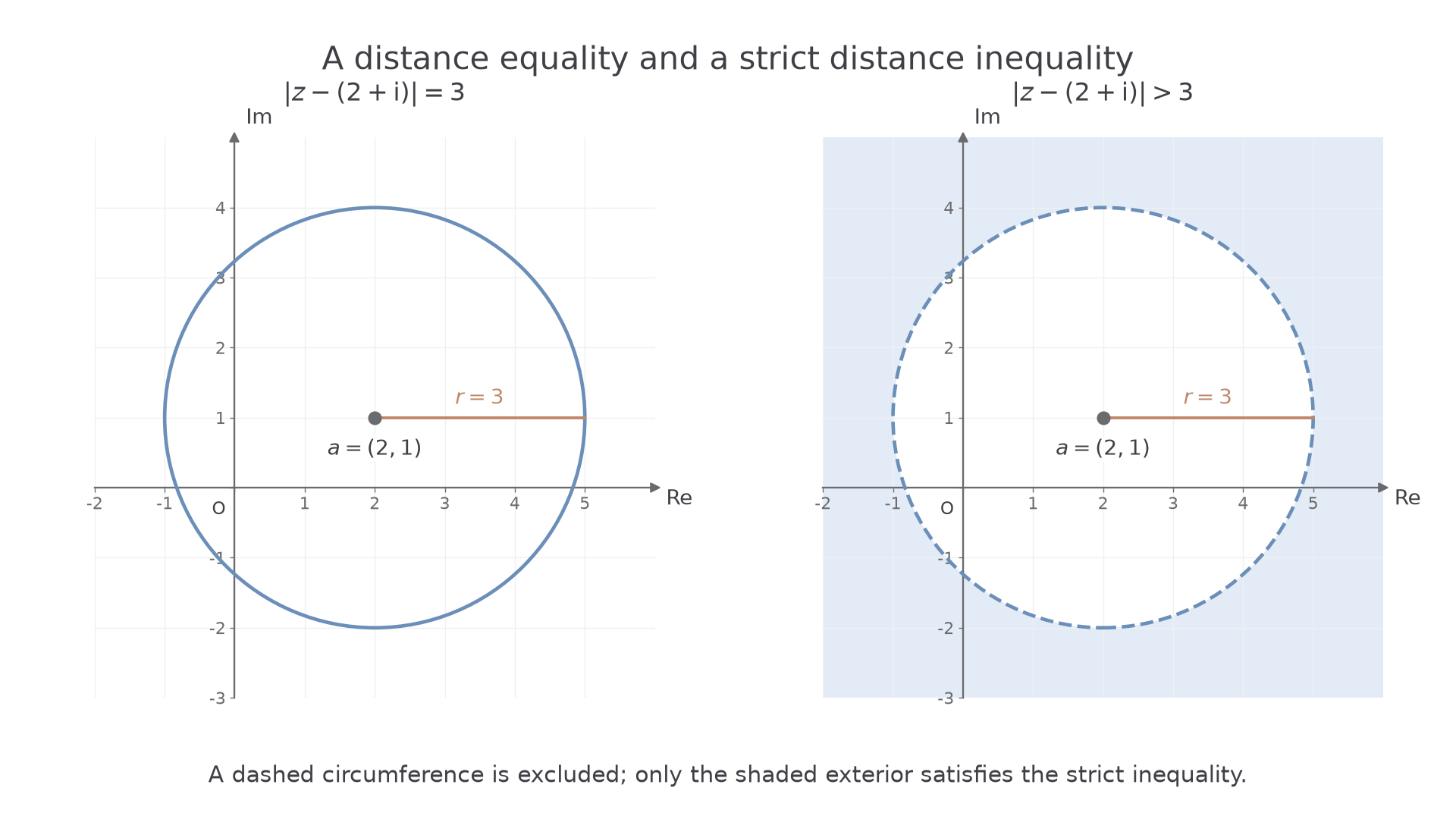
Worked example 1: a distance equality
Question. Describe and give its Cartesian equation.
Plan. Identify the fixed centre and square the nonnegative distance equation.
Answer. The circumference of a circle with centre , radius 3, and equation .
Check. The point is 3 units right of the centre; substitution gives .
Keep the centre and radius fixed, but change equality to a strict greater-than inequality. The boundary is now excluded, and points outside it are selected.
Worked example 2: a distance inequality
Question. Describe and give its Cartesian inequality.
Plan. Use the same squared distance, preserving the strict inequality because both distances are nonnegative.
Answer. The exterior of the same circle, excluding the circumference; .
Check. The centre has distance 0 and fails the condition. The point has distance 4 and satisfies it; , at distance 3, is excluded.
When reading a centre, preserve the full bracket: has centre . The zero-radius case is different: selects just , selects every point except , and a distance less than zero is impossible.
Watch out
The sign inside is a subtraction. Rewrite the expression explicitly as before reading off its centre, especially when has a negative coefficient.
Translate a new non-strict inequality.
Perpendicular bisectors
Points equally far from two different fixed points form the perpendicular bisector of the segment joining them. For complex numbers , the condition expresses exactly those equal distances.
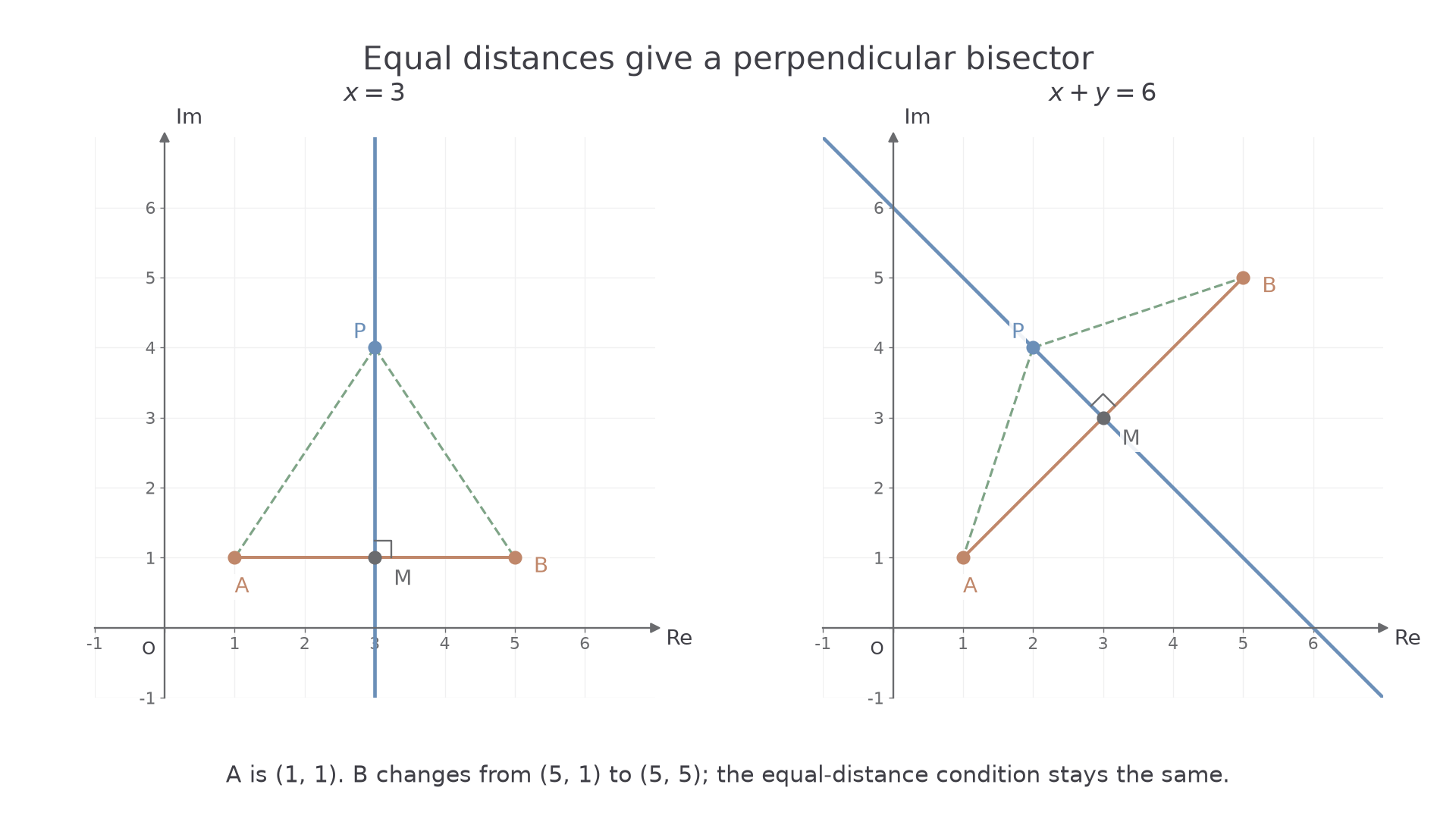
To see why, let be the midpoint of the fixed segment . A point on the perpendicular through gives two right triangles with the same height and equal half-bases, so . Conversely, if and , triangles and are congruent by three equal sides. Their equal adjacent angles at sum to , so each is a right angle. The midpoint itself is also included.
Algebra supplies a useful route: square the distances, expand, and cancel the common and terms. A straight-line equation remains. If the two fixed points coincide instead, every point is equidistant from them; there is no unique bisector.
[DIAGRAM: asset_name: Equal distances and perpendicular bisectors; asset_slug: aqa7367-loci-bisectors; caption: Changing one fixed point tilts the perpendicular bisector; description: Two equal-scale Argand panels show A at (1,1). The first has B at (5,1), midpoint (3,1), and vertical bisector x equals 3. The second has B at (5,5), midpoint (3,3), and descending bisector x plus y equals 6. Equal-length dashed segments join a sample point on each bisector to A and B. Right-angle markers indicate perpendicularity at the midpoints.]
Worked example 3: a vertical bisector
Question. Find and describe the locus .
Plan. Equate squared distances and simplify.
Answer. The entire vertical line , the perpendicular bisector of the segment from to .
Check. Its midpoint is . At the sample point , both squared distances are .
Change only the imaginary part of the second fixed point, from 1 to 5. The joining segment tilts, so its bisector must tilt too.
Worked example 4: a tilted bisector
Question. Find and describe .
Plan. Use the same squared-distance method with the new vertical coordinate.
Answer. The line , perpendicular bisector of the segment joining and .
Check. The midpoint satisfies the equation. The original segment has gradient 1 and the bisector gradient , so they are perpendicular.
An inequality selects a side of the bisector: means “closer to ”. Test : its distance to is zero, so it belongs to that side when . Equality includes the dividing line; a strict inequality excludes it.
Watch out
is usually a line, whereas with a fixed positive real is a circle. In the first condition, both distances change as moves.
Find a fresh bisector with neither a horizontal nor a vertical fixed segment.
Argument rays excluding their origin
The condition fixes the direction from to . It does not fix a distance. Starting at , points can be as close or as far away as you like, provided they lie in that one direction.
Argument ray
For a permitted principal angle , the locus is the ray from at angle to the positive real direction, with itself excluded. Equivalently,
The positive number is the distance along the ray.
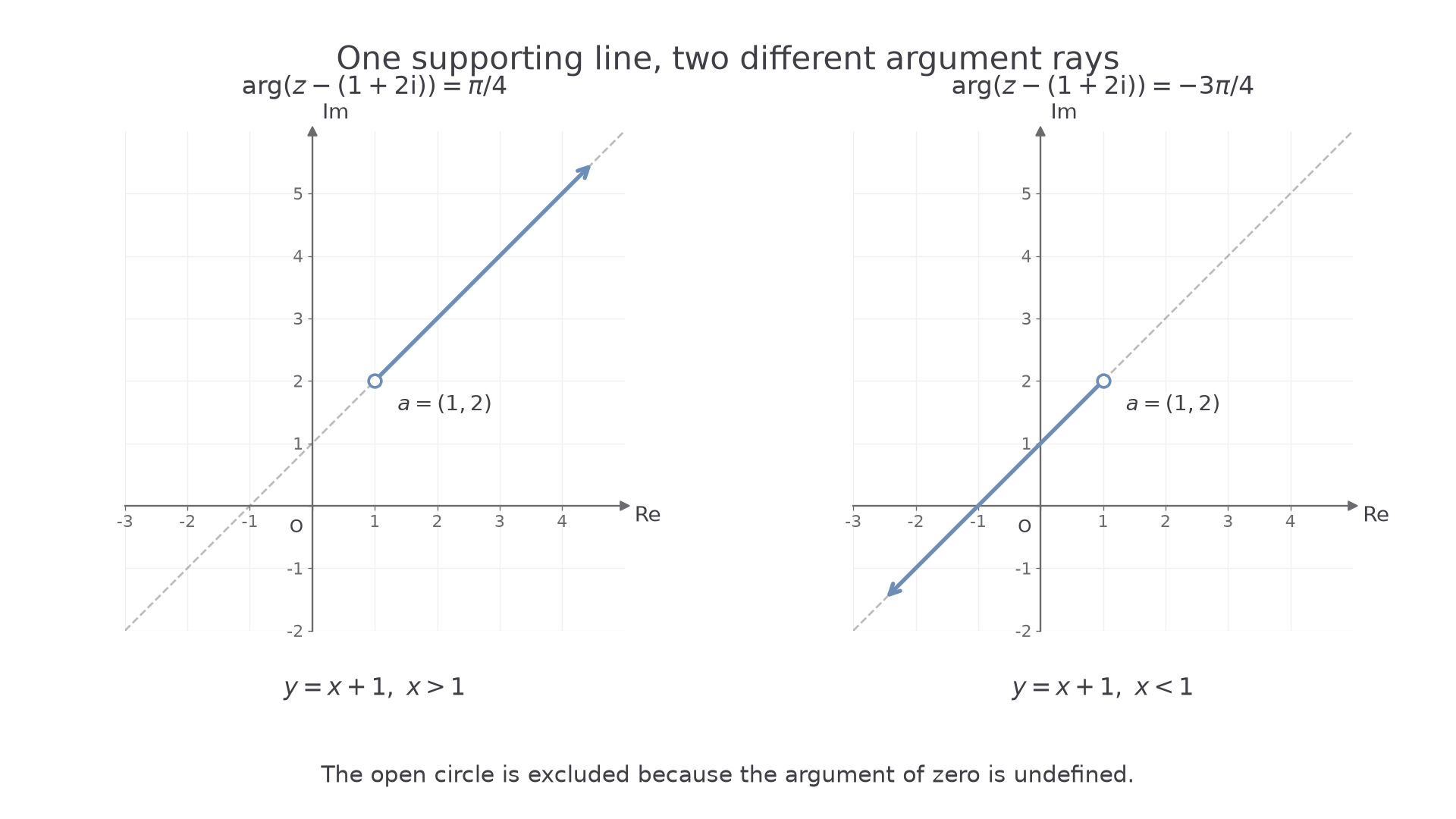
The starting point is excluded because makes , whose argument is undefined. Mark it with an open circle. The opposite half of the same straight line has a direction differing by , so it is not part of the ray. With the interval , the leftward ray uses , rather than the excluded value .
[DIAGRAM: asset_name: Opposite argument rays on one line; asset_slug: aqa7367-loci-rays; caption: The same line contains two different argument rays and neither includes its starting point; description: Two equal-scale Argand panels show an open circle at a equals 1 plus 2i. The first highlights the northeast ray y equals x plus 1 with x greater than 1 for argument pi over 4. The second highlights the southwest ray on the same line with x less than 1 for argument minus 3 pi over 4. A faint dashed extension indicates the excluded opposite half in each panel.]
Worked example 5: a northeast ray
Question. Describe using Cartesian conditions.
Plan. Use the gradient of the direction and choose the correct half-line.
Answer. with ; the point is excluded.
Check. At , the displacement is , with argument . At , it is , with argument , so that opposite point is correctly excluded.
Keep the starting point and supporting line fixed, but change the angle by . Only the opposite ray now satisfies the condition.
Worked example 6: the southwest ray
Question. Describe using Cartesian conditions.
Plan. Keep gradient 1, but select points southwest of the starting point.
Answer. , , again excluding .
Check. At , the displacement is , which has principal argument . The start would give zero and is undefined.
Vertical rays need no tangent calculation. For example, means directly above , while means directly below. A tangent ratio would be undefined at those angles, although the geometric loci are perfectly well defined.
Watch out
A straight-line equation alone does not specify an argument ray. Include its direction restriction and exclude its starting point.
Describe a vertical ray with a new starting point.
Shifted loci and intersecting regions
Replacing by shifts the reference point from the origin to . Combining conditions with “and” selects their intersection: every point retained must satisfy every condition.
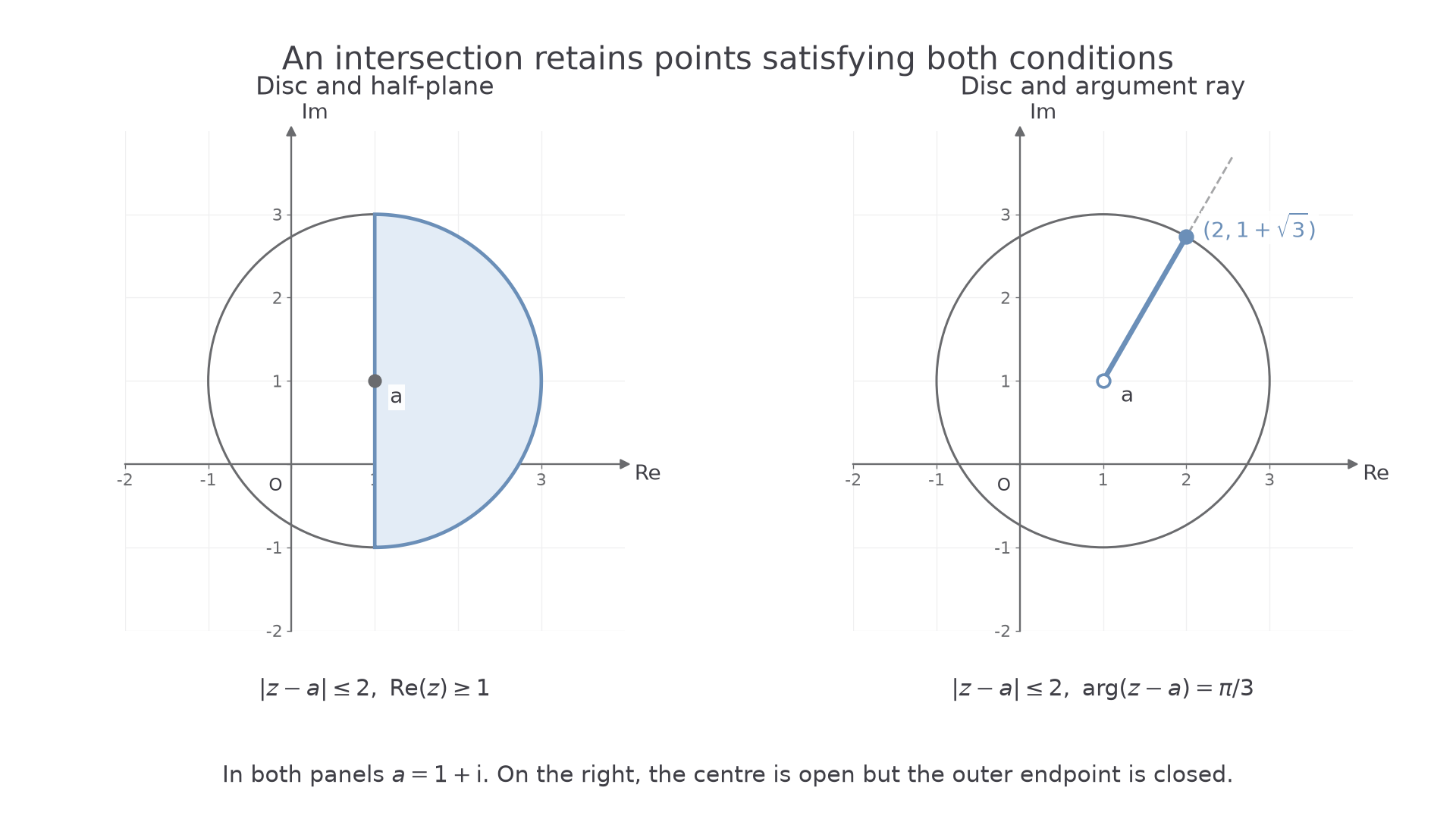
For a two-dimensional example, and select the right half of the closed disc centred at . The circle boundary is included by , and the vertical diameter is included by . The inequalities do not mean the union of the whole disc and the whole right-hand half-plane.
An argument condition can narrow a disc to a segment on one ray. Measure distance along the ray from its shifted starting point; a modulus condition then becomes a restriction on .
[DIAGRAM: asset_name: Intersections select only shared points; asset_slug: aqa7367-loci-intersections; caption: A disc with a half-plane gives a half-disc while a disc with an argument ray gives a segment; description: Two equal-scale Argand panels use centre a at (1,1) and radius 2. The first shades the right half of the closed disc for modulus of z minus a at most 2 and real part of z at least 1, including the diameter and semicircle. The second shows the ray at pi over 3 with a solid blue segment from the open centre to the closed endpoint at (2,1 plus square root of 3); the continuing ray beyond the circle is pale dashed and excluded.]
Worked example 7: a ray inside a disc
Question. Describe the points satisfying both and . Find the segment's outer endpoint and state which endpoints are included.
Plan. Parameterise the ray by its positive distance , then impose the modulus bound.
Answer. The straight segment from to , excluding the first endpoint and including the second.
Check. At the outer endpoint, the displacement is , with modulus 2 and argument , so both conditions hold. At the centre, the distance condition holds but the argument is undefined, so the centre is excluded.
Change only the modulus inequality from to . The direction remains the same, but the allowable distances begin at the circle and extend outwards.
Worked example 8: a ray outside a disc
Question. Describe the points satisfying both and . State the starting point and whether it is included.
Plan. Keep the ray parameterisation and reverse the distance restriction.
Answer. A ray beginning at , including that point, and extending in direction .
Check. At , the displacement has modulus 3 and argument , so it is included. At , the argument is correct but the modulus is too small, so it is excluded. The endpoint at meets equality.
Notice the two different starting points. The original argument ray excludes , because its displacement is zero. The restricted outer ray begins at a different point with a nonzero displacement; that point is included by the non-strict modulus inequality.
Extreme arguments on a circle
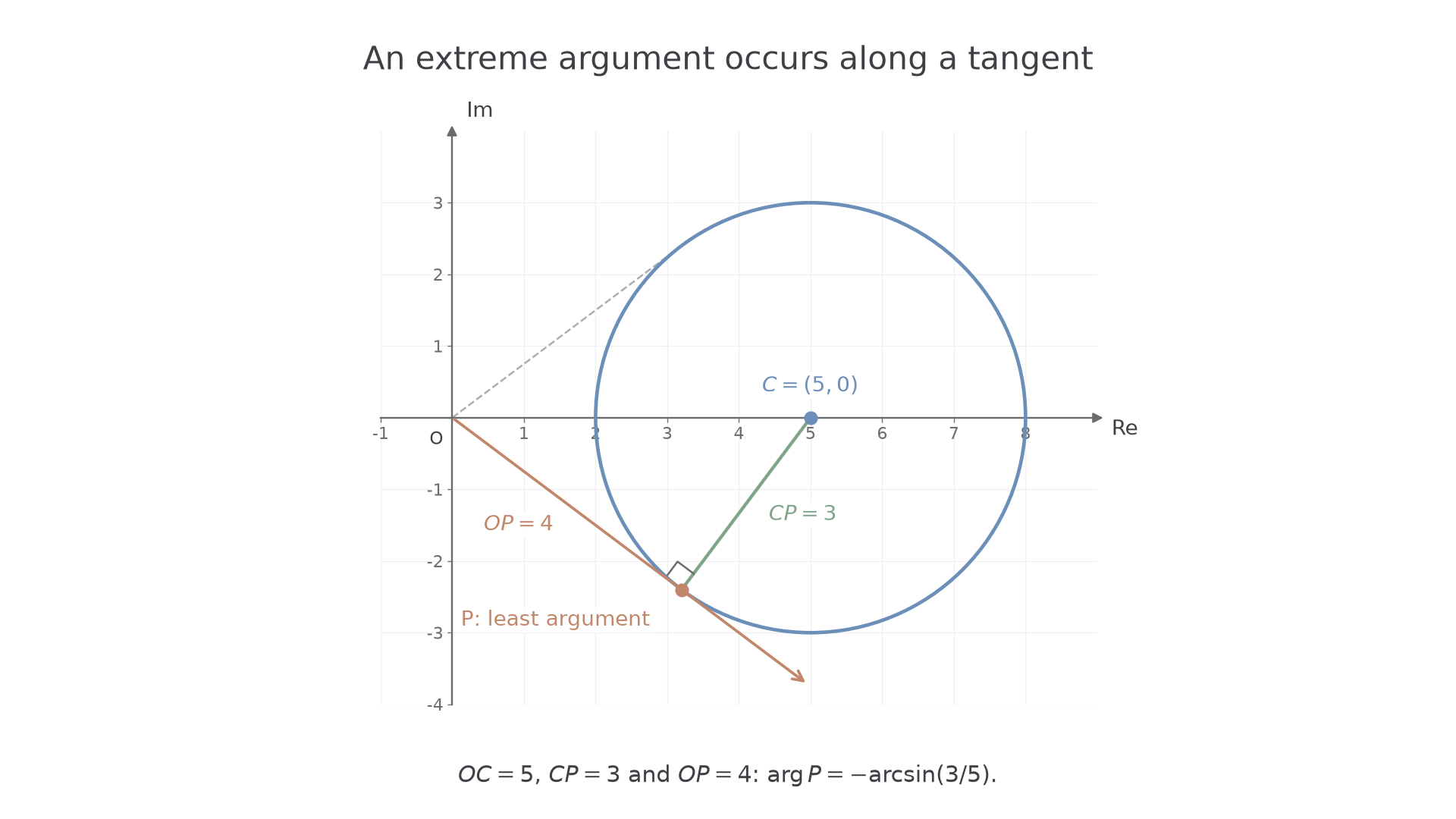
A circle can also restrict which directions from the origin are possible. If the origin is outside a circle, its two tangents from the origin give the extreme directions between which the circle is visible. At a tangent point , the radius is perpendicular to . This gives a right triangle, not an assumption that the tangent point is the circle's lowest or highest point.
Let the centre have distance from the origin and radius . If is the positive angle between and either tangent, then
When these directions stay within a single principal branch, the extreme arguments are the centre's direction minus and plus . A circle crossing the negative real axis needs extra care with the principal-argument jump; blindly adding these angles would not decide whether a least principal argument exists. The following circles stay away from that boundary.
[DIAGRAM: asset_name: A tangent gives the least argument; asset_slug: aqa7367-loci-tangent; caption: A radius perpendicular to the tangent creates a right triangle for the extreme direction; description: An equal-scale Argand diagram shows the circle with centre C at (5,0) and radius 3, outside the origin. The lower tangent from O touches at P at (16 over 5,minus 12 over 5). OC has length 5, CP length 3, and OP length 4. A right-angle marker at P shows OP perpendicular to CP. A faint upper tangent indicates the other extreme direction.]
Worked example 9: the least argument on a circle
Question. A point on represents the complex number with least principal argument. Find that argument and at .
Plan. Use the lower tangent from the origin and its right triangle with the centre.
Answer. The least argument is , and .
Check. The tangent point is : its modulus is 4, and its distance from 5 is . Its sine of argument is , agreeing with the negative angle.
Rotate the centre from 5 to , keeping the radius fixed. The circle and tangents turn by , while every length stays unchanged.
Worked example 10: rotating the circle
Question. A point on represents the complex number with least principal argument. Find that argument and the modulus of that number.
Plan. Use the same right triangle, measured from the centre direction .
Answer. , with modulus 4.
Check. The relevant tangent point is the rotation of the previous one: . It lies on this circle because its displacement from has length 3; it has modulus 4 and a positive quadrant I argument.
The tangent method and the intersection method both require checking the original geometric conditions.
Key idea
Check boundary membership against each original condition. A point admitted by one inequality can still be rejected by another condition, especially when an argument becomes undefined. For an extreme direction on a circle outside the origin, use a tangent and its perpendicular radius.
Try a fresh circle whose centre is on the positive imaginary axis.
Quick Recap
- measures distance from the fixed point .
- A fixed positive distance gives a circle; a distance inequality gives a region with an included or excluded boundary.
- Equal distances from two distinct points give their perpendicular bisector.
- gives one ray and excludes .
- For combined conditions, retain only the points satisfying every condition.
The opening equation describes a circle because every selected point lies exactly 3 units from .