DE6 - Scheduling with limited resources
Precedence allows activities to overlap, but workers or machines may be unavailable. You will move flexible activities to reduce peaks, build schedules under a hard resource limit and use bounds to distinguish an improved schedule from a proved optimum.
Shifting activities within float
Can moving a job later make a project easier to staff without making it finish later? Use this nine-day project, released at time zero. Activities have fixed durations, constant worker requirements and run continuously without interruption. Workers are interchangeable; no activity becomes faster when assigned extra workers.
| Activity | Duration (days) | Immediate predecessors | Workers |
|---|---|---|---|
| A | 4 | None | 3 |
| B | 3 | None | 2 |
| C | 4 | A | 1 |
| D | 1 | B, C | 1 |
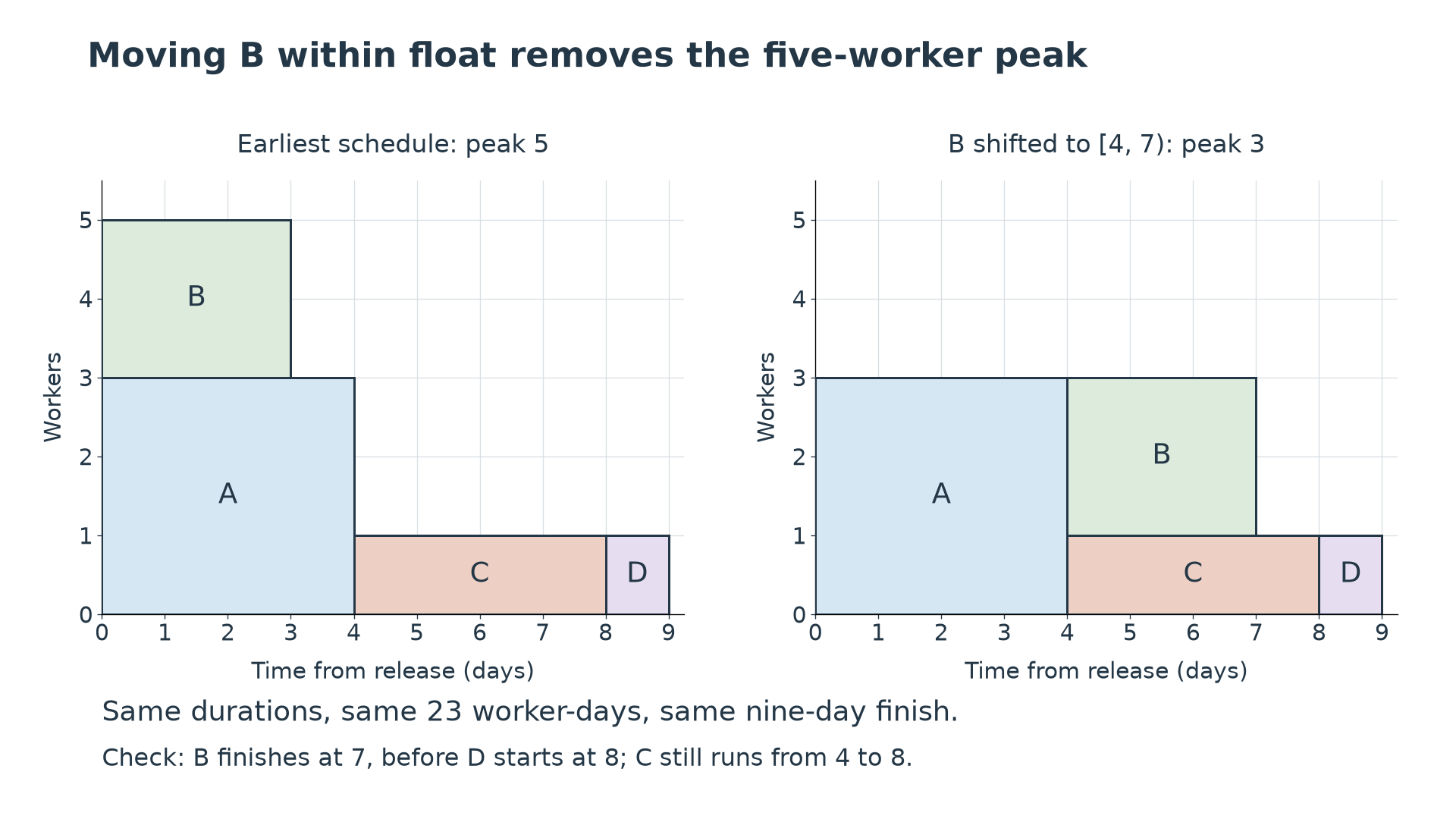
A–C–D takes nine days. B starts earliest at 0 and must finish by 8, so its total float is 5 days. Starting everything early gives a peak of five workers while A and B overlap.
Resource levelling
Resource levelling adjusts activity start times to obtain a more manageable resource demand. A heuristic is a practical selection rule that guides the search, such as moving a flexible activity away from a peak. It can find a useful schedule without guaranteeing the best possible one.
A simple procedure is: draw the current bars and histogram; identify a peak; select a flexible activity contributing to it; try a later permitted start; check every predecessor and successor; redraw the whole affected profile. Retain the change only if it serves the stated objective. Recalculate available flexibility after linked activities move.
Worked example 1: remove a peak by moving B
Question. For the table above, keep A at , C at and D at . Try B at time 4. Find the new peak and finish.
Plan. Check B against its latest finish, then recompute concurrent requirements.
B occupies , finishing before D starts at 8. Demand is 3 on , on , 1 on , and 1 on .
Answer. The peak falls from 5 to 3 workers, with completion still at day 9.
Check. B uses 4 of its 5 days of total float. All arrows remain satisfied, and area is worker-days, equal to the original activity work. Because A itself requires 3 workers, no schedule can use fewer than 3; this particular trial reaches that workforce lower bound.
Change only B's start to 5. A levelled schedule need not have a unique set of start times.
Worked example 2: another placement with the same peak
Question. Use the same project and fixed bars for A, C and D, but start B at 5. Find the peak and whether any of B's original float remains unused.
Plan. Place B for its full three-day duration and compare its new finish with D's start.
B occupies . Demand is 3 on , 1 on , 3 on , and 1 on . B finishes exactly when D starts.
Answer. Peak 3 workers, finish day 9. B has used all 5 days of its original float; it cannot move later while D stays at 8.
Check. Work remains worker-days. The two schedules have the same peak and completion but put low-demand periods in different places; neither is automatically preferable if worker availability varies by day.
[DIAGRAM: asset_name: Levelling by moving B; asset_slug: aqa7367-levelled-resources; caption: Shifting B within float reduces the peak from five workers to three while preserving the nine-day finish; description: Two stacked labelled resource histograms share scales zero to nine days and zero to five workers. Left has A three workers on zero to four, B two on zero to three stacked above A, C one on four to eight and D one on eight to nine. Right keeps A C D and moves B to four to seven, stacked above C. The right histogram never exceeds three workers.]
Watch out
An activity's original float is not permission to ignore the revised schedule. Check predecessor finishes and successor starts together, and keep the whole fixed-duration activity intact.
Move the flexible job and verify the new demand interval by interval.
Hard resource limits can extend completion
Float comes from the precedence-only model. If a resource cap cannot be met within that earliest project duration, something must change: allow a later finish, provide extra resources or revise an actual working assumption. A cap is a constraint, not a request to draw a lower bar while retaining incompatible activities.
For the examples here, activity durations and crew sizes are fixed, workers are interchangeable and activities cannot be split or interrupted. If an activity itself requires more workers than the cap, the project is infeasible under these assumptions, however long you wait.
A work lower bound
If total work is worker-days and at most workers can be used, then any feasible completion time satisfies
Also respect every precedence-chain length. Round the work bound up only if completion must be in whole time units. These bounds are necessary; indivisible activities and timing conflicts may force a longer finish. The scheduling bound is not supplied in the AQA formula booklet.
The next pair shows when the work bound is sharp and when crew conflicts make it too weak.
Worked example 3: a binding two-worker cap
Question. A takes 4 days with 2 workers, B takes 3 days with 2 workers, and C takes 2 days with 2 workers after both A and B. A and B have no predecessors. Find the minimum completion time with only 2 workers.
Plan. Identify forbidden overlaps, construct a feasible schedule and compare it with a lower bound.
Without resource restrictions, A and B can overlap and C finishes at . Under the cap, A and B cannot overlap: together they need 4 workers. Schedule A , B , C .
Answer. Minimum completion is 9 days, three days later than the precedence-only finish.
Check. Total work is worker-days. Two workers require at least days, and the schedule attains 9. Reversing A and B gives the same finish.
Continue this lesson.
You’re previewing NovaLearn without an account. Create a free account to read the rest.
Create free account