ME4 - Solids of revolution
Locate the centre of a solid made by rotating a region about the horizontal axis. You will turn thin strips into discs or washers, weight their positions by volume and explain exactly when uniform density cancels.
Masses of discs and washers
Why is a uniform cone's centre three-quarters of the way from its vertex to its base, while a triangular sheet's centre is only two-thirds of the way? Rotation changes the weighting: a strip's height becomes a disc's radius, so its mass depends on the square of that height.
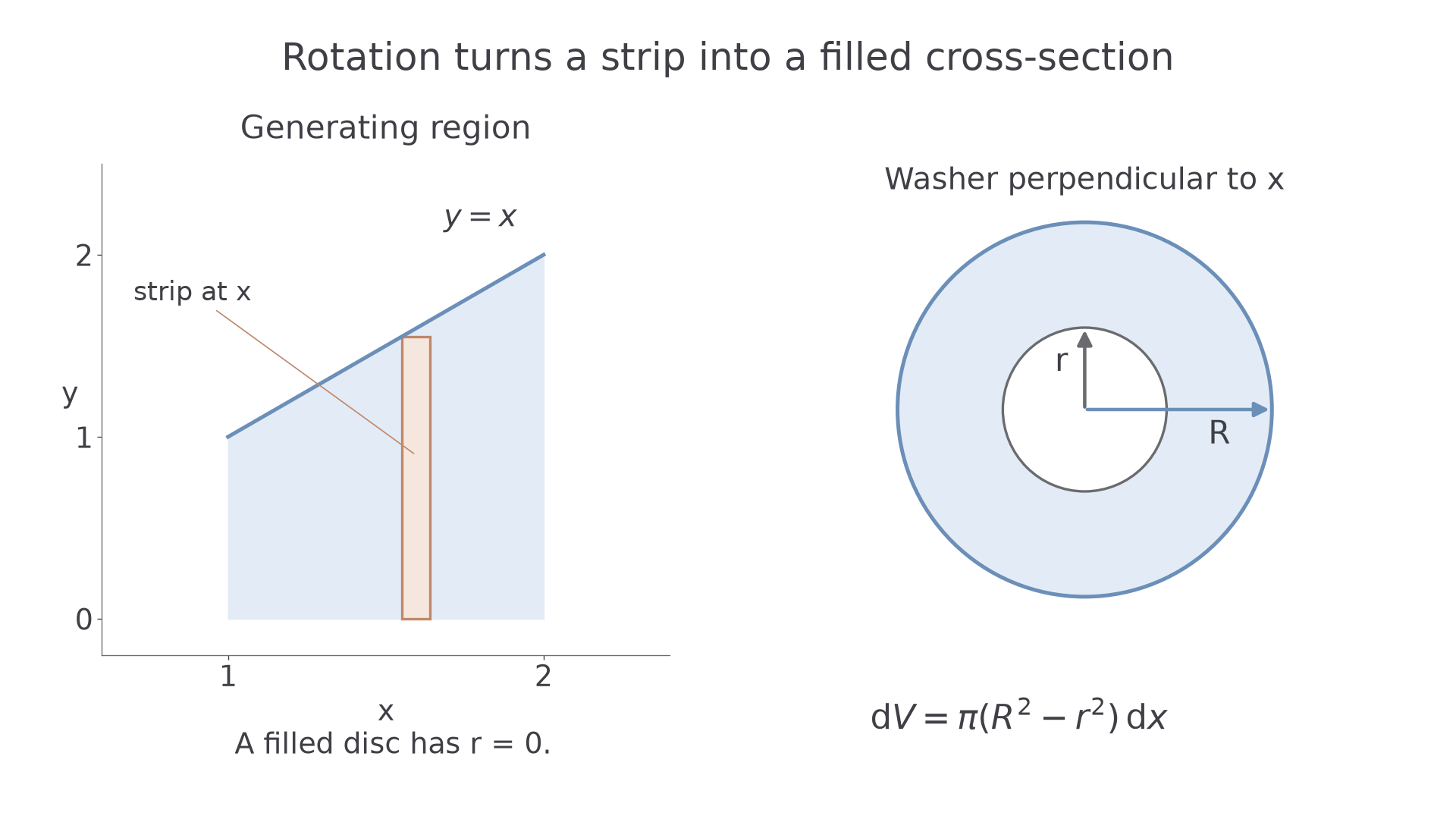
A small slice perpendicular to the -axis at position has thickness . If its radius is , its volume is . Its centre is on the axis at , by circular symmetry. Uniform volume density gives mass .
If the rotated region leaves a hole of inner radius , the slice is a washer. Subtract its missing disc. Identify radii as non-negative distances from the axis, not signed function values. If the region crosses the axis, rotating its upper and lower halves may generate the same volume; do not count that overlap twice.
Disc and washer masses
For a uniform solid occupying complete circular or annular cross-sections perpendicular to the -axis, with ,
Set for a disc. The mass model follows from constant density. These disc/washer volume and slice-mass formulas are not separately supplied in the formula booklet: learn their derivation.
[DIAGRAM: asset_name: A strip becomes a disc or washer; asset_slug: aqa7367-solid-discs; caption: Rotation squares each radius before the inner disc is subtracted; description: Left shows the generating region zero less than or equal to y less than or equal to x for x from one to two, with a narrow vertical slice near x equals 1.6. Right shows an annular cross-section perpendicular to the x-axis, with outer radius R and inner radius r. A note gives slice volume pi times R squared minus r squared times dx. A filled disc has inner radius zero.]
Worked example 1: a solid with disc slices
Question. The region , , in metres, is rotated through about the -axis. Find the mass if its volume density is , constant and positive.
Plan. Use radius , square it to obtain disc area, and integrate slice masses.
Answer. kg.
Check. This is a cone of height 2 and radius 2 with a cone of height 1 and radius 1 removed: , giving the same mass.
Keep the outer boundary and interval, but raise the inner boundary from the axis to . Each slice now loses a unit-radius disc.
Worked example 2: a coaxial hole
Question. Instead rotate , , with the same constant density. Find the mass.
Plan. Subtract inner disc area from outer disc area before integrating.
The slice at has zero area; all slices for have positive area.
Answer. kg.
Check. The hole is a cylinder of radius 1 and length 1, volume . Subtracting its mass from Worked example 1 gives .
The rotation multiplies wider strips' contributions more strongly than a lamina calculation does.
Watch out
Wrong: washer area . The inner circle is removed from the outer circle, so use . For a solid, is a lamina-style mass, not a disc mass.
Use the correct squared radii for a new washer solid.
Centres along the axis
Every complete uniform disc or washer has its centre on the axis. Therefore the whole solid has ; only its position along the axis remains to be found. Multiply the slice mass by its coordinate , integrate, then divide by total mass.
Axial centre of a uniform solid of revolution
For , complete disc or washer slices, constant , and finite positive volume,
Hence
Both density and cancel. Measure the final coordinate from the chosen origin; distance from the far end is .
The centre integral is not in the formula booklet: learn its derivation from moments.
For a cone with its vertex at the origin, wider slices occur at larger . Keep their squared-radius weighting visible in the integration.
Continue this lesson.
You’re previewing NovaLearn without an account. Create a free account to read the rest.
Create free account