DG7, DG9 - Groups and subgroups
A smaller collection of moves can sometimes form a group inside a larger one. You will distinguish finite and infinite groups, combine polygon symmetries, recognise cyclic and abelian groups, and prove when a subset is a subgroup. The words proper and non-trivial describe different restrictions.
Finite/infinite groups
If a square can be turned or reflected, do the turns alone still form a group? To answer, we need to describe both the full collection of moves and smaller collections within it.
A clock with twelve positions gives a finite example: adding positions modulo has the twelve elements . Ordinary integer addition gives an infinite example: there is no last integer to count. Both have identity , but their sets have different sizes.
Finite and infinite groups
A finite group has finitely many elements; its order is that number. An infinite group has infinitely many elements. The operation is part of the description of either group.
For , sums are integers, the identity is , every integer has inverse , and associativity is inherited from ordinary addition. The even integers also form an infinite group under addition: adding or negating an even integer stays even. Restricting the allowed elements has preserved all four axioms.
An infinite group need not give every element infinite period. In , the element has period , because , although the group has infinitely many elements. Group size and element period remain different ideas.
Key idea
Finite or infinite describes how many elements the group contains. It does not describe how often one chosen element must be repeated to reach the identity.
Use that distinction in a new infinite group.
Polygon symmetries
A symmetry of a regular polygon moves it onto exactly the same outline. The elements are transformations, rather than the vertices themselves. Combining two symmetries means performing them in succession.
We use the convention : perform first, then . This agrees with matrices acting on column vectors, where applies first. A question may specify another convention; follow its definition.
For a regular -gon with , there are rotations, including the identity, and reflections. We call its full symmetry group , so . The meaning of the notation is fixed here because other texts sometimes use a different subscript. Composing symmetries is closed, doing nothing is the identity, reversing a movement gives its inverse, and function composition is associative. Thus these transformations form a group.
For the square, label , , , . Let be rotation anticlockwise through , and let be reflection in the -axis. Then
The eight symmetries can be listed as . Powers mean repeated composition.
[DIAGRAM: asset_name: Reversing two square symmetries; asset_slug: aqa7367-square-composition; caption: Reflection followed by rotation sends A to C, while rotation followed by reflection sends A to A; description: Two sequences of three identical coordinate squares show the labelled vertex A travelling under s then r in the top row, and r then s in the bottom row. The square has A at (1,1), B at (minus 1,1), C at (minus 1,minus 1), D at (1,minus 1). Blue dots track the original A: top row positions (1,1), (minus 1,1), (minus 1,minus 1); bottom row positions (1,1), (minus 1,1), (1,1). Headings state rs means s first then r, and sr means r first then s.]
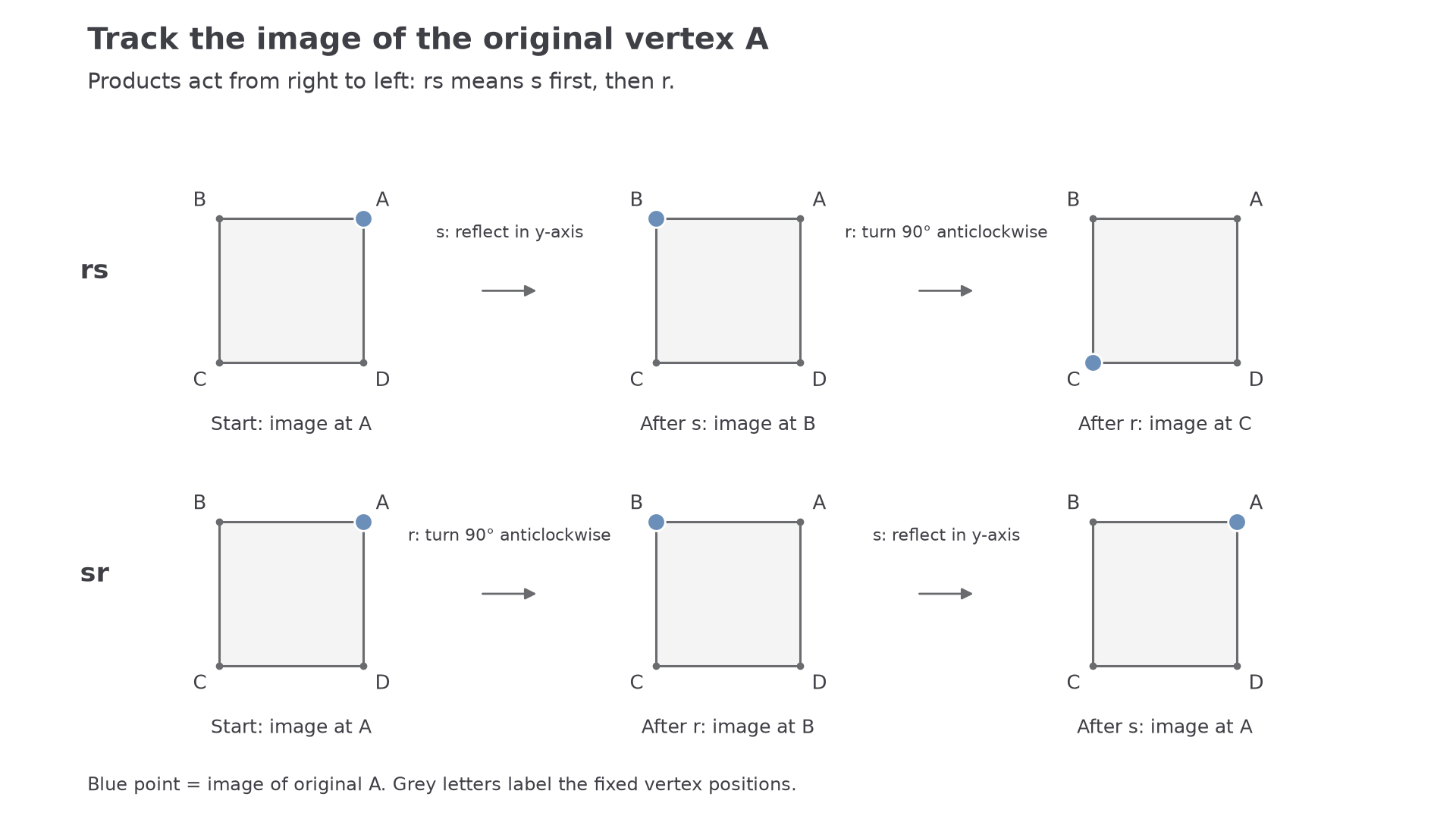
Worked example 1: reflection then rotation
Question. Find the vertex images under for this square, and identify the resulting symmetry.
Plan. Apply to each vertex first, then apply to its image.
The composite swaps and fixes .
Answer. is reflection in the diagonal , whose equation is .
Check. Coordinate reflection in sends to . It interchanges and , while fixing the other two vertices, independently confirming all four images.
Keep the same two moves and reverse only their order. The result can change even though each individual move is unchanged.
Worked example 2: rotation then reflection
Question. Find the vertex images under , and compare it with .
Plan. Apply first, then .
Now are fixed and are interchanged.
Answer. is reflection in , or . Hence .
Check. The coordinate rule has exactly these images. In particular, , whereas ; one differing image already proves the transformations are different.
This gives a geometric group where commutativity fails, without any failure of the group axioms.
Watch out
With our convention, . Reading the letters as “ first” reverses the calculation. Also, a group of polygon symmetries includes reflections unless it specifically says rotational symmetries.
Try the same reasoning with a different polygon and explicitly supplied moves.
Cyclic and abelian groups
Repeated quarter-turns produce every rotational symmetry of a square: , then . Reflections never appear in this sequence. The rotations form a cyclic group, while the full square symmetry group does not.
Cyclic and abelian
A group is cyclic if every element is an integer power of one element . Negative powers mean repetitions of , and . Such an element is called a generator.
A group is abelian if for every pair of elements. This is a property of the operation on the whole set.
In additive language, integer powers become integer multiples. Thus is infinite cyclic: all its elements are integer multiples of . The group is finite cyclic: repeating gives .
Continue this lesson.
You’re previewing NovaLearn without an account. Create a free account to read the rest.
Create free account