B10 - Finding all complex roots
Taking one root on a calculator does not necessarily find every complex solution. You will use de Moivre’s theorem to find all the roots of a nonzero complex number, explain why the list has exactly the required number of distinct values, and recognise the regular polygons formed by those roots.
All distinct nth roots
How many numbers have cube equal to ? The real answer is only one possibility. A number with modulus and argument also cubes to , because its argument triples to a full turn.
Suppose , where and is a positive integer. Write , with . Comparing moduli gives , hence . Comparing arguments requires every full-turn alternative:
All nth roots of a nonzero number
For and positive integer , all roots of are
These roots are distinct. The formula booklet supplies the special case ; the general formula follows from de Moivre’s theorem.
Why stop at ? Increasing by adds to , repeating the same root. Within the listed range, the angle difference between two roots is , which cannot be a full turn unless . This proves both completeness and distinctness.
Worked example 1: all cube roots of a positive real number
Question. Find all solutions of , in Cartesian form.
Plan. Use , take the positive cube root of the modulus, and list three argument branches.
Answer. , and .
Check. For a non-real candidate, , and multiplying once more gives . Its conjugate also cubes to , and .
Change only the sign of the target, from to . The root modulus stays , while the starting root angle shifts by .
Worked example 2: all cube roots of a negative real number
Question. Find all solutions of , in Cartesian form.
Plan. Give an argument , then divide each full-turn alternative by three.
Answer. , and .
Check. Directly, , whose product with is . The conjugate gives the same real cube, and .
Choosing instead of for the target’s argument gives the same three roots in another order. A choice of initial argument cannot change the solutions of the equation.
For , the only distinct root is : a nonzero number has nonzero modulus, so its positive power cannot be zero. As a polynomial root, zero has multiplicity , but it is one point, not distinct points. This is why the nonzero condition belongs in the theorem.
Watch out
Dividing only the principal argument by finds one root. First include , then divide by , and list distinct values when the target is nonzero.
Rotate the target by another quarter-turn.
Arguments and regular-polygon geometry
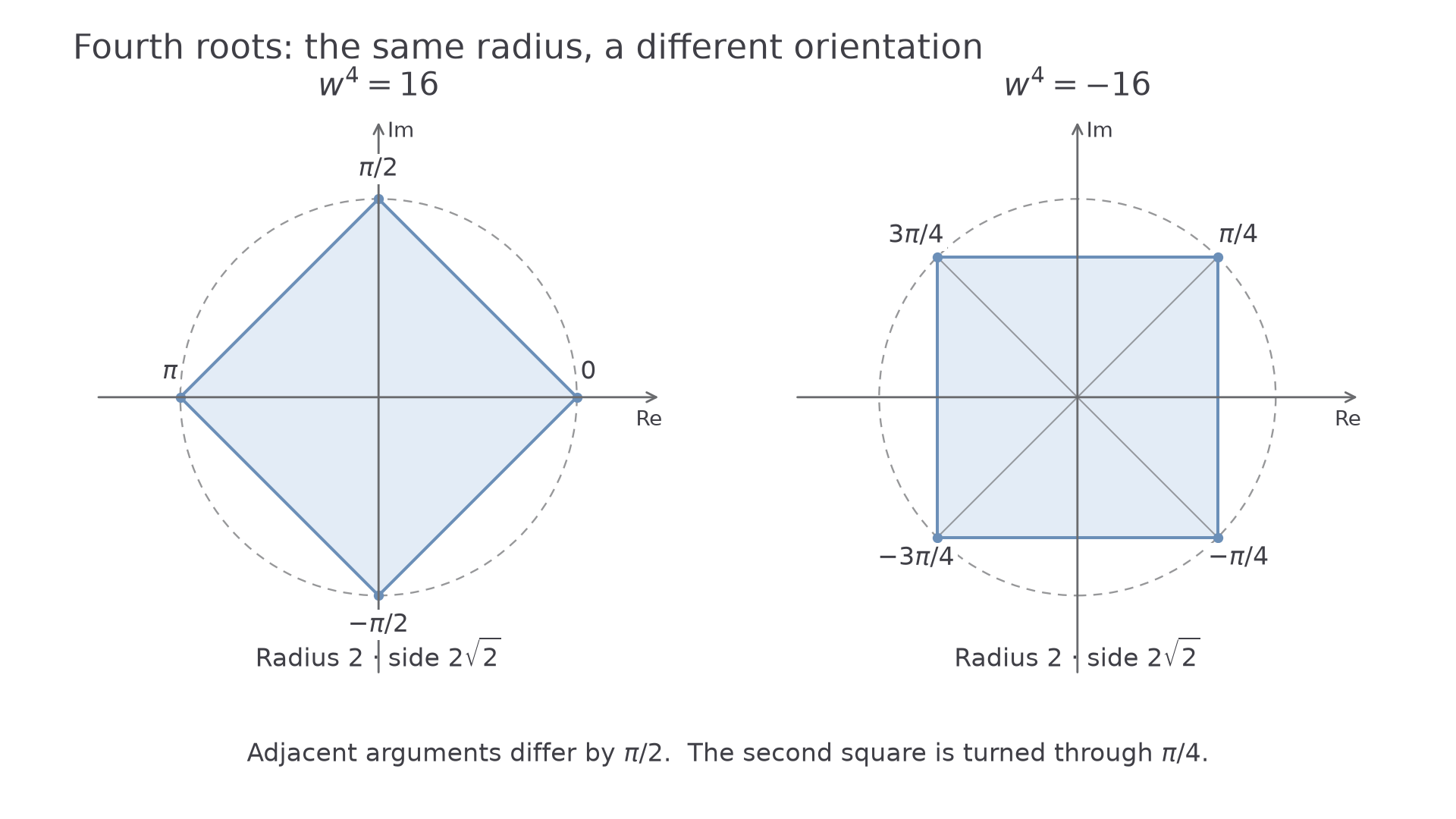
Every root has the same modulus , and successive roots differ in argument by . Thus, for , they form a regular -gon centred at the origin. For , the two roots are opposite ends of a diameter; for , there is one point.
The full angle list is useful even if a question asks only for a diagram. It fixes the polygon’s orientation. Changing the target argument by rotates its root polygon by , while leaving the radius unchanged.
For a principal-argument list in , first construct all roots, then subtract from angles greater than . Do not replace by in this interval.
Worked example 3: a square on the axes
Question. Find the four roots of , state their principal arguments, and find the side length of their square.
Plan. Use radius and angle spacing , then calculate the distance between adjacent roots.
Answer. The roots are , with principal arguments . Their square has side .
Check. Each fourth power is . The square’s diagonal is the diameter , and Pythagoras gives side , confirming the distance calculation.
Change only the target’s argument, from zero to . The square rotates through .
Worked example 4: the rotated square
Question. Find the four roots of , state their principal arguments, and find the side length of their square.
Plan. Keep radius , start at angle , and add three times.
The first two roots differ by , whose modulus is .
Answer. The four Cartesian values above have principal arguments . The side length remains .
Check. Squaring the first root gives , whose square is . Rotating the polygon preserves its diagonal and therefore its side length.
[DIAGRAM: asset_name: Fourth roots before and after a rotation; asset_slug: aqa7367-fourth-root-squares; caption: Changing the target from 16 to minus 16 rotates the root square through pi over four; description: Two equal-scale Argand panels show the roots of w to the fourth equals 16 and w to the fourth equals minus 16. Both circles have radius 2. The first square has vertices 2, 2i, minus 2 and minus 2i. The second has vertices with coordinates plus or minus root two in each direction. Every root is labelled by its argument, including negative principal arguments below the real axis. The annotation states that adjacent arguments differ by pi over two and both side lengths are two root two.]
The opening cube equation has the same geometry with three rather than four roots: gives an equilateral triangle of radius , with one vertex at . Its other two vertices are the non-real answers that a real-only search misses.
Watch out
The root angles are spaced by , not by . Also, equal spacing does not mean that one root must lie on the positive real axis; the target’s argument fixes the starting angle.
Change the modulus while keeping the rotated-square structure.
Quick Recap
- For a nonzero target, take its positive real modulus root and divide every full-turn argument alternative by .
- Values give exactly distinct roots.
- Root arguments differ by ; for , the roots form a regular polygon centred at zero.
- Zero has only one distinct nth root, zero, even though its polynomial multiplicity is .
Three numbers cube to : and . They are the vertices of an equilateral triangle in the Argand diagram.