MC4 - Hooke’s law
Pull an elastic string further and it pulls back harder. MC4 describes this response using stiffness or modulus of elasticity. You will measure extension from natural length, calculate elastic forces and distinguish a slack string from a compressed spring.
Elastic restoring forces
An elastic string has natural length and modulus of elasticity . What tension does it exert when its length is , and could it push if shortened below ? We will build a force model that answers both questions.
Imagine a light spring attached to a wall. At its natural length it is neither stretched nor compressed. Stretch it by : a spring with stiffness pulls back with . Double that extension and its force doubles, within the range where the model applies.
Extension and stiffness
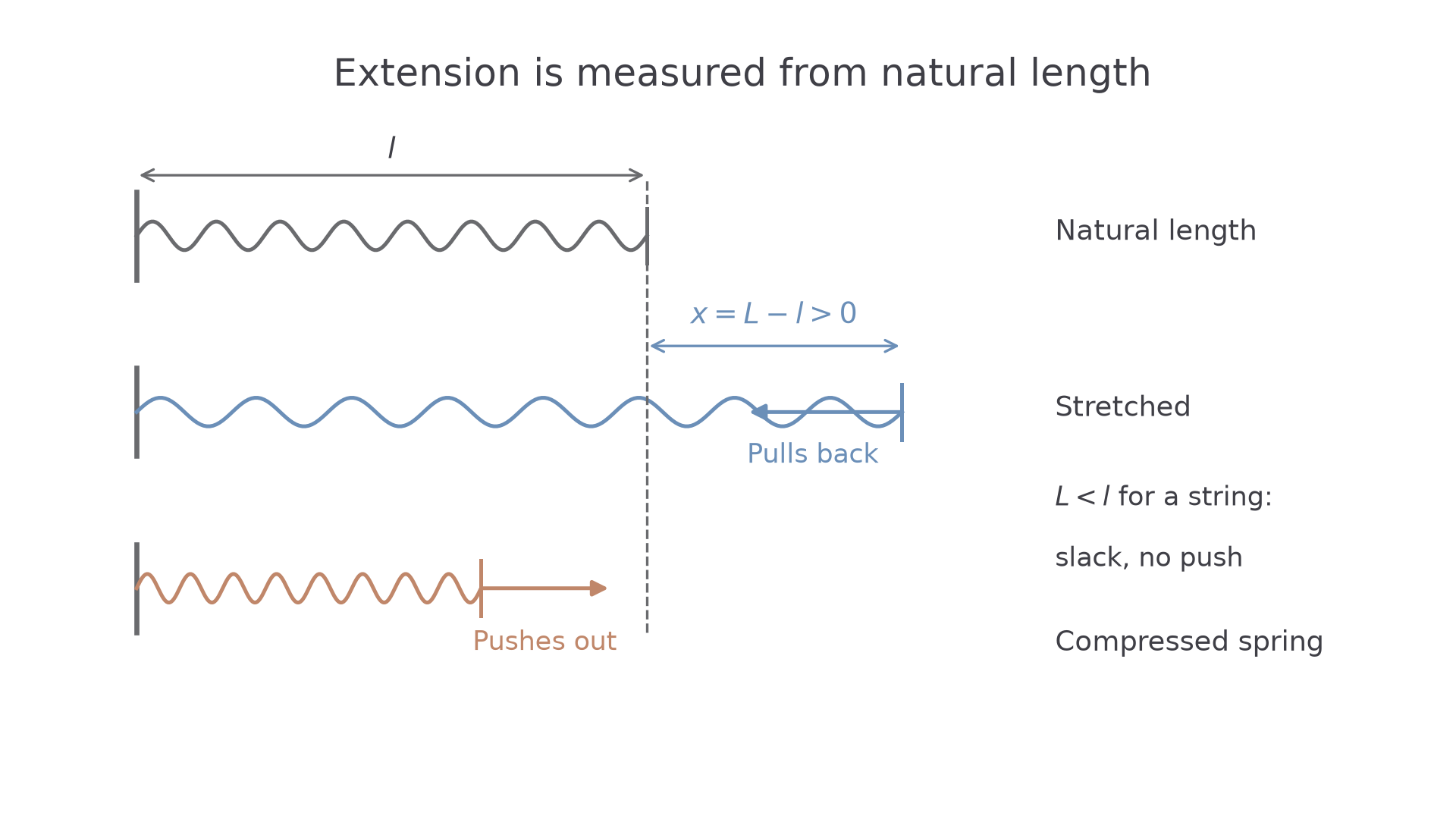
The extension, , is the increase from natural length: , where is current length and is natural length. The stiffness, , is the force per unit extension in the linear elastic model. Its SI unit is .
A stretched spring pulls its ends towards each other. A stretched elastic string also pulls: its force is called tension. “Light” means that we neglect the spring's or string's mass; a light string has the same tension throughout in this model.
Hooke’s law
For an ideal elastic spring or a taut elastic string obeying Hooke’s law,
Here is the magnitude of the restoring force. State its direction separately. A real material follows this linear law only within its proportional range.
Not in the formula booklet: learn this law.
The force acts to reduce the extension; it does not point along the direction in which you originally pulled.
Worked example 1: a small extension
Question. A light spring has stiffness . Find the force it exerts on a particle when stretched by .
Plan. Use Hooke’s law for the magnitude and the restoring behaviour for the direction.
Answer. , towards the spring's fixed end.
Check. , the stated stiffness.
Change only the extension. This shows the proportional relationship without changing the spring.
Worked example 2: twice the extension
Question. The same spring is stretched by . Find its force on the particle.
Plan. Keep fixed and substitute the new extension.
Answer. , towards the fixed end.
Check. The force ratio equals the extension ratio , as linearity requires.
A straight force-extension graph through the origin therefore has gradient . A stiffer spring needs more force for the same extension.
Watch out
Wrong: “the spring is long, so ”. Hooke’s law uses extension, not total length. Subtract the natural length first, and convert centimetres to metres when is in .
Use the stated extension directly in this check.
Stiffness and modulus of elasticity
Two pieces of elastic material can have the same modulus but different stiffnesses. Their natural lengths matter: the same extra is a larger fractional stretch for a short string than for a long one.
Modulus of elasticity
For the ideal elastic string model, the modulus of elasticity, , is the constant multiplying fractional extension . It is measured in newtons. It is distinct from stiffness, which is measured in newtons per metre.
For example, a string with has tension when extended by one quarter of its natural length. The fraction is dimensionless.
Modulus form of Hooke’s law
For a taut elastic string of natural length , extension and modulus ,
If , the model gives : the total length is then . This is a mathematical interpretation of the parameter, not a promise that every real material remains linear at that stretch.
Not in the formula booklet: learn these relations.
Dividing the modulus by natural length converts newtons into newtons per metre. Merely renaming as loses that length factor.
Worked example 3: a shorter string
Question. A light elastic string has natural length , modulus and current length . Find its tension.
Plan. Find the extension, then multiply its fraction of natural length by the modulus.
Answer. .
Check. Its stiffness is , so .
Keep the modulus and the extension fixed, but double the natural length. The fractional stretch halves.
Worked example 4: a longer string
Question. Another light elastic string has modulus and natural length . It is extended by . Find its tension.
Plan. Use the longer natural length in the denominator.
Answer. .
Check. Directly, . Doubling at fixed halves .
The opening string has . Its extension therefore gives tension .
Watch out
Wrong: when the supplied quantity is a modulus in newtons. Correct: . Inspect the units and parameter name before choosing the form.
Apply the modulus form to a new string.
Finding an extended length
An elastic force often has to be combined with Newton’s laws. A particle hanging at rest has zero resultant force, so its upward tension equals its downward weight. Hooke’s law then turns the required tension into an extension; adding the natural length gives the final length.
[DIAGRAM: asset_name: Extension and compression measured from natural length; asset_slug: aqa7367-elastic-extension; caption: A stretched spring pulls back; a compressed spring pushes out; a string shorter than its natural length is slack; description: Three horizontal elastic models share a fixed left end and a dashed reference at the natural endpoint. Natural length l is marked on the top model. The stretched model extends beyond the reference by x equals L minus l and pulls left. The compressed spring ends before the reference and pushes right. A note distinguishes a slack string from a compressed spring.]
Continue this lesson.
You’re previewing NovaLearn without an account. Create a free account to read the rest.
Create free account