E1, E9 - Improper integrals
An infinite interval can enclose a finite area, while a finite interval can give an infinite integral. You will replace troublesome endpoints by limits, decide whether those limits exist, and use exponential and logarithmic limits to finish exact evaluations.
Where an integral becomes improper
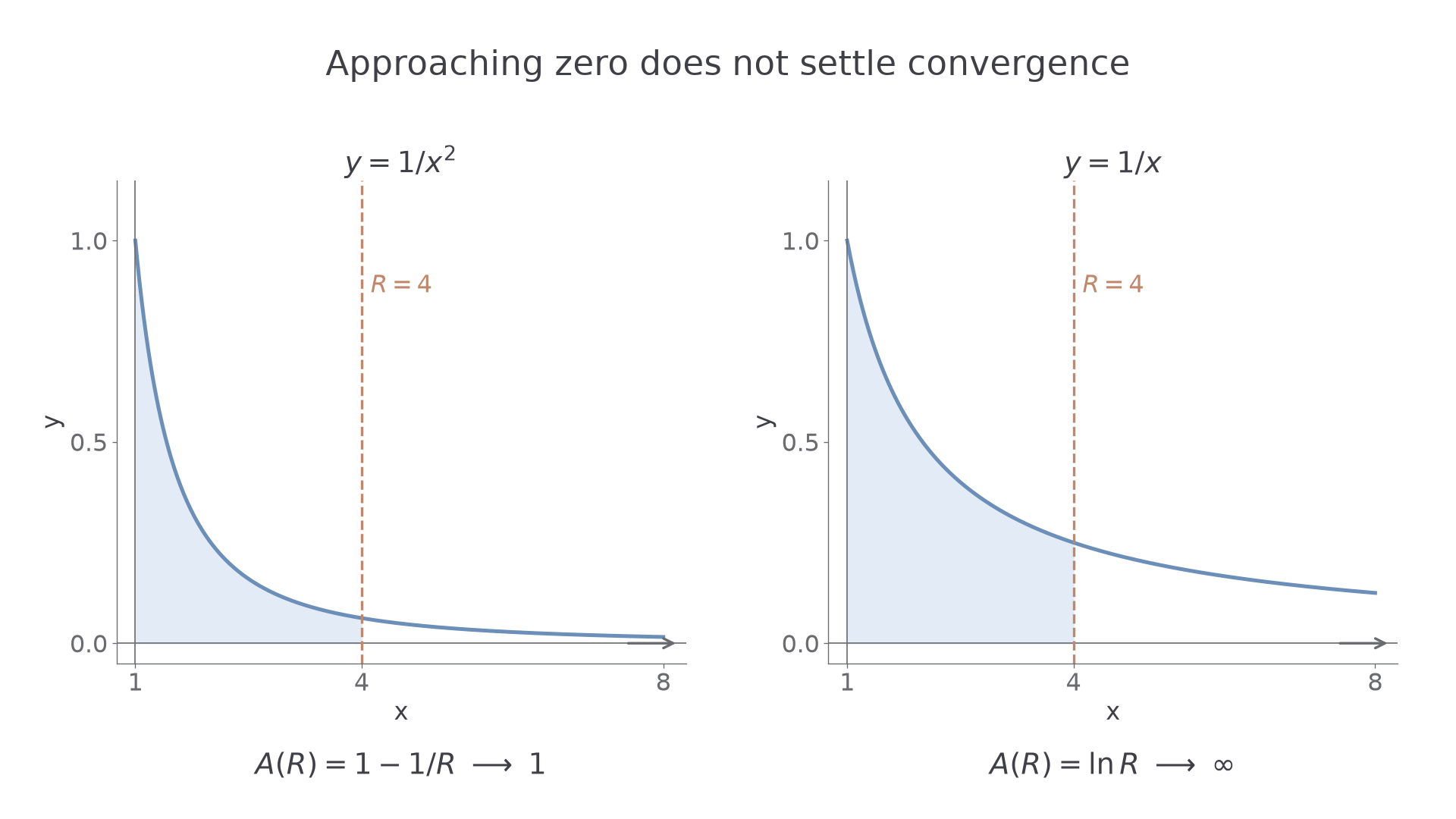
Can the area under , from onwards, be finite even though the graph continues for ever? Up to , ordinary integration gives . Extending the interval adds positive area, but this total never reaches 1. The question is about the limit of the total, not the length of the interval.
[DIAGRAM: asset_name: Two infinite tails with different totals; asset_slug: aqa7367-improper-tails; caption: Both curves approach zero, but their accumulated areas behave differently; description: Side-by-side graphs of y equals one over x squared and y equals one over x for x at least one. Shading extends from one to a marked R equals four. The first panel states area to R equals one minus one over R, tending to one. The second states area to R equals ln R, growing without bound. Arrows indicate that both intervals continue to the right.]
Improper integral
An integral is improper when its interval is unbounded, or its integrand is undefined or unbounded at a point of the integration interval, including an endpoint. Its value is defined using limits of ordinary integrals on intervals avoiding the difficulty.
For , infinity is the difficulty; it is not a real number to substitute into an antiderivative. In , the interval is finite but the integrand is undefined at zero. In , zero lies inside the interval: there are two sides to examine.
Undefined does not automatically mean divergent. Conversely, a graph approaching zero does not automatically give a finite integral: approaches zero, yet its accumulated area grows without bound. The distinction is how much area remains as the interval grows or approaches a singularity.
Key idea
Locate every difficulty before integrating. An infinite endpoint needs a limit; an interior singularity needs two separate one-sided limits.
Identify the type before doing any calculation.
Limits at every troublesome point
Replace a troublesome endpoint with a variable that stays inside the domain, integrate, then take the indicated one-sided limit. The limit notation records which ordinary areas are being accumulated.
Defining the limits
For an infinite upper endpoint,
when this limit is finite. At a singular lower endpoint, use . At an interior singularity , define the integral as
only if both limits are finite. These definitions are not in the formula booklet: learn them.
For two infinite endpoints, choose any finite ordinary point and evaluate and separately. Both must converge. For example, splits at zero; the arctangent gives from each tail, hence . A common cutoff on both ends is not the definition.
Worked example 1: an endpoint singularity
Question. Evaluate , showing the limit.
Plan. Start at , where the integrand is defined, then approach zero from above.
Answer. The integral converges to .
Check. Put with . Then ; integrating from to 1 independently gives the same finite limit.
Keep the same reciprocal-square-root behaviour, but move the singularity into the interval. Both sides now contribute.
Worked example 2: the singularity is inside
Question. Evaluate .
Plan. Split at 1 and evaluate the two sides independently.
Let and separately. Each limit is 2.
Answer. The integral converges to .
Check. On either side, distance from 1 runs from 0 to 1. Each piece is the integral in Worked example 1, so the total is twice 2.
Cancellation can conceal divergence. For on ,
The two limits are not finite. Choosing would make the truncated sum zero, but that special symmetric cancellation does not give the improper integral a value. Similarly, two divergent infinite tails cannot rescue one another.
Watch out
Wrong: . The antiderivative crosses a singularity. Split at zero; the integral diverges.
Use independent one-sided limits in the new interval.
Continue this lesson.
You’re previewing NovaLearn without an account. Create a free account to read the rest.
Create free account