ME2 - Composite bodies
Replace each simple component of a body by its mass at its own centre, then combine those masses. You will handle joined pieces, removed material and different densities without confusing length, area and volume weights.
Combine uniform components
Can a uniform L-shaped sheet have its centre of mass at the centre of its bounding square? Consider a 6 by 2 rectangle with a 2 by 4 rectangle attached above its left end. The missing upper-right material makes the answer doubtful.
A lamina is an ideal thin sheet whose mass is distributed over an area. For a uniform lamina its mass per unit area, , is constant, so . The centre of a uniform rectangle is its geometric centre: equal pieces reflect across both midlines.
For any component, the sum of all its particle first moments equals its mass times its own centre coordinate. Therefore replacing that whole component by a particle at its centre leaves the body's total mass and first moments unchanged. Components must not overlap, unless their overlap is deliberately subtracted.
Combining components
For components with masses and centres ,
where . For laminas with the same constant area density, a common cancels, so areas may replace masses.
Not in the formula booklet: learn it.
[DIAGRAM: asset_name: Splitting an L-shaped lamina; asset_slug: aqa7367-composite-lamina; caption: Two non-overlapping rectangles replace the L-shape by two area-weighted centres; description: An L-shaped lamina is the union of the rectangle zero to six in x and zero to two in y, and the rectangle zero to two in x and two to six in y. Their centres are marked at (3,1) and (1,4), with areas twelve and eight. The combined centre at (2.2,2.2) lies in the empty notch, outside the lamina.]
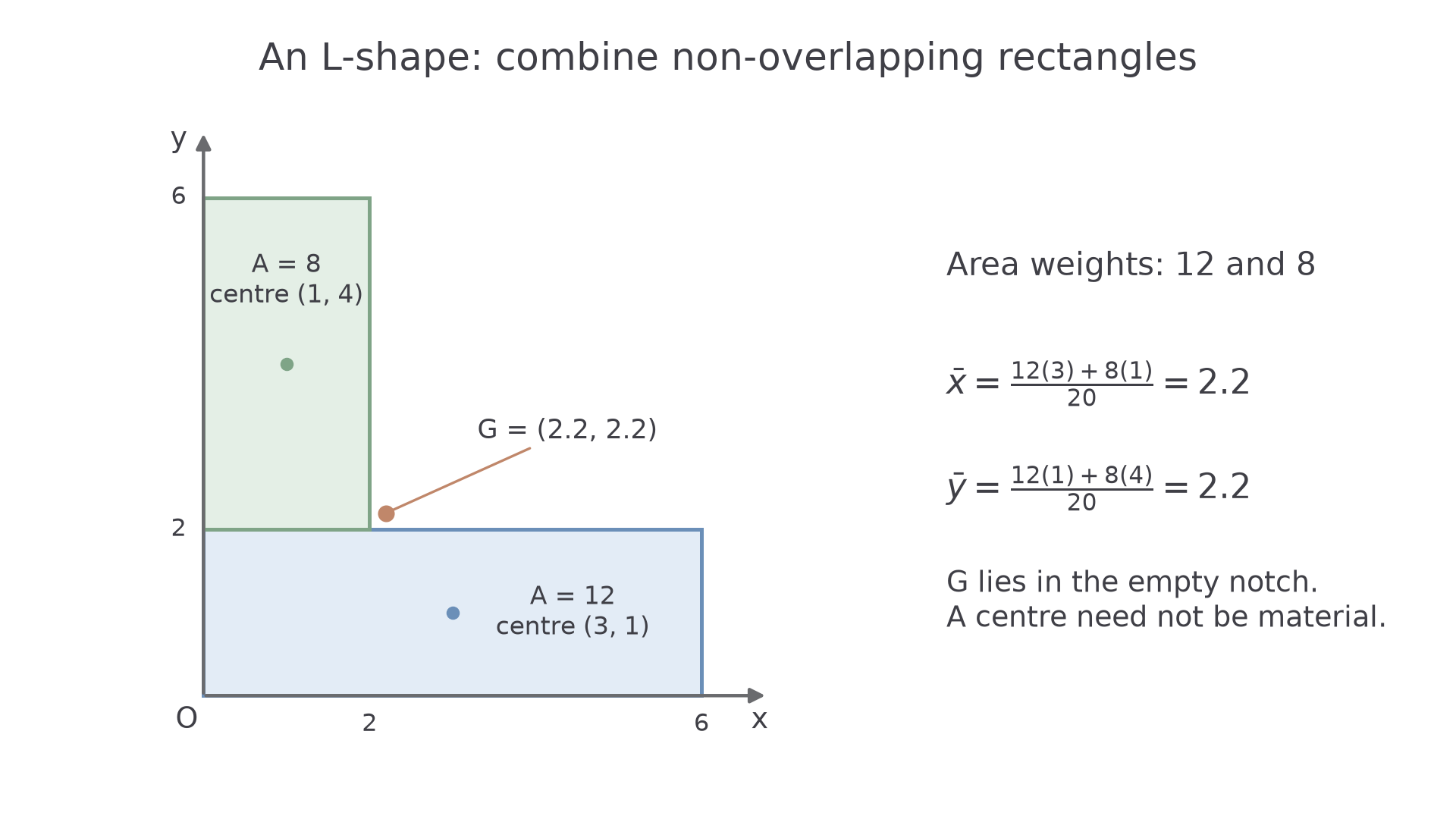
Worked example 1: an L-shaped sheet
Question. A uniform lamina consists of and , with lengths in centimetres. Find its centre.
Plan. Use the areas and centres of the two non-overlapping rectangles.
A common area density cancels from each ratio.
Answer. cm. It lies in the notch, where there is no sheet.
Check. Reflection in leaves the L-shape unchanged, so equal coordinates are required. About , area moments are .
A centre outside the material is perfectly possible: it is a weighted position, not a requirement that material be present there. Now move the upper rectangle from the left end to the right end, keeping both areas fixed.
Worked example 2: reflecting the upper component
Question. Replace the upper rectangle by , leaving the base rectangle unchanged. Find the centre of the new uniform lamina.
Plan. Change only the upper rectangle's horizontal centre from 1 to 5.
The vertical distribution is unchanged, so its coordinate is unchanged.
Answer. cm.
Check. The new shape is the reflection of the first in . Its centre must be .
Choose a split that gives familiar centres and simple weights.
Watch out
Wrong: average the two rectangle centres equally. Their areas are unequal. Correct: use , not , for the first horizontal moment.
Try a new two-rectangle shape.
Holes as removed mass
Cutting out material removes both mass and first moment. You can calculate with the complete original body and subtract the missing piece; the hole is a bookkeeping device with a negative weight in the sum, not a physical negative mass.
If the original mass is and the removed mass is , the remaining first moment is and remaining mass is . Use the same subtraction for every coordinate. A centred circular hole in a uniform circular disc leaves the centre at the common centre, inside empty space.
Worked example 3: removing material on the right
Question. From a uniform rectangular lamina , remove . Find the remaining centre. Lengths are in cm.
Plan. Subtract a square of area 4 and centre from area 24 centred at .
The same area density applies to the original rectangle and the removed material.
Answer. cm, shifted left from .
Check. Adding the hole back recovers the original first moment: . Horizontal symmetry gives .
Reflect the hole to the left while keeping its size and height. Removing left-hand mass must now shift the centre to the right.
Worked example 4: moving the same hole
Question. Instead remove from the same original rectangle. Find the remaining centre.
Plan. Keep the masses unchanged but move the removed centre to .
Subtraction is necessary in both numerator and denominator.
Answer. cm.
Check. Reflection in takes the first remaining body to this one and takes to .
Continue this lesson.
You’re previewing NovaLearn without an account. Create a free account to read the rest.
Create free account