F1 - Equations of lines in space
How can one equation describe a line when every point needs three coordinates? F1 uses a starting point, a direction and one shared parameter to do exactly that. You will connect vector and Cartesian equations, handle zero direction components and decide whether two equations describe the same line or distinct parallel lines.
Vector and Cartesian line forms
How can one equation describe every point on a line in space? Start at . Moving by , twice that displacement or a negative multiple keeps you on one straight line. The multiplier changes how far you move; the component proportions keep the direction fixed.
Recall that a position vector locates a point from the origin. We write vectors in bold, such as ; an underlined letter is another common handwritten notation. The coordinate unit vectors point along the positive perpendicular axes, so
The directed displacement points from to . Its magnitude is the distance between them. For any , Pythagoras gives ; a plain may also denote this magnitude when stated. A unit vector in a nonzero direction is . A line needs a direction, but it does not need a unit direction vector.
Vector equation of a line
The line through the point with position vector , in nonzero direction , is
Here is the position vector of a variable point. One value of must apply to all three components.
In components, this means , , . If all three direction components are nonzero, solve each equation for the same .
Cartesian equation of a line
For ,
In the formula booklet. A zero direction component needs a fixed-coordinate equation instead; you will handle that next.
The fractions are equal because they all recover the same parameter, not because the three coordinates are equal.
[DIAGRAM: asset_name: One shared parameter describes a line; asset_slug: aqa7367-line-parameter; caption: Starting at A and moving by a shared multiple of d reaches every point of the line; description: An exact direction diagram in the plane containing the origin O and the line. A blue position vector a runs from O to A, a clay direction vector d runs from A to B, and a lavender position vector r runs from O to B. The line extends through A and B in both directions. A is (1, minus 2, 3), B is (3, 1, minus 1), with t equal to zero and one respectively.]
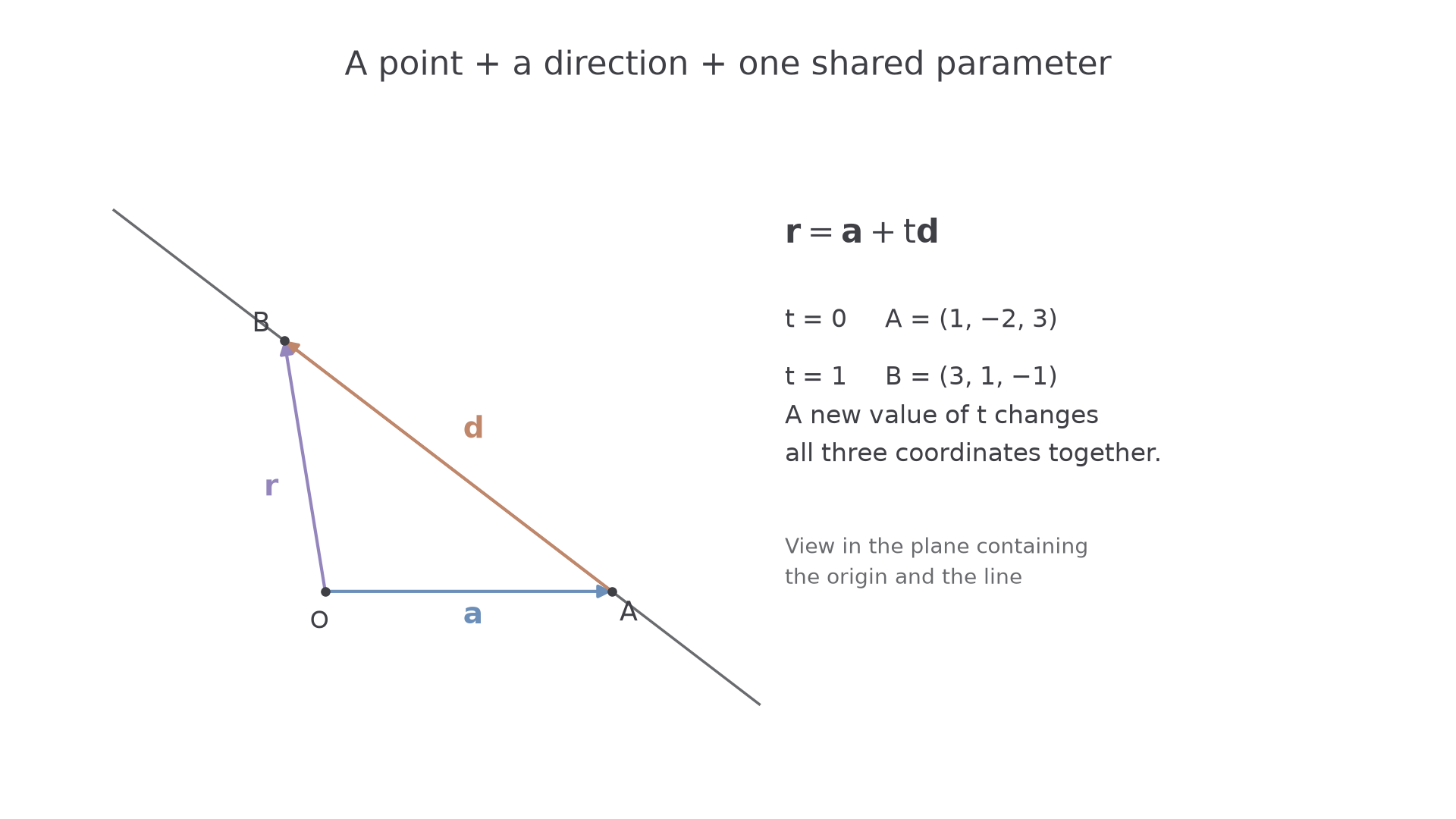
At , vector addition makes the triangle in the picture: .
Worked example 1: a line through two points
Question. Find vector and Cartesian equations of the line through and .
Plan. Use as a direction, then eliminate the parameter.
Answer. , , and
Check. Substituting into the three fractions gives . Substituting gives , so both given points satisfy the equation.
Change only the final coordinate of . The last direction component changes sign, and the Cartesian denominator must change with it.
Worked example 2: one coordinate changes the direction
Question. Find vector and Cartesian equations of the line through and .
Plan. Subtract the same starting point and use the new displacement.
Answer. The displayed vector equation, with , and the Cartesian equation .
Check. The midpoint of and is . It gives in every fraction, as a halfway point should.
The parameter is a real number, so negative values extend the line beyond the starting point in the opposite direction. Restricting it to in these examples would give only the segment between the named points.
Direction components including zero
A zero direction component means that coordinate stays fixed as the parameter changes. It does not make the line invalid. For example, changes and , but leaves unchanged.
Write the component equations first. Whenever a component of the direction is zero, retain its fixed-coordinate equation and form ratios only from nonzero components. Division by zero is never part of a Cartesian equation.
Continue this lesson.
You’re previewing NovaLearn without an account. Create a free account to read the rest.
Create free account