E5, E6 - Inverse trigonometric functions
An integral containing a square root can have an exact answer involving an angle. In E5 you will derive inverse trigonometric derivatives by undoing familiar functions. In E6 you will reverse those derivatives to integrate, keeping track of scales, branches and domains.
Deriving inverse trigonometric derivatives
Why is ? The integrand contains no angle, yet its antiderivative will be an inverse sine. Start with a simpler question: if , how quickly does change when changes?
For example, . Although also has sine , the inverse must return just one value. We restrict the original function to a branch on which every output occurs once.
Principal inverse trigonometric functions
The principal value is the angle returned by the chosen inverse branch. In radians, use these branches:
| Function | Input domain | Principal-value range |
|---|---|---|
Here the superscript means an inverse function. In contrast, .
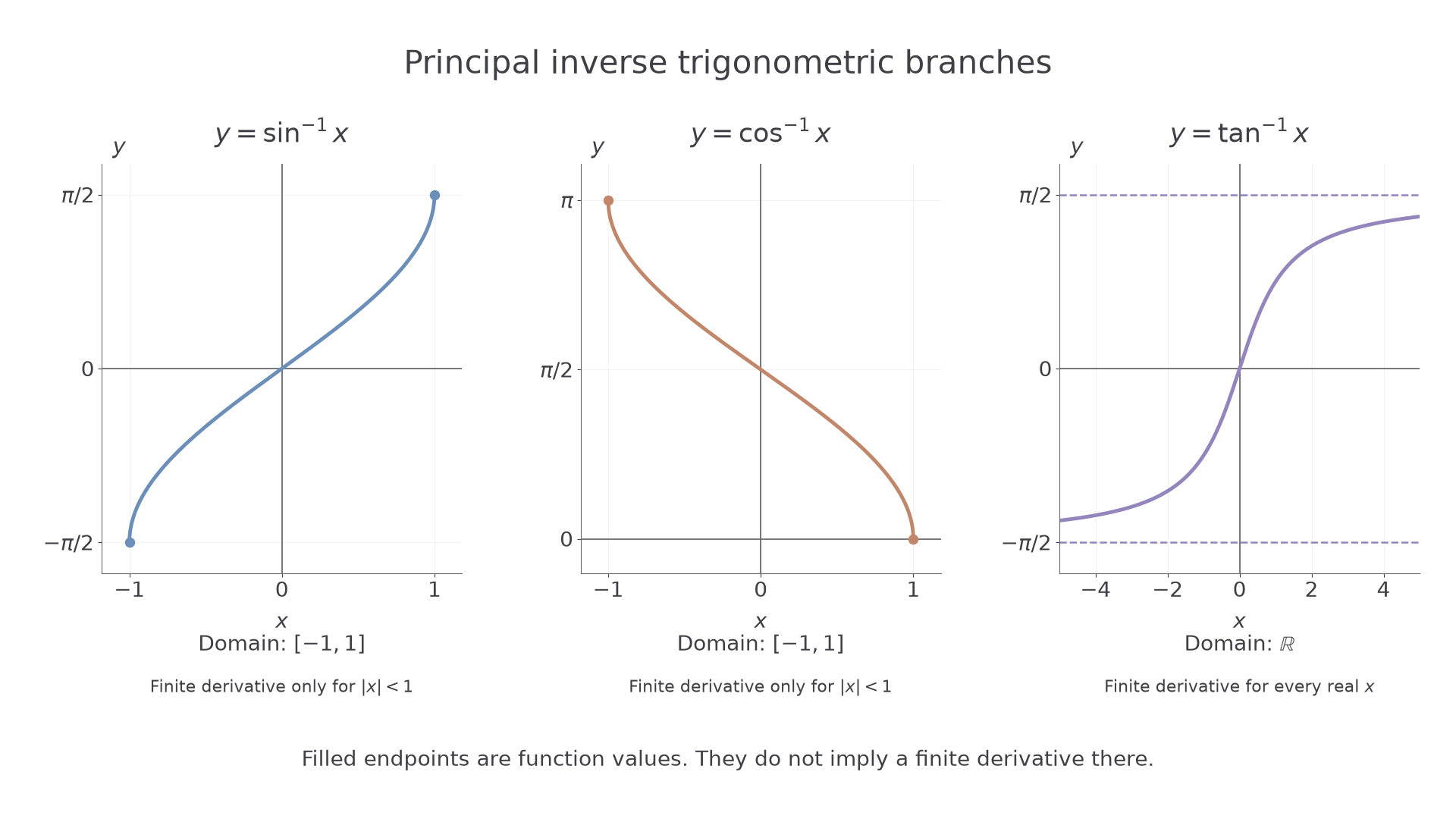
The graphs show why inverse sine increases, inverse cosine decreases, and neither has a finite derivative at its domain endpoints.
[DIAGRAM: asset_name: Principal inverse sine cosine and tangent; asset_slug: aqa7367-inverse-trig-branches; caption: Principal inverse sine increases, inverse cosine decreases, and inverse tangent approaches two horizontal asymptotes; description: Three coordinate panels show y equals inverse sine x on minus one to one with range minus pi over two to pi over two, y equals inverse cosine x on minus one to one with range zero to pi, and y equals inverse tangent x on the real line with dashed asymptotes y equals plus and minus pi over two. Filled endpoint dots mark the included endpoints of inverse sine and inverse cosine. The first two panels state that derivatives require absolute x less than one.]
Undo the function, then differentiate implicitly
For , write . Differentiating with respect to gives
Why the positive root? Inside the chosen sine branch, , so . At , ; division is impossible and there is no finite derivative.
For , gives . Since , , so . The minus sign agrees with the decreasing graph.
For , gives . Use to obtain , for every real .
Inverse sine, cosine and tangent derivatives
For a differentiable inner function ,
The three derivatives with are in the formula booklet, page 5. Apply the chain rule yourself for a composite function.
The other three inverse functions
Use , with range , and , with range . Both have domain . For cotangent choose range , so
These identities specify the branches being used. In particular, ; replacing it blindly by would lose this value and give the wrong branch when .
The chain rule now derives the remaining results. For example,
The absolute value appears because , including when . Applying the same chain rule to changes the sign; differentiating gives the cotangent result.
Inverse secant, cosecant and cotangent derivatives
For the branches just defined,
These three derivatives are not separately printed in the formula booklet: derive them from the supplied results and the branch identities.
Now practise the chain rule with one deliberate change between examples: inverse sine becomes inverse cosine, while the inner function stays the same.
Worked example 1: an inverse sine of a multiple
Question. Find the derivative of , stating where the formula applies.
Plan. Differentiate the outer inverse sine and multiply by the derivative of .
Answer. , for .
Check. Undo the inverse: gives . Substituting the proposed derivative and recovers 2.
Changing the outer function changes the sign, because cosine decreases on its principal branch.
Worked example 2: the corresponding inverse cosine
Question. Find the derivative of , stating where the formula applies.
Plan. Use the inverse cosine derivative with the same inner derivative as before.
Answer. , for .
Check. . The two proposed derivatives add to zero, as the derivative of this constant must.
The branch and the inner derivative both matter.
Watch out
Wrong: . It loses the negative sign, the inner derivative and the square of the whole input. Use .
Try a new inner multiple.
Continue this lesson.
You’re previewing NovaLearn without an account. Create a free account to read the rest.
Create free account