B5 - Modulus and argument
Can you locate a complex number using a distance and a direction instead of two coordinates? You will calculate its modulus and argument, handle the axes and zero carefully, and convert between Cartesian and modulus-argument forms. These descriptions prepare you to interpret multiplication geometrically.
Magnitude from Pythagoras
How far from the origin is ? Its horizontal and vertical displacements form the perpendicular sides of a right triangle, so its distance is .
Modulus
The modulus of , written , is its distance from the origin on an equal-scale Argand diagram:
It is nonnegative, and it is zero exactly when .
Coordinates can be negative; distances cannot. A point 3 units left and 4 up is also 5 units from the origin. Use the nonnegative square root, rather than .
Worked example 1: a familiar triangle
Question. Find .
Plan. Use Pythagoras on the real and imaginary coefficients.
Answer. .
Check. The conjugate product is .
Change only the sign of the real part. Squaring that coefficient removes its sign, so the distance should stay the same.
Worked example 2: a point to the left
Question. Find .
Plan. Square the signed coefficients, then take the nonnegative root.
Answer. .
Check. Reflection in the imaginary axis takes to and preserves distance from the origin, confirming Worked example 1's modulus.
The earlier conjugate identity therefore has a geometric meaning:
Modulus and conjugation
For every complex ,
The second equality follows because reflection in the real axis preserves distance. These identities are not separately supplied in the formula booklet: learn them.
For a real number, this agrees with ordinary absolute value: . For a purely imaginary number, too.
Quadrant-correct arguments in radians
A distance does not determine a point: many points are 5 units from the origin. You also need the direction of the arrow from the origin.
Argument
For , an argument is an angle from the positive real axis to the arrow representing . Anticlockwise angles are positive and clockwise angles negative. Angles differing by an integer multiple of describe the same direction.
The principal argument, written here, is the unique representative in
unless a question specifies another interval. Use radians.
A half-turn is . The abbreviation means radians; set your calculator to radians when evaluating these arguments.
For , , but the inverse tangent alone cannot distinguish opposite directions. For example, and both give . Locate the quadrant before choosing the angle.
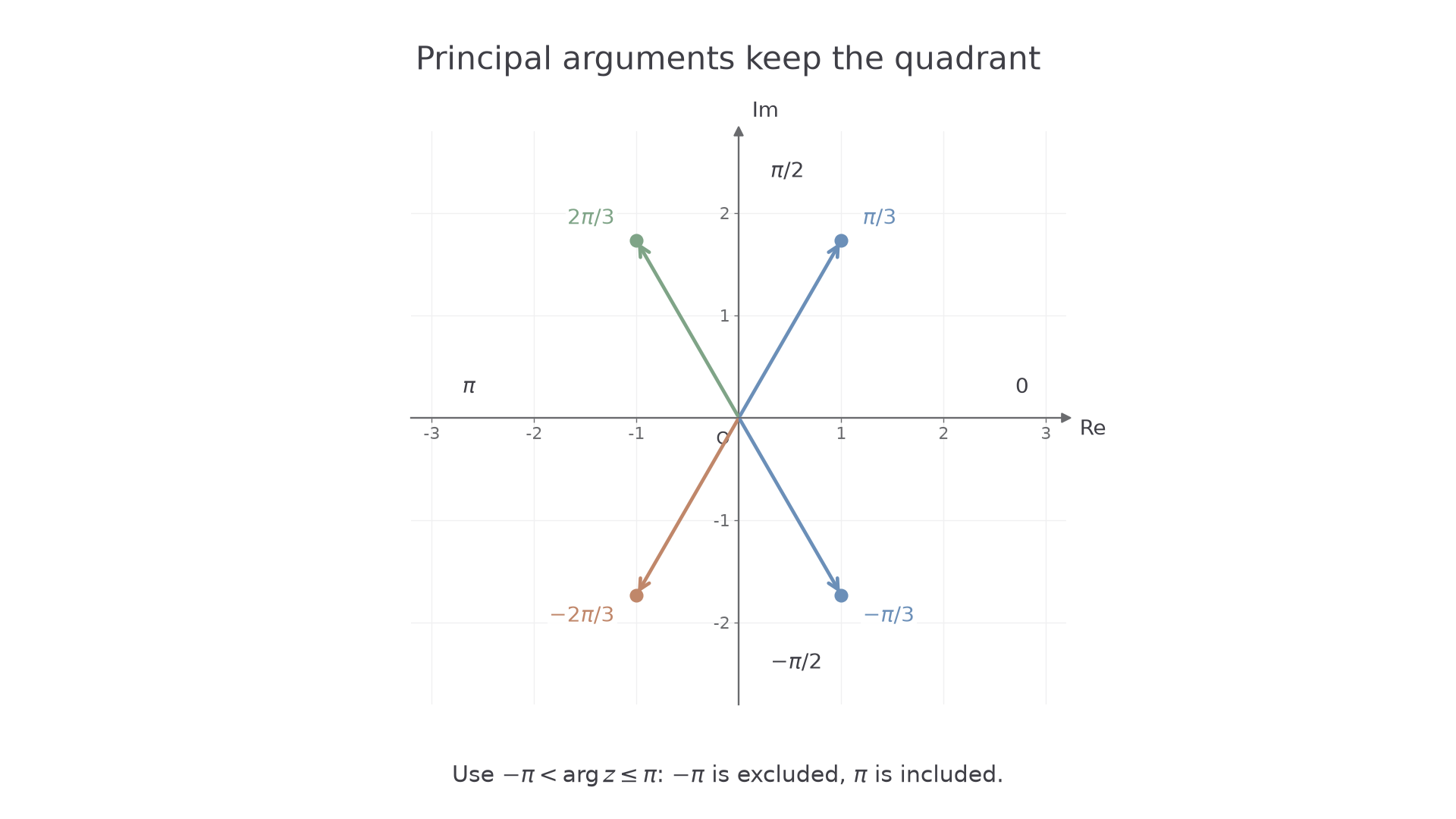
For a point off the axes, calculate the positive reference angle . The principal arguments are:
| Quadrant | Signs of | Principal argument |
|---|---|---|
| I | ||
| II | ||
| III | ||
| IV |
[DIAGRAM: asset_name: Quadrants and principal arguments; asset_slug: aqa7367-principal-arguments; caption: The quadrant fixes the argument and the negative real axis uses positive pi; description: An equal-scale Argand diagram shows four rays through (1,square root of 3), (minus 1,square root of 3), (minus 1,minus square root of 3), and (1,minus square root of 3), labelled pi over 3, 2 pi over 3, minus 2 pi over 3, and minus pi over 3. Axis directions are labelled 0, pi over 2, pi, and minus pi over 2. A note says minus pi is excluded and pi is included.]
Worked example 3: a quadrant I argument
Question. Find exactly.
Plan. Locate the point, then use its reference triangle.
Answer. .
Check. Its modulus is 2, and , . Both original coordinates are recovered.
Change only the real sign. The reference angle is unchanged, but the point moves into quadrant II.
Worked example 4: a quadrant II argument
Question. Find exactly.
Plan. Use because the point is above and to the left.
Answer. .
Check. With modulus 2, and . The calculator value would put the point in the wrong quadrant.
On the axes, use the direction directly: positive real gives 0, positive imaginary gives , negative imaginary gives , and negative real gives . The last uses the included endpoint: represents the same direction but is outside this principal interval.
Conjugation reverses the direction angle modulo . Usually , but there is a boundary exception: for a negative real number, both and have principal argument , rather than . Zero has no argument at all, as the next part explains.
Watch out
Wrong: . The point is in quadrant II, so the principal argument is . A ratio of coordinates loses quadrant information.
Try a point below the negative real axis.
Zero has no argument
The origin has a distance, zero, but no direction from itself. The arrow representing zero has zero length, so it cannot point at a particular angle.
For a nonzero number, dividing the coordinates by its positive modulus gives the direction components and . At zero these would require division by zero. The missing argument is a mathematical boundary, rather than a calculator setting you can fix.
You can write
for every real . That equality does not select any direction. Consequently is undefined, rather than zero or “all angles”. By contrast, : a positive real number has a nonzero arrow pointing right.
Key idea
Always separate the two statements: is defined; is undefined. Rules involving arguments require the relevant numbers to be nonzero.
Judge a conclusion that confuses a valid representation with a defined argument.
Cartesian and modulus-argument forms
A distance and direction locate a nonzero point by resolving its arrow horizontally and vertically. For instance, a length 4 at angle gives horizontal component 2 and vertical component .
Two descriptions of one complex number
For , let and let be an argument. Then
The expression on the right is modulus-argument form. These conversion rules are not separately supplied in the formula booklet: learn them.
The equations come from the right-triangle ratios, extended to all quadrants by the signed sine and cosine functions. Cartesian to modulus-argument means calculating and a quadrant-correct . The reverse means evaluating and .
Worked example 5: converting an upper point and back
Question. Write in modulus-argument form with a principal argument, then recover its Cartesian coordinates from that form.
Plan. Calculate the distance and direction, then resolve the resulting arrow.
Answer. ; converting back gives .
Check. The conjugate product is ; the recovered point has the required negative real and positive imaginary signs.
Change only the imaginary sign. Reflection preserves the modulus and reverses this non-boundary principal argument.
Worked example 6: converting the reflected point and back
Question. Write in modulus-argument form with a principal argument, then recover its Cartesian coordinates.
Plan. Keep the distance calculation, choose quadrant III, then resolve.
Answer. ; its coordinates are .
Check. This is the conjugate of Worked example 5's number: cosine is even and sine is odd, so the resolved imaginary component alone changes sign.
An angle outside the principal interval still gives a valid representation. For example, and have the same sine and cosine. Add or subtract when a principal argument is requested. Keep the radius nonnegative; a negative leading factor must be absorbed into a half-turn before it can be called a modulus.
Watch out
In , the factor multiplies both components. Writing generally gives a different number.
Start from a distance and direction this time.
Quick Recap
- is a nonnegative distance.
- Choose arguments from the quadrant and the requested interval, including its endpoint convention.
- Zero has modulus zero and no argument.
- Use and to convert back.
Yes: a positive distance and a direction locate any nonzero complex number. At zero, the distance remains meaningful but the direction disappears.