D16 - Transforming curves
Transform a curve by following its points, then use the inverse coordinate map to find its new equation. This method handles translations, stretches, reflections, rotations and enlargements, including combinations whose order matters.
Translations, stretches and reflections
If you translate a parabola and then rotate it, does reversing those two operations give the same curve? We will track its vertex and its whole equation to answer this precisely.
Use for an old point and for its image. Translating by gives . To obtain the image equation, substitute the inverse expressions into the old equation.
For example, translating by gives . Its centre is , confirming the signs.
| Transformation | Forward point map | Substitute into the old equation |
|---|---|---|
| Translation by | ||
| Stretch parallel to horizontal axis, factor | ||
| Stretch parallel to vertical axis, factor | ||
| Reflection in horizontal axis | ||
| Reflection in vertical axis | ||
| Reflection in | ||
| Reflection in |
These point and substitution rules are not separately tabulated in the formula booklet: learn their meaning. The booklet's general reflection matrix on page 7 can recover the reflection maps. A zero stretch factor collapses the plane onto a line, so it has no inverse; a negative factor combines a positive stretch with an axis reflection.
To see the stretch factors in a curve, stretch the same ellipse horizontally by . Substituting gives : its horizontal intercepts double. A vertical stretch by instead gives . The denominators acquire the square of the point scale factor.
Worked example 1: reflecting in the positive diagonal
Question. Find the image of under reflection in , and state its opening direction.
Plan. Swap the coordinates of every point; substitute the inverse swap into the old equation.
Answer. , a parabola opening upwards, with vertex .
Check. Old point becomes . It satisfies , confirming the image equation.
Change only the mirror line, to the negative diagonal. Both coordinates swap and change sign.
Worked example 2: reflecting in the negative diagonal
Question. Find the image of under reflection in , and state its opening direction.
Plan. Use , then solve for the old coordinates.
Answer. , a parabola opening downwards, with vertex .
Check. Old point becomes , and .
Reflecting the graph in gives its inverse relation. It represents an inverse function only if the original function is one-to-one on the domain being used. For example, the full relation has two heights for many inputs; it is useful to transform it as an equation without forcing function notation onto it.
Watch out
Wrong: translating right by means replace by . That is the forward movement written in the wrong place. A new point at came from , so use the inverse in the old equation.
Apply the negative-diagonal reflection to another curve.
Ordered combinations, rotations and enlargements
For a combination, build one forward point map in the stated order, then invert that whole map. This avoids guessing how several replacements should be ordered inside the equation.
An anticlockwise rotation about the origin through maps a point by
This rotation matrix is supplied on page 7 of the formula booklet. A quarter-turn anticlockwise gives ; clockwise gives . The inverse rotation uses .
An enlargement with centre and scale factor maps
The vector from the centre is multiplied by . For , direction is preserved; for , it reverses as well. This enlargement rule is not supplied in the formula booklet. At , all points collapse to the centre and the inverse method fails. A rotation about a non-origin centre can similarly be performed by subtracting the centre, rotating and adding the centre back.
If transformations are called and , means apply first, then , just as . This does not generally equal . All mapped points, open endpoints and excluded points follow the same ordered map.
Worked example 3: translate, rotate, enlarge
Question. The curve is translated by , then rotated anticlockwise about the origin, then enlarged by factor about the origin. Find its image equation and vertex.
Plan. Compose the three forward point maps, solve for , and substitute into the old equation.
Hence .
Answer. , with vertex , opening upwards.
Check. Old vertex follows , then , then . Old point maps to , satisfying .
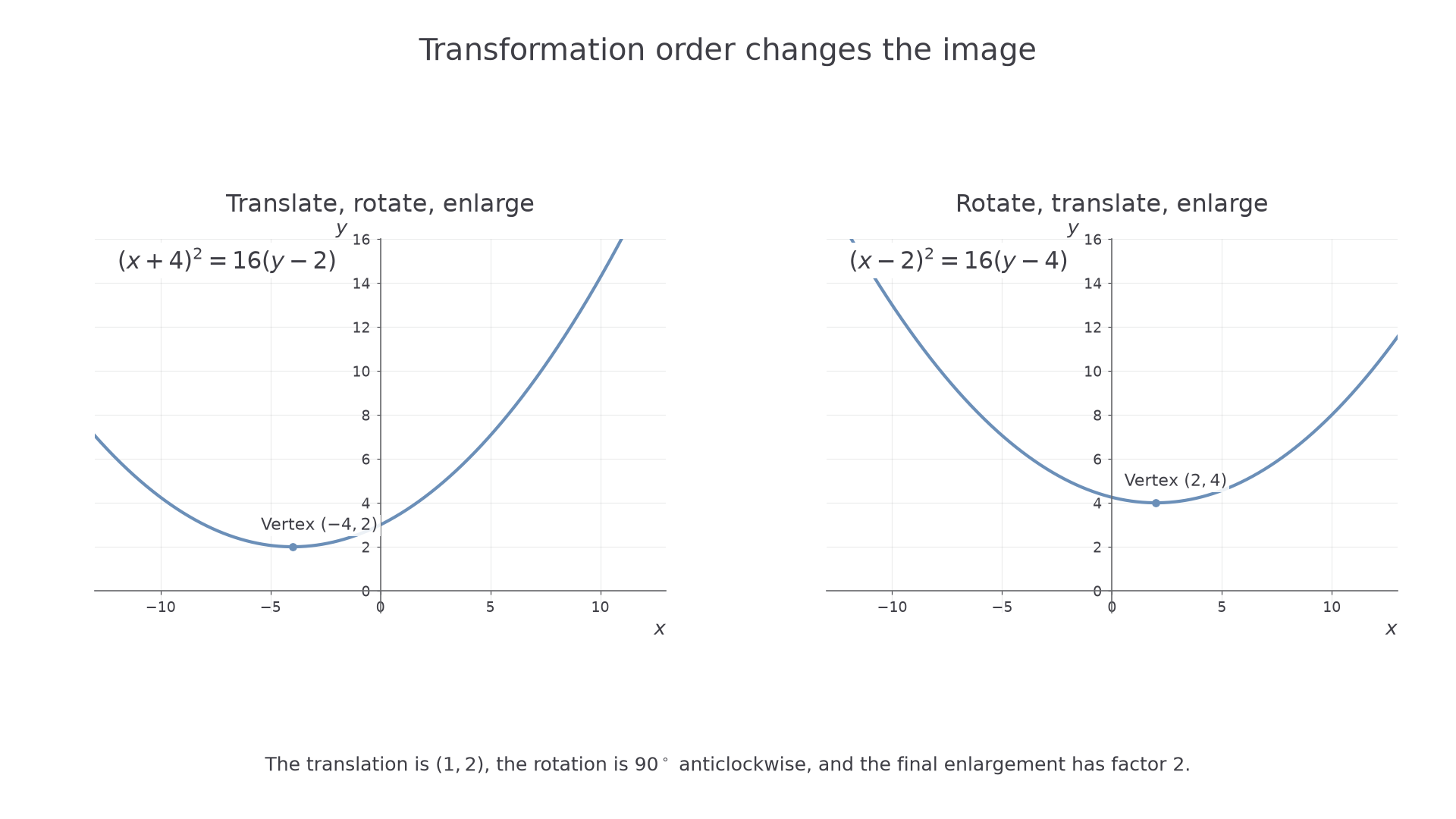
Swap only the first two operations, keeping the same final enlargement. The point map will expose exactly where order changes the result.
Worked example 4: rotate before translating
Question. The same curve is first rotated anticlockwise about the origin, then translated by , then enlarged by factor about the origin. Find its image equation and vertex.
Plan. Follow the revised order, then invert the final coordinate map.
Hence .
Answer. , with vertex , opening upwards.
Check. The old vertex follows , then , then . Old point maps to , satisfying .
Before the final enlargement, the vertices were already different: and . This answers the opening question: rotating a translation vector changes its direction, whereas translating after a rotation uses the vector as originally stated.
[DIAGRAM: asset_name: Order changes the image of a parabola; asset_slug: aqa7367-curve-order; caption: Swapping translation and rotation changes the final vertex even though the final enlargement is identical; description: Two equal-scale coordinate panels show the images of v squared equals eight u. Translate then rotate then enlarge gives (x plus four) squared equals sixteen times (y minus two), with vertex (minus four,two). Rotate then translate then enlarge gives (x minus two) squared equals sixteen times (y minus four), with vertex (two,four). Both open upwards and have identical shape.]
For a centre other than the origin, use the centre explicitly. For example, enlarging a point by about gives , not . Inverting gives , ready to substitute into any old curve equation.
Watch out
Wrong: treat a translation as a matrix acting on a two-coordinate vector, or swap two operations without checking. A translation adds a vector. Compose the actual point maps in the stated order; inverse operations then undo that order in reverse.
Use the same three-stage method with new data.
Quick Recap
- Track old points forward, but substitute the inverse coordinate map into the old equation.
- Axis stretches scale the relevant coordinate; diagonal reflections swap coordinates, with signs for .
- Use the stated centres for rotations and enlargements, and nonzero scale factors for inverse maps.
- Compose transformations in the stated order and check the result with a vertex and another point.
Reversing translation and rotation generally changes the curve. Here their vertices before the final enlargement are and ; afterwards they are and .