B9 - Exponential form
An exponential can describe a direction as well as a real growth factor. You will connect to the unit circle, convert between Cartesian, trigonometric and exponential forms, and use index laws to combine complex numbers. You will also see why zero needs special care.
Euler’s definition
How can an exponential represent ? On the unit circle, the point at angle has coordinates , so its complex number is .
We give the unit-circle number at angle the compact name . Here is a real angle in radians. The imaginary exponent describes a rotation; it is not a positive real exponential value.
Euler’s definition
For real ,
The notation means the same thing. This definition is not separately printed in the formula booklet: learn it.
For example, , and . The last equality reflects a full turn, not a failure of exponent notation.
[DIAGRAM: asset_name: Exponentials around the unit circle; asset_slug: aqa7367-exponential-circle; caption: The number e to the i theta lies on the unit circle at angle theta; description: An equal-scale Argand diagram shows the unit circle, the points 1, i, minus 1 and minus i, and a blue radius to e to the i pi over 3 at coordinates one half and root three over two. A dashed horizontal and vertical projection shows cosine pi over three and sine pi over three. A right-hand panel gives Euler’s definition, modulus one, and the equality of angles differing by a full turn.]
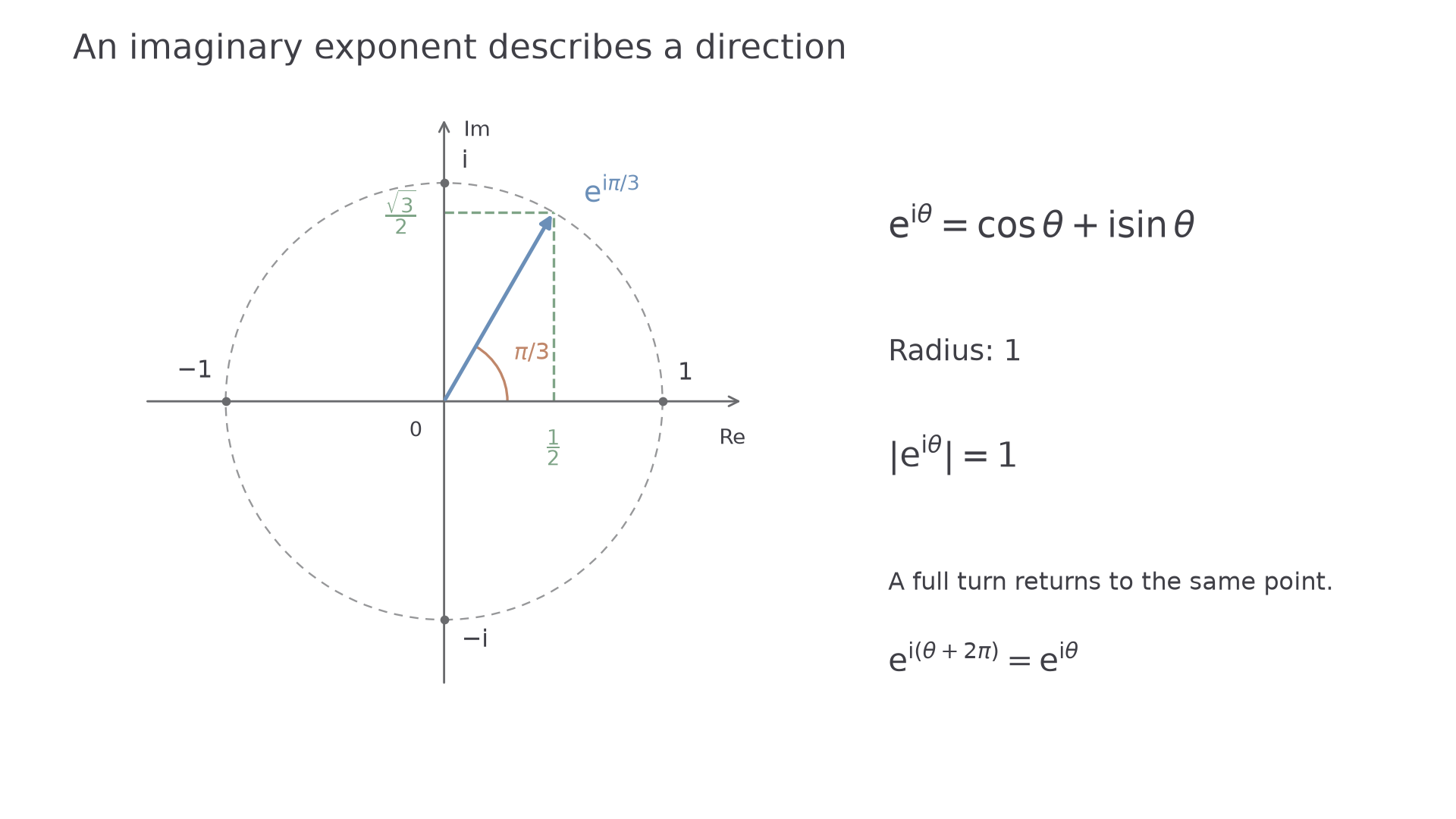
The coordinates show two important facts:
Different angles can therefore name the same number. In particular, . If you use the principal interval , the principal argument of is .
Key idea
is the unit-circle point with angle . Its modulus is always one, and a full turn leaves it unchanged.
Use the unit circle to read a new angle.
Converting forms and combining arguments
A positive factor in front of the exponential gives the distance from the origin. Thus and both mean .
For , find , then choose the correct quadrant for an argument . The three forms are
The familiar polar product rule now looks like an index law: multiplying adds angles. Dividing must undo that addition, so it subtracts the denominator’s angle.
Exponential product and quotient
For and real ,
The denominator must be nonzero. These index laws are not separately supplied in the formula booklet: learn them.
Why do the laws work? Expanding gives the cosine and sine addition formulae. The exponential notation packages that existing result.
Worked example 1: convert, then multiply
Question. Let and . Express in exponential form and in Cartesian form.
Plan. Find the modulus and first-quadrant argument of , add arguments in the product, then use exact trigonometric values.
Answer. and .
Check. Convert separately: . Direct multiplication gives .
Keep both numbers fixed and change multiplication to division. Only the radius operation and angle operation change.
Worked example 2: convert, then divide
Question. For the same and , express in exponential and Cartesian forms.
Plan. Divide the radii and subtract the denominator’s argument, then evaluate sine and cosine.
Answer. .
Check. Multiply the answer by : the real part is , and the imaginary part is . This recovers .
Reduce an angle by a multiple of only when a particular argument interval is required. The number itself is already correct before that reduction.
Watch out
Wrong: . A quotient subtracts arguments: .
Now change the numerator’s angle and complete the same conversion.
Radius, arguments and zero
The radius in the standard exponential form is the modulus, so it is positive for a nonzero number. A minus sign belongs in the direction rather than in the modulus.
For example, is a valid expression, but its leading coefficient is not its modulus. Turn through another half-turn to write its standard form:
Both sides have modulus . Their coordinates are , whose principal argument is .
Zero is different. Since , no real makes . Multiplying by zero does give , for every , but those arbitrary angles are not arguments of zero. The zero vector has no direction.
Standard exponential form
For , write with . All arguments are , where is an integer. Zero has modulus zero and no argument.
These conditions also explain why you may divide by when : neither factor is zero. For a zero numerator and a nonzero denominator, the quotient is simply zero; there is no numerator argument to subtract.
The opening puzzle now has an exact answer: because Euler’s definition gives and . A unit-circle exponential can be negative real while its modulus remains positive.
Key idea
Use a positive modulus to describe a nonzero number. Treat zero directly: it has no argument and cannot be a denominator.
Distinguish a correct algebraic equality from an invalid claim about an argument.
Quick Recap
- , with in radians.
- For , the standard form is , where .
- Products add arguments; quotients subtract them and require a nonzero denominator.
- Arguments differing by represent the same number. Zero has no argument.
An exponential represents when its imaginary exponent describes a half-turn: .