MC5, MC6 - Variable forces and elastic energy
A force that changes as an object moves cannot usually be handled by multiplying one force value by the whole distance. MC5 uses integration to calculate its work; MC6 applies that idea to elastic potential energy. You will track kinetic, gravitational and elastic energies together, including friction when it acts.
Work as an integral
A particle is released from rest, hanging from a vertical elastic string of natural length and modulus . The string initially has extension . Is the particle fastest when the string first becomes slack? Use and ignore air resistance. To answer, we need the work of a force that changes with extension.
Suppose a force along a straight line has value newtons, with measured in metres. Between and , the force increases from to . Using would treat the largest force as if it acted throughout.
Split the displacement into tiny intervals. On one interval of width , the work is approximately . Summing these narrow rectangles and taking the limit gives the integral.
Work by a variable force
For motion along a line from coordinate to ,
Here is the signed force component along the positive coordinate direction. Work is signed area on a force-coordinate graph. With several forces, integrate their resultant to obtain the change in kinetic energy:
Use constant mass and the force model for the stated interval. Break a journey at a change of force law or direction where necessary.
Not in the formula booklet: learn the work integral and its connection to kinetic energy.
Area above the axis contributes positively when the coordinate increases; area below contributes negatively. If the endpoints are reversed, the integral changes sign. A force opposing the actual motion does negative work whichever coordinate direction you choose.
[DIAGRAM: asset_name: Work as area under a variable force; asset_slug: aqa7367-variable-work; caption: For F equals 2x, work from x equals 1 to x equals 3 is the shaded area, 8 joules; description: A straight force-displacement graph F equals 2x passes through the origin. The region below it and above the horizontal axis between x equals 1 and x equals 3 is shaded pale blue. Dashed vertical lines mark both endpoints. The displayed integral evaluates to 3 squared minus 1 squared equals 8 joules.]
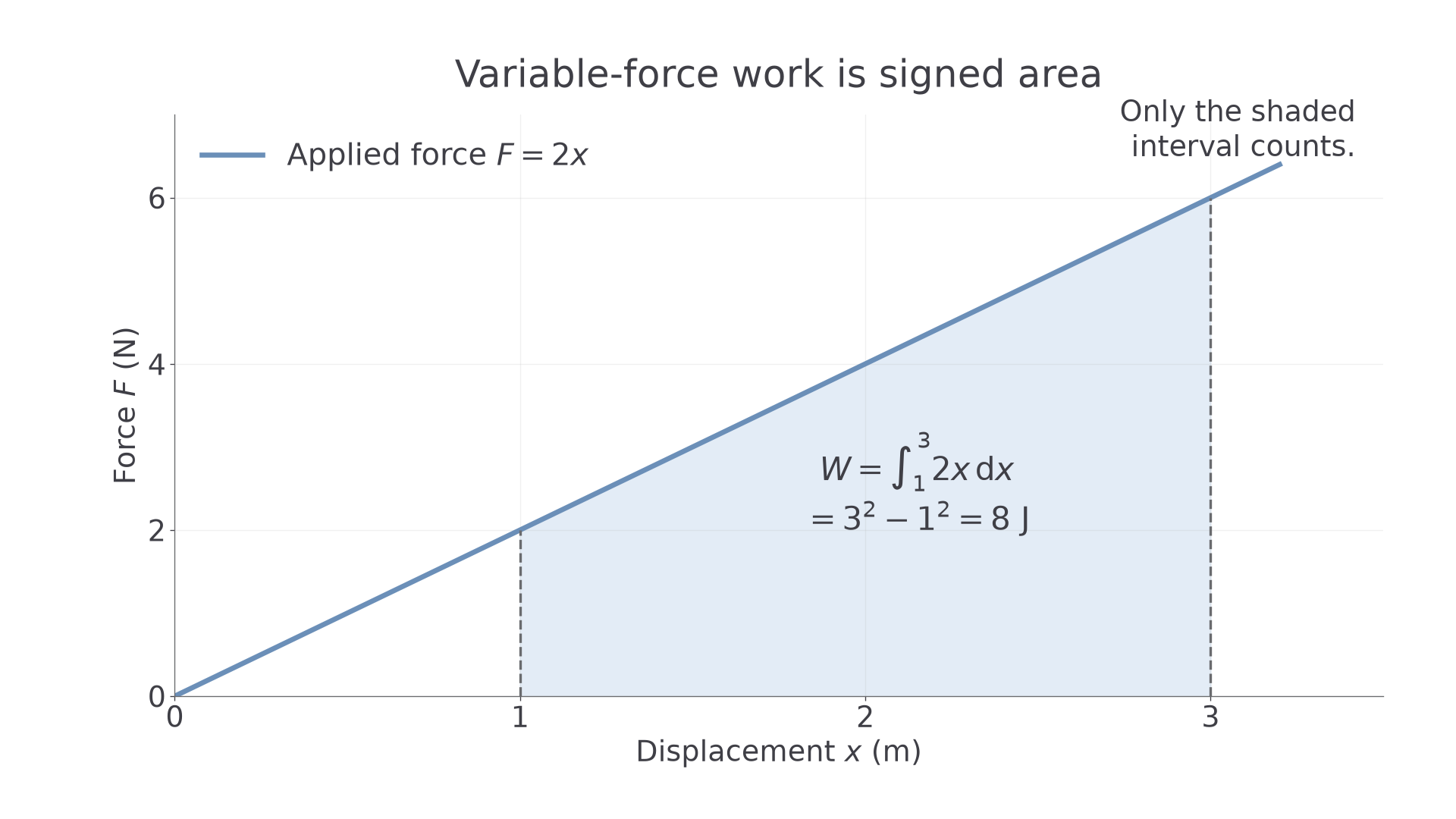
Worked example 1: using the shaded interval
Question. A particle starts from rest at . The only force doing work is newtons in the positive direction. Find its speed at .
Plan. Integrate over the actual displacement interval, then equate the work to the gain in kinetic energy.
Answer. , approximately .
Check. The graph is a straight line, so its trapezium area is , agreeing with the integral.
Change only the starting coordinate to , keeping release from rest. The upper endpoint is unchanged, but less work is done.
Worked example 2: changing the lower limit
Question. The same particle is instead released from rest at , under the same force newtons. Find its speed at .
Plan. Change the lower limit of the integral; keep the kinetic-energy method.
Answer. , approximately .
Check. The trapezium now has parallel sides and and width , so its area is . The speed is smaller because less energy has been transferred.
Multiplying the mean endpoint force by the distance worked here because the force was linear. For a curved force graph, endpoint averaging generally fails; the integral remains valid. Also, since the force changes with position, acceleration is generally not constant.
Watch out
Wrong: for a varying force. Integrate over the travelled interval and evaluate both limits. Do not then use constant-acceleration equations unless constant acceleration has separately been established.
Use a curved force law in this fresh check.
Elastic potential energy
Stretching a string from its natural length takes work. The force starts at zero and increases as the string stretches, so using the final force over the whole extension would overestimate that work. In an ideal elastic model, the work put in during a slow stretch is stored as elastic potential energy.
At an intermediate extension , a slowly applied force balances the restoring force . Integrate using as a temporary variable so that the final extension stays a fixed upper limit:
The same result is the area of a triangle on the force-extension graph: half of final force times extension. The spring itself does the opposite work during stretching, ; the positive stored energy is not that signed work.
Elastic potential energy
Measured from the unstretched state, the stored elastic energy is
For a taut string, ; a slack ideal string has zero elastic energy. For a spring obeying the linear law in compression, the same squared-deformation formula holds for negative . Assume no elastic energy loss or hysteresis.
Not in the formula booklet: learn both forms and their derivation.
To move between two stretched states, calculate the difference between their stored energies. The work needed is , not . Stretching an already taut string begins against a nonzero force.
Worked example 3: energy from natural length
Question. A light elastic string has natural length and modulus . Find its elastic potential energy when its total length is .
Plan. Calculate the extension and use the modulus form of the energy formula.
Answer. .
Check. Final tension is ; the triangular area is .
Keep the same string and final length, but begin from an already stretched state. This changes the energy transferred, although the final stored energy is unchanged.
Worked example 4: adding to stored energy
Question. The same string is slowly stretched from total length to . Find the work done against its elastic force.
Plan. Subtract initial stored energy from final stored energy.
Answer. of external work; the string's work is .
Check. Tension rises linearly from to . The trapezium area is .
Continue this lesson.
You’re previewing NovaLearn without an account. Create a free account to read the rest.
Create free account