I3, I7, I10 - Simple harmonic motion
A restoring acceleration can keep a particle moving backwards and forwards around equilibrium. I7 connects that motion to an oscillatory differential equation; I10 derives it from Hooke's law; I3 interprets the resulting displacement, velocity and acceleration. You will find the amplitude, phase and period, with the kinematics needed for the model introduced here.
Solving the SHM equation
A particle starts to the right of equilibrium at rest, with . When does it first pass equilibrium, and how fast is it moving? The acceleration keeps pointing towards equilibrium, but the particle's inertia carries it through rather than stopping it there.
Choose a fixed positive direction along the line of motion. Let be the signed displacement from equilibrium, measured in metres, and let be time in seconds. A dot means a derivative with respect to time:
Here and are signed velocity and acceleration components; speed is . They are not all positive magnitudes.
The vector notation describes the same straight-line motion. If is a fixed unit vector in the positive direction, the displacement vector is , velocity vector is , and acceleration vector is . Bold symbols have direction; the scalar records a signed component along the chosen axis.
Simple harmonic motion
Simple harmonic motion (SHM) is motion with acceleration proportional to displacement from a fixed equilibrium and directed towards that equilibrium:
The constant is the angular speed of the associated oscillation phase, also called angular frequency, in . It is not the particle's speed along the line.
For , the acceleration is negative; for , it is positive. The minus sign expresses the restoring direction. Writing instead would produce exponential modes, not SHM.
SHM solution
The auxiliary roots of are , giving
with arbitrary real constants , using radians. The SHM equation and its solution forms are not supplied in the formula booklet: learn them. If , the equation becomes , giving , rather than a genuine oscillation.
We can now translate the opening information into two initial conditions.
Worked example 1: release from rest
Question. Solve , given , .
Plan. Use , differentiate the general solution and apply both conditions.
Answer. .
Check. Differentiating twice gives . At zero the displacement is and velocity is zero.
Keep the equation and starting displacement, changing only the initial velocity to in the positive direction. A sine component is now needed.
Worked example 2: a nonzero starting velocity
Question. Solve , given , .
Plan. Apply the changed velocity to the same differentiated general solution.
Answer. .
Check. Both trigonometric terms have second derivative times themselves, so the equation holds. At zero the displacement is and the velocity is . The particle initially moves farther from equilibrium despite its restoring acceleration.
That last observation is important: acceleration towards equilibrium does not require velocity towards equilibrium at every instant.
Watch out
Wrong: reading the in as . It is , so . Also, is a second time derivative, not .
Apply the same conditions method with new values.
Amplitude, phase and period
Two different combinations of sine and cosine can describe the same wave. Combining them makes the size and timing of an oscillation visible.
For , expand
Thus , , and . Choose the phase from both coefficient signs, usually with . A tangent value alone cannot distinguish opposite quadrants.
Amplitude, phase and period
In , the amplitude is the maximum distance from equilibrium; the phase is . One complete oscillation takes the period
The frequency in cycles per second is , measured in hertz. These SHM relations are not supplied in the formula booklet: learn them. The zero solution has amplitude zero and no unique phase or fundamental period.
The period follows because adding to the time increases the phase by . In this model it does not depend on amplitude: doubling how far a particle moves also doubles its restoring acceleration, keeping the cycle time unchanged.
Worked example 3: positive sine and cosine coefficients
Question. For , find the amplitude, period and a phase form , with .
Plan. Match coefficients after expanding the phase form, then use the angular frequency.
Answer. Amplitude , period , and .
Check. Expanding recovers coefficients and . At , , confirming that the stated amplitude is attained.
Change only the sign of the cosine coefficient. The amplitude and period stay the same, but the phase moves to a different quadrant.
Worked example 4: choosing the phase quadrant
Question. Find the same features for .
Plan. Match both coefficient signs rather than taking an acute inverse tangent automatically.
Answer. Amplitude , period , and , with the phase above.
Check. At zero the phase form gives . Its starting velocity is , matching the derivative of the original expression.
For the opening release from rest, has amplitude and period . Its first equilibrium crossing occurs after a quarter-period, at . We will find the velocity there in the final part.
Watch out
Wrong: calling the starting displacement the amplitude in every solution. That is true for release from rest at an extreme position, but a nonzero initial velocity can make the amplitude larger. Use for a sine-and-cosine combination.
Find the phase with a new coefficient pair and angular frequency.
Hooke's law and equilibrium
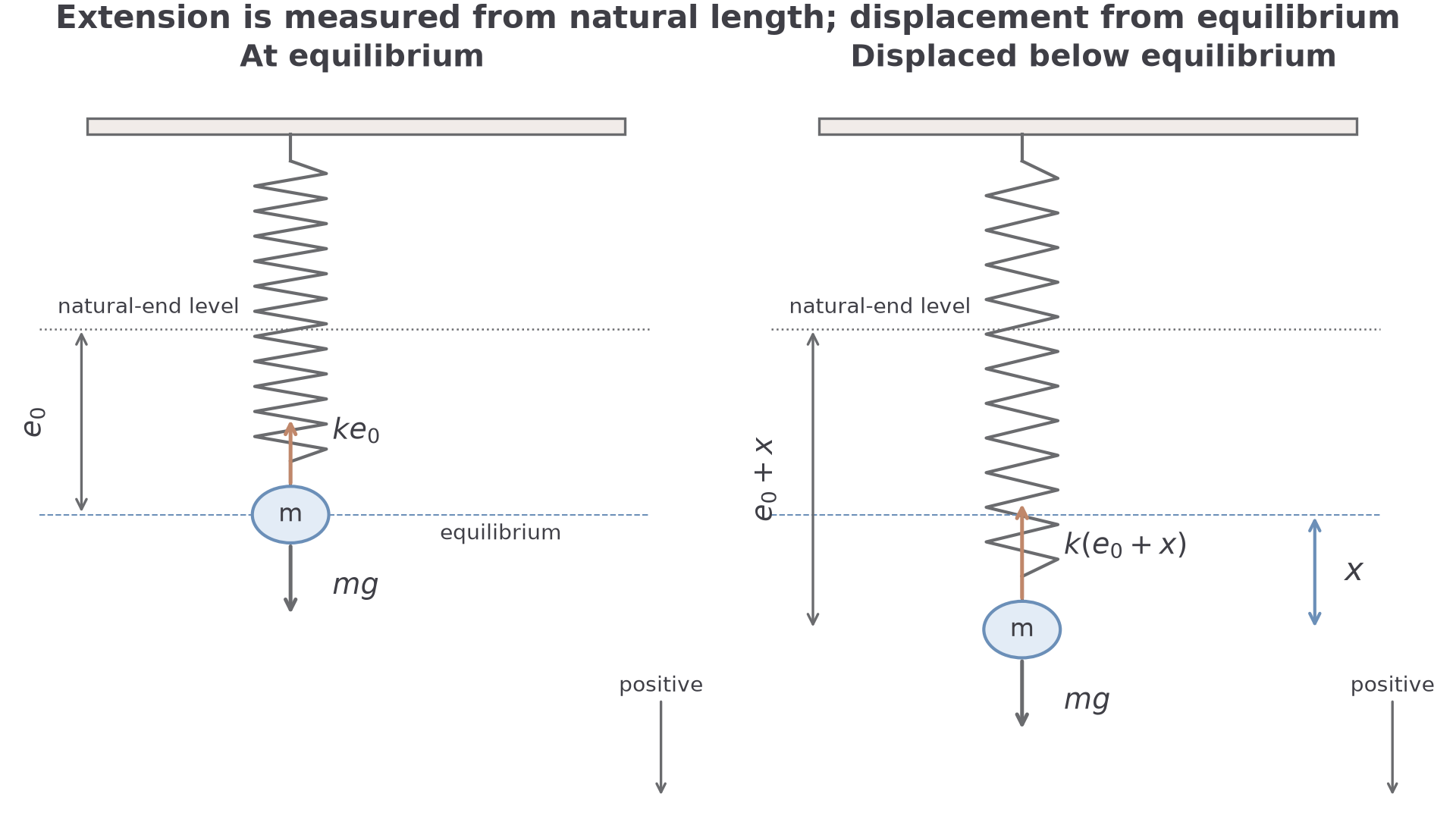
A spring provides a physical reason for restoring acceleration. Hooke's law, often written , says that the tension is proportional to extension within the elastic range. To distinguish extension from displacement about equilibrium, write it here as , where is extension and is stiffness in .
Consider a mass hanging from a light vertical spring. Choose downwards as positive. At equilibrium its extension satisfies , since upward tension balances downward weight. When its displacement below equilibrium is , its total extension is .
Newton's second law states that resultant force equals mass times acceleration. It gives
The motion is SHM with . Gravity fixes the equilibrium extension, then cancels when displacement is measured from equilibrium.
[DIAGRAM: asset_name: Extension and displacement are different; asset_slug: aqa7367-shm-spring; caption: At displacement x below equilibrium, the total extension is e zero plus x; description: Two vertical spring diagrams share a fixed support and a common natural-end reference. At equilibrium the mass has extension e zero, with upward tension k e zero balancing downward weight m g. In a displaced position x below equilibrium, total extension is e zero plus x and the upward spring force is k times e zero plus x. A downward positive direction arrow and a bracket for x separate the motion coordinate from the total extension.]
Continue this lesson.
You’re previewing NovaLearn without an account. Create a free account to read the rest.
Create free account