F3 - Angles involving planes
Can the same dot-product calculation describe two different geometric angles? F3 uses normals to find angles between planes and uses a complementary angle for a line and a plane. You will choose the smaller unoriented angle carefully and interpret the parallel and perpendicular boundary cases.
Angle between planes from normals
Can the same dot-product calculation describe two different geometric angles? Consider the planes and . Their normals are and . A scalar product compares those normals, but you need to understand why that gives an angle between the planes.
Imagine looking along the intersection of two nonparallel planes. In a cross-section perpendicular to that intersection, the planes appear as two intersecting lines, and their normals are perpendicular to those lines. Turning both lines through the same right angle preserves their smaller angle. Therefore the smaller angle between planes equals the smaller angle between their normal directions.
[DIAGRAM: asset_name: Plane angles from perpendicular normals; asset_slug: aqa7367-plane-angle; caption: In a perpendicular cross-section, the smaller plane angle equals the smaller normal angle; description: An equal-scale cross-section shows two traces of planes meeting at an angle of sixty degrees. A second panel shows a normal perpendicular to each trace, translated to a common origin. The normals also form sixty degrees. The blue plane and blue normal correspond, as do the clay plane and clay normal. Right-angle markers identify the perpendicular relationships.]
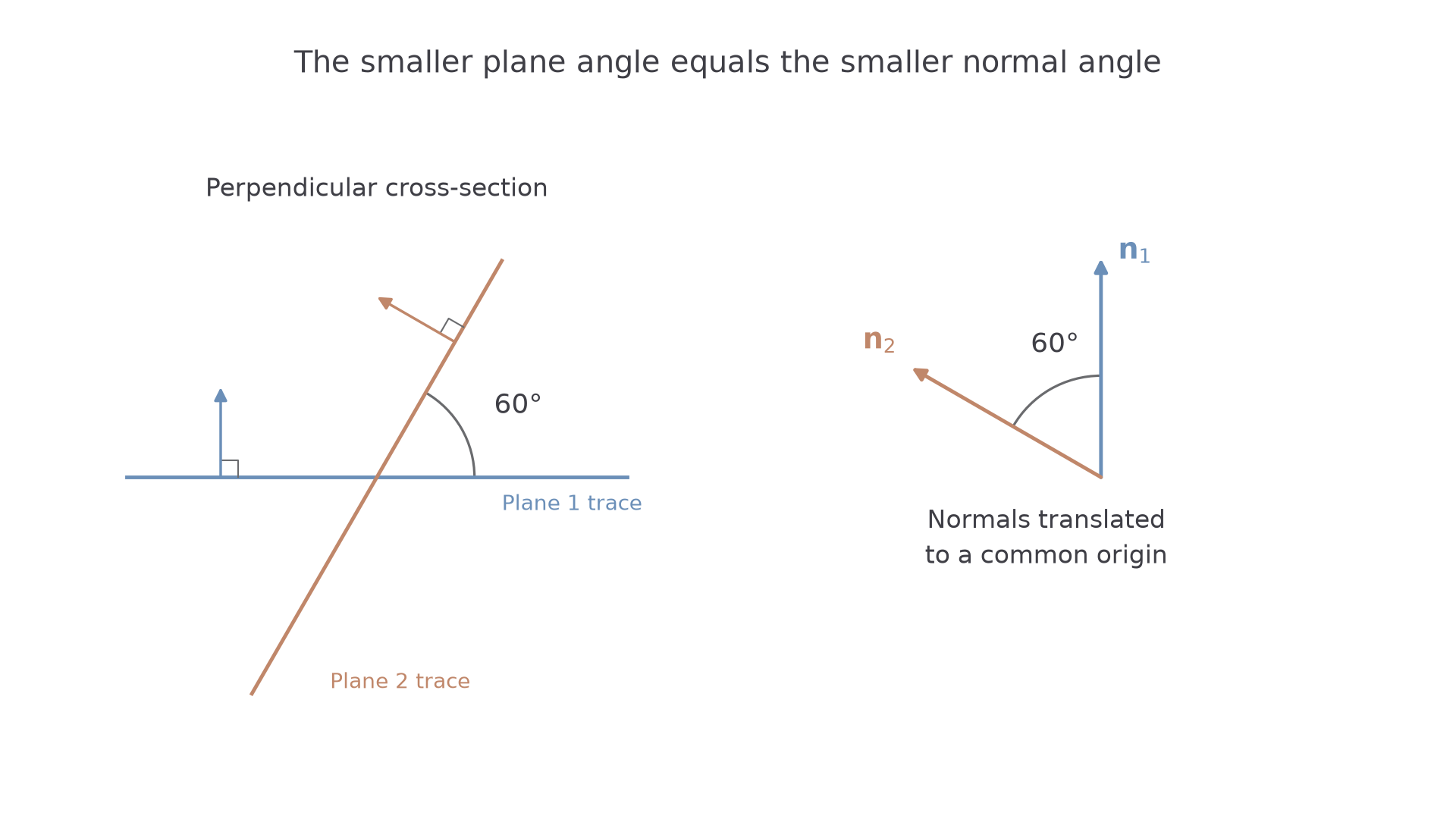
Neither plane has a preferred normal arrow. Reversing either normal must leave the plane angle unchanged, so use an absolute value just as for unoriented lines.
Smaller angle between planes
For nonzero normals , the smaller plane angle satisfies
Not in the formula booklet: learn it.
Constants in the plane equations locate the planes; their normals determine the angle.
Worked example 1: the smaller angle between planes
Question. Find the smaller angle between and .
Plan. Read off the coefficient normals and compare them using the scalar product.
Answer. .
Check. also has length . The triangle formed by the two normals and their difference is equilateral, confirming their angle.
Now multiply the second plane equation by . Only the chosen normal arrow changes.
Worked example 2: an equivalent equation reverses the normal
Question. Find the smaller angle between and .
Plan. Use the new coefficient normal, retaining the absolute dot product.
Answer. , unchanged.
Check. The signed vector calculation gives ; its supplement is . Also, multiplying by recovers the plane in Worked example 1, so the plane angle must agree.
Some questions explicitly request an obtuse angle between planes. First find the smaller angle, then take its supplement when required. For , the other dihedral angle is . The unqualified smaller angle includes and as boundary cases.
Line-plane angle as a complement
The angle between a line and a plane is measured from the line to its projection in the plane. Use the angle in . When the line is perpendicular to the plane its projection has no direction, and the line-plane angle is defined as .
The normal is perpendicular to the plane. In the cross-section containing the line direction and the normal, the smaller angle between those directions and the line-plane angle therefore satisfy .
[DIAGRAM: asset_name: Complementary line and plane angles; asset_slug: aqa7367-line-plane-angle; caption: The line-plane angle and the smaller angle to the normal add to a right angle; description: An exact two-dimensional cross-section contains a horizontal trace of a plane, a vertical normal and a line direction at thirty degrees above the plane. The angle alpha from the plane to the line is thirty degrees and beta from the line to the normal is sixty degrees. A pale right-angle marker shows that the plane trace and normal are perpendicular. A note states alpha plus beta equals ninety degrees.]
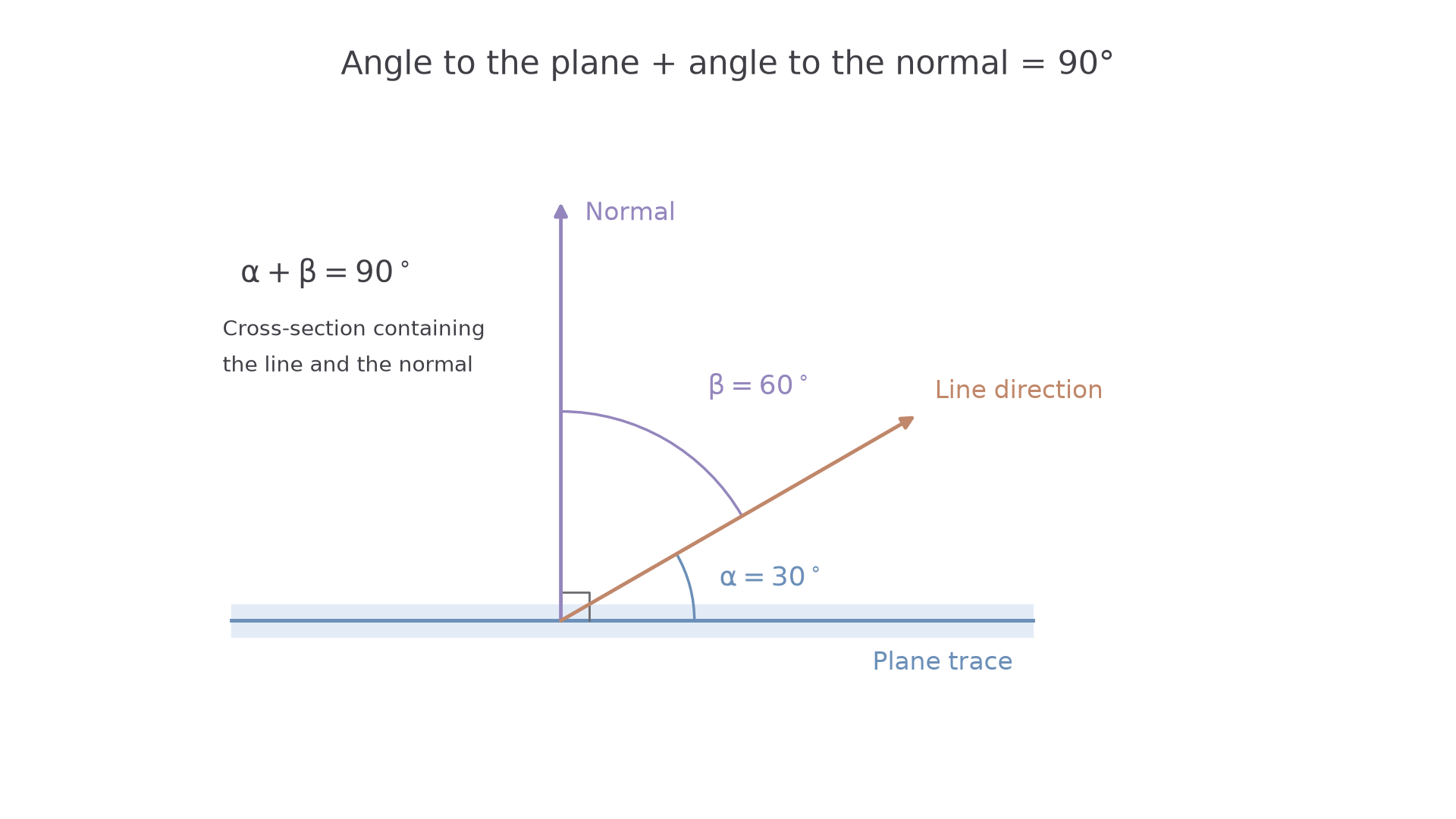
If is the line direction and is the plane normal, the dot product gives , which equals . This is why a direct line-plane calculation uses inverse sine, not inverse cosine.
Angle between a line and a plane
For a nonzero line direction and nonzero plane normal ,
Alternatively, find the smaller direction-normal angle using inverse cosine, then use . Not in the formula booklet: learn it.
The absolute value removes arbitrary choices of the line arrow or normal arrow.
Continue this lesson.
You’re previewing NovaLearn without an account. Create a free account to read the rest.
Create free account