MD1–MD3 - Speed in circular motion
A particle can keep the same speed while accelerating throughout its journey. Learn how its velocity changes around a circle, convert between angular-speed units, and connect radius, speed and inward acceleration to the real forces acting.
Constant-speed circle
A bead travels around a smooth circular wire at a steady speed. If its speed never changes, why must the wire keep exerting a force on it? Think first about the bead at the right-hand edge of a horizontal circle, travelling anticlockwise. Its velocity points upwards on a plan view. A quarter-turn later, at the top of the circle, its velocity points left. The two speeds agree, but the two velocities do not.
Uniform circular motion
Uniform circular motion is motion around a fixed circle with constant speed. Velocity is tangent to the circle and changes direction continuously. Acceleration is the rate of change of velocity, so it need not be zero when speed is constant.
[DIAGRAM: asset_name: Tangential velocity and inward acceleration; asset_slug: aqa7367-circle-directions; caption: Equal-length velocity arrows turn around the circle while acceleration always points towards its centre; description: A plan view of a circle with centre O and particles at the rightmost and uppermost points. Blue velocity arrows point upwards and left respectively. Clay acceleration arrows point left and down respectively towards O. The circle is labelled constant speed, changing velocity.]
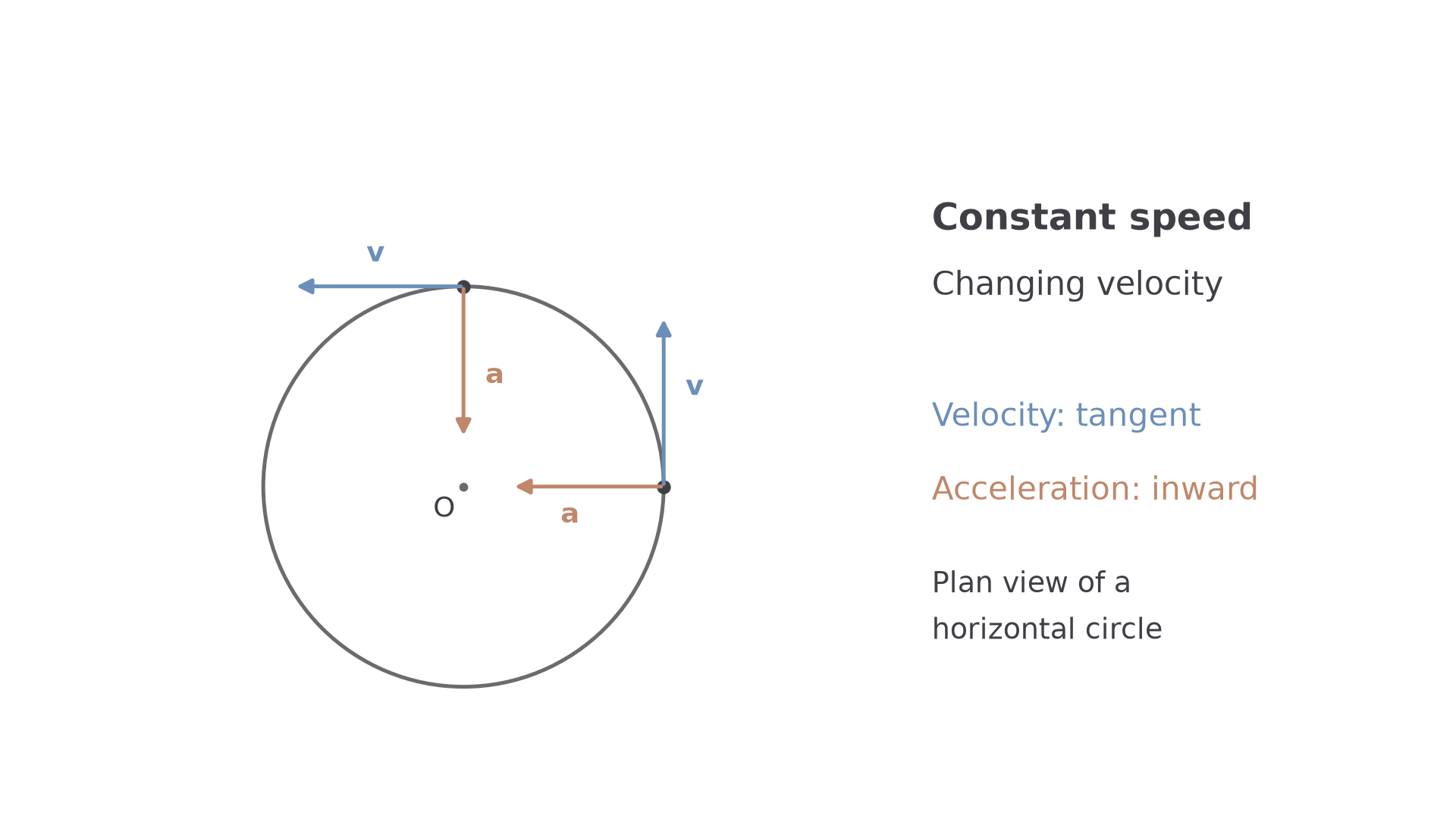
Over a very short time, the particle's velocity turns through a small angle. Subtract the old velocity from the new velocity: their difference points nearly towards the centre. In the limit, the acceleration points exactly inwards. The next lesson will confirm this using vector differentiation.
Newton's second law then requires an inward resultant force. Tension, friction, gravity or a normal reaction may supply that resultant, depending on the system. “Centripetal” means centre-seeking: it names the direction and role of the resultant. It is not another force to add to a force diagram.
For a bead on a smooth horizontal circular wire, weight and the upward support balance vertically. The wire's sideways reaction turns the velocity. If that sideways force vanished, the bead would initially move along the tangent, rather than continue around the circle.
Key idea
Constant speed fixes the length of the velocity vector, not its direction. Draw the actual forces, then identify their inward resultant.
Angular speed in radians and revolutions
A wheel turning at 90 revolutions per minute makes one and a half turns each second. The angle swept by a radius is therefore radians each second. Convert the angle and the time separately: one revolution is radians, and one minute is 60 seconds.
Angular speed
Angular speed is the rate at which the angle swept out by a radius increases. For uniform motion through angle in time , . Use radians per second, , in circular-motion formulae.
If the period is the time for one revolution and the frequency is the number of revolutions each second, then one complete turn gives the following relationships.
Angular-speed conversions
For a constant angular speed and period ,
where is the number of revolutions per minute. These conversion formulae are not in the formula booklet: learn how to obtain them from one turn being radians.
Worked example 1: revolutions per minute to radians per second
Question. A turntable rotates uniformly at 75 revolutions per minute. Find its angular speed in radians per second and its period.
Plan. Convert turns per minute to turns per second, then to radians per second; invert the turns-per-second rate for the period.
Answer. and .
Check. In 60 seconds there are turns, recovering the given rate.
Now reverse the direction of the conversion. Dividing by , rather than multiplying, changes radians into turns.
Worked example 2: radians per second to revolutions per minute
Question. Another turntable rotates uniformly at . Find its rate in revolutions per minute, correct to two significant figures, and its period.
Plan. Divide by the angle in one revolution, then multiply the turns-per-second rate by 60.
Answer. 48 revolutions per minute, to two significant figures; .
Check. turns per minute, agreeing with the unrounded result. Using the rounded 48 as exact would slightly change the original angular speed.
Continue this lesson.
You’re previewing NovaLearn without an account. Create a free account to read the rest.
Create free account