D15 - Parabolas, ellipses and hyperbolas
Recognise four standard curve equations and sketch them from symmetry, intercepts and limiting behaviour. You will see why changing one plus sign to a minus sign can turn a closed ellipse into two unbounded branches.
The sideways parabola
What happens to the graph of if its plus sign becomes a minus sign? First build a small collection of standard curves, starting with a parabola that opens sideways.
For , write . Every real gives one nonnegative , so the curve lies to the right of the vertical axis. Both signs of are allowed: and lie on it.
Parabola in standard form
The curve
has vertex , symmetry axis , and only one point on either coordinate axis: the origin. It opens right for and left for . This standard equation is in the formula booklet, page 8.
The condition matters: if , the equation becomes , which is the whole horizontal axis, not a nondegenerate parabola. The full sideways parabola is a curve, but is not a single-valued function of .
Worked example 1: a right-opening parabola
Question. Describe the sketch of , including vertex, symmetry and the points with .
Plan. Compare with , then calculate a pair of symmetric points.
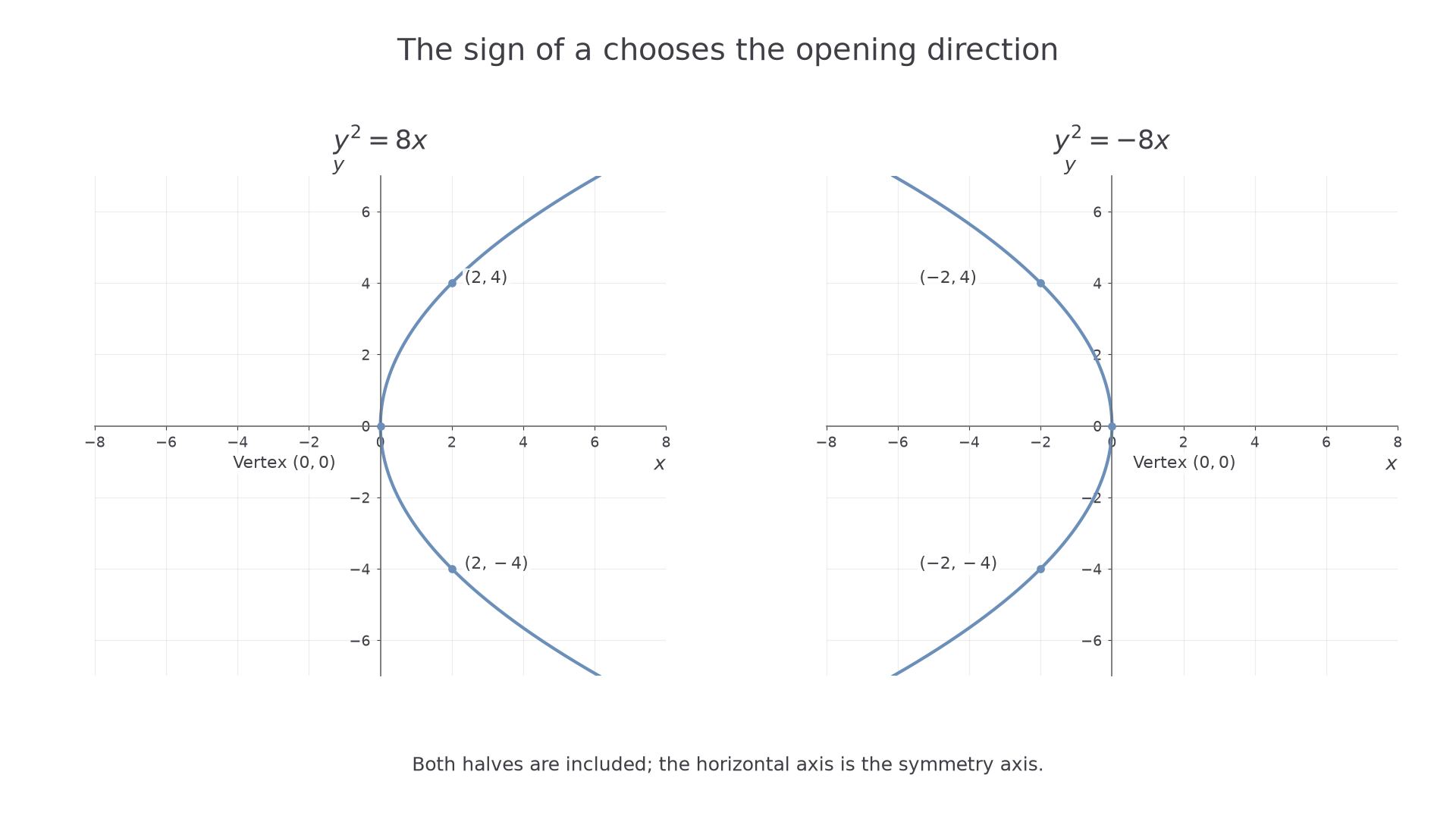
Answer. Vertex ; symmetry axis ; opens right through and . It has no straight-line asymptote.
Check. Both points give . Replacing by leaves the equation unchanged.
Change only the sign of . The same heights now occur on the other side of the vertical axis.
Worked example 2: a left-opening parabola
Question. Describe the corresponding features of , using the points with .
Plan. Read , rearrange for , and calculate the symmetric heights.
Answer. Vertex ; symmetry axis ; opens left through and .
Check. Reflecting from Worked example 1 in the vertical axis gives these points and changes to .
The paired sketches make the sign change visible.
[DIAGRAM: asset_name: Right and left opening parabolas; asset_slug: aqa7367-sideways-parabolas; caption: Changing the sign of a reflects the sideways parabola in the vertical axis; description: Two equal-scale coordinate panels show y squared equals eight x opening right and y squared equals minus eight x opening left. Both have vertex at the origin and horizontal symmetry axis. The right panel labels points minus two, plus or minus four; the left panel labels two, plus or minus four.]
Watch out
Wrong: describes the whole first parabola. It describes only the upper half. The equation includes too, for .
Keep both halves when describing this fresh curve.
Ellipses and hyperbolas
In an ellipse equation, two nonnegative terms add to . Each term must therefore be at most , enclosing the curve in a rectangle. Replacing the plus by a minus removes that bound.
Two standard conics
Take , so they represent lengths.
Both are centred at and symmetric in both coordinate axes. The ellipse has intercepts . This hyperbola has vertices and axis intercepts , with branches opening left and right. Both standard equations are in the formula booklet, page 8.
For the ellipse, and . If , it is a circle. For the stated hyperbola, , so or ; there is no point with . It has every real height .
Worked example 3: a closed ellipse
Question. Describe a sketch of , including all axis intercepts and its bounds.
Plan. Read the lengths from the square denominators and set one coordinate to zero at a time.
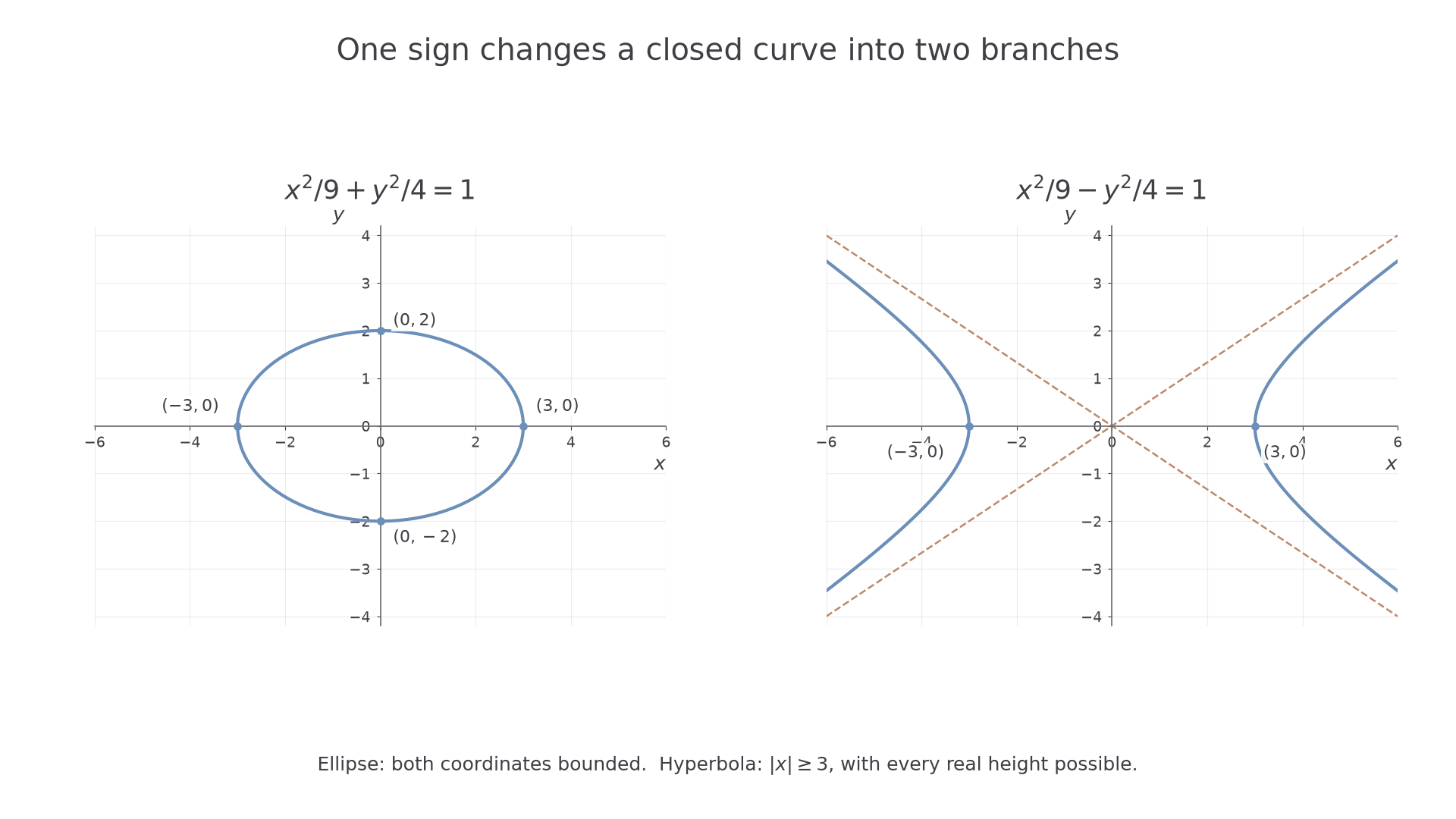
Answer. A closed ellipse through , with horizontal extent and vertical extent . It has no asymptotes.
Check. At , the largest possible magnitude of is ; at , the largest magnitude of is . No squared term can exceed in the equation.
Change just the plus sign. The denominators stay and , but the intercepts and allowed inputs change.
Worked example 4: two unbounded branches
Question. Describe the intercepts and allowed coordinates of .
Plan. Test the axes, then require the expression for to be nonnegative.
Answer. Axis intercepts , no vertical-axis intercept; two branches with or . Every real is possible because .
Check. For , the two points have . Substitution gives , while , previously an ellipse intercept, no longer works.
The signs decide whether the curve stays inside or extends outside its vertex positions.
[DIAGRAM: asset_name: One sign separates an ellipse from a hyperbola; asset_slug: aqa7367-conic-sign; caption: The plus equation is closed, while the minus equation has two branches beyond x equals plus or minus three; description: Equal-scale panels show x squared over nine plus y squared over four equals one, and the same equation with a minus sign. The ellipse labels all four axis intercepts. The hyperbola labels the vertices minus three and three, has no y axis intercepts, and approaches dashed lines y equals plus or minus two x over three.]
Watch out
Wrong: read the ellipse's horizontal intercepts as . The denominator is , not . Take its positive square root: .
Use a new pair of square denominators.
The rectangular hyperbola
The equation gives another standard hyperbola. For real , its right side is positive, so and have the same sign.
Rectangular hyperbola
For , the curve , or , has one branch in quadrant I and one in quadrant III. Neither coordinate can be zero. Its asymptotes are the perpendicular coordinate axes and ; this is why it is called rectangular.
Changing the sign of would give the same equation because is squared; taking avoids duplicate parameter descriptions. At , is the pair of axes, not this nondegenerate hyperbola. The equation is not separately listed in the formula booklet's conics table; learn its reciprocal interpretation.
Worked example 5: a positive product
Question. Describe , and find the points with and .
Plan. Rearrange as a reciprocal and retain the sign of the input.
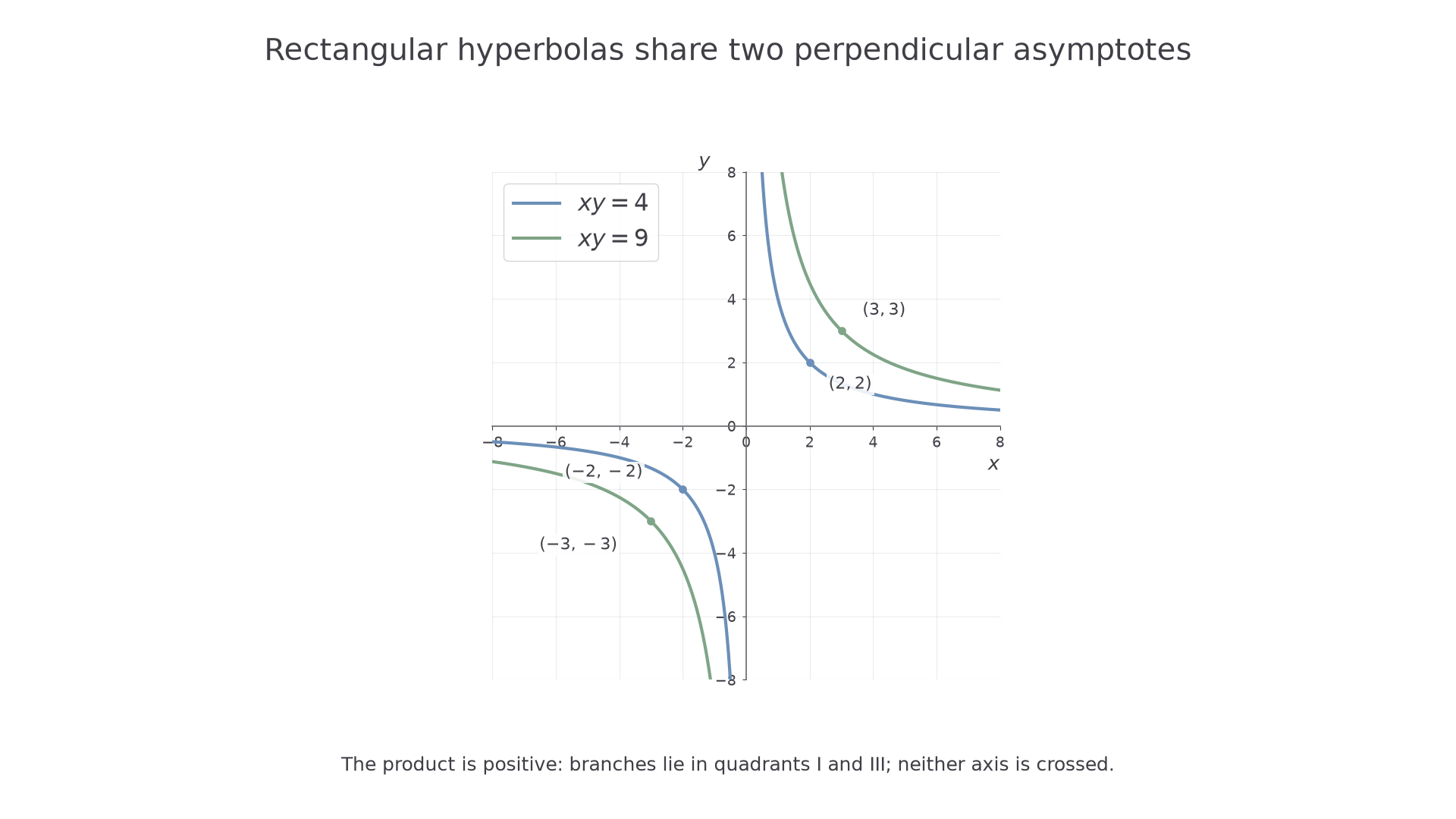
Answer. Points ; branches in quadrants I and III; no axis intercepts; asymptotes .
Check. Each point has product . At , , close to the horizontal axis, while gives , illustrating the vertical asymptote.
Change only the product constant from to . The branch quadrants and asymptotes remain the same.
Worked example 6: changing the product constant
Question. Describe , and find the points with and .
Plan. Use and identify which features depend on the constant.
Answer. Points ; branches in quadrants I and III; no axis intercepts; asymptotes .
Check. Both coordinate products are . The change multiplies the product by , taking the curve to this curve.
That scaling connection explains why the two curves have the same shape but sit at different distances from the origin.
[DIAGRAM: asset_name: Rectangular hyperbolas with different constants; asset_slug: aqa7367-rectangular-hyperbolas; caption: The curves xy equals four and xy equals nine share the coordinate axes as asymptotes; description: An equal-scale coordinate plot shows xy equals four in blue through (two,two) and (minus two,minus two), and xy equals nine in sage through (three,three) and (minus three,minus three). Both have branches only in quadrants I and III and do not meet either axis.]
Watch out
Wrong: with nonzero real has branches in quadrants II and IV. Those quadrants have opposite-signed coordinates and negative products; is positive.
Keep the product sign when calculating the next points.
Intercepts and hyperbola asymptotes
For , the intercepts locate the vertices, and two oblique asymptotes guide the unbounded branches. Both are needed for a useful sketch.
Rearranging gives . For large , the constant term becomes negligible compared with , so the straight-line directions satisfy .
Hyperbola asymptotes
For ,
The booklet gives these as , on page 8. They are the same two lines. The branches pass through ; the rectangle with corners has diagonals along the asymptotes.
The lines really are approached, not merely parallel directions. For on the upper branch,
Symmetry gives the other ends. For comparison, the ellipse and parabola have no straight-line asymptotes, and approaches the two coordinate axes.
Worked example 7: vertices and sloping guides
Question. State the intercepts and asymptotes needed to sketch .
Plan. Read , test each axis and use gradients .
Answer. Intercepts , no vertical-axis intercept; asymptotes and . Draw branches opening left and right through the vertices.
Check. The rectangle corners lie on the two lines. At , the upper branch has , below its asymptote value .
Double only , leaving fixed. The vertices stay in place, but the asymptote gradients double.
Worked example 8: changing the vertical scale
Question. State the corresponding features of .
Plan. Use ; compare the axis equations before drawing the new lines.
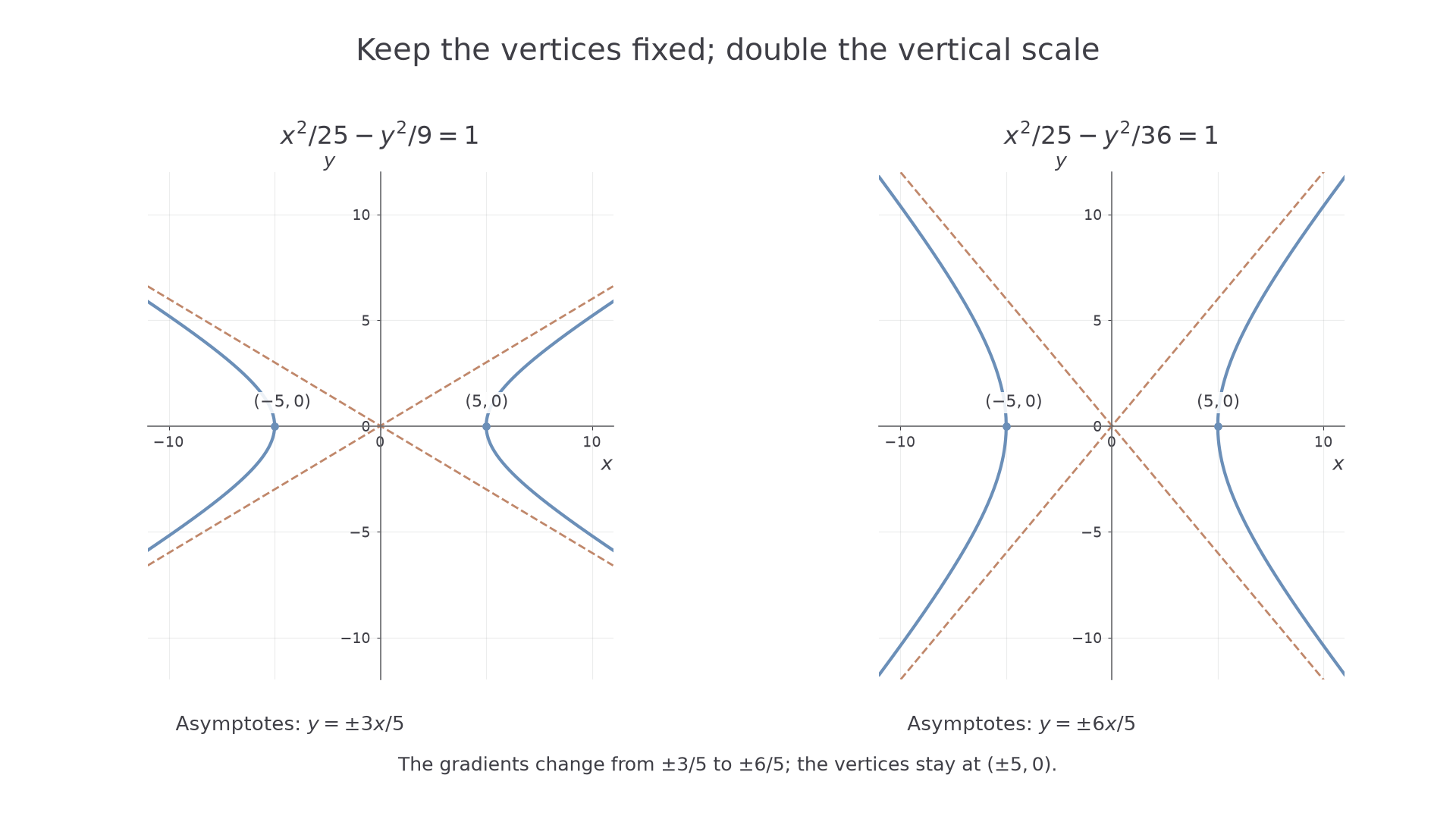
Answer. Intercepts ; no vertical-axis intercept; asymptotes , .
Check. At , the upper branch has , exactly twice the height in Worked example 7, while the corresponding asymptote height doubles from to .
Use the same meaning for the blue curve and dashed clay guides in both panels.
[DIAGRAM: asset_name: Hyperbola vertices and asymptote gradients; asset_slug: aqa7367-hyperbola-guides; caption: Doubling b doubles the asymptote gradients and branch heights while the vertices stay fixed; description: Two equal-scale panels show x squared over twenty five minus y squared over nine equals one, and x squared over twenty five minus y squared over thirty six equals one. Both label vertices (minus five,zero) and (five,zero). Dashed clay lines have gradients plus or minus three fifths in the first panel and plus or minus six fifths in the second.]
Watch out
Wrong: asymptote gradients . Rearrange the booklet equation for : the gradients are .
Finish with a new hyperbola.
Quick Recap
- is a sideways parabola; the sign of nonzero determines its direction.
- is a bounded ellipse, with lengths .
- opens left and right, through , approaching .
- , for , lies in quadrants I and III and approaches the coordinate axes.
Changing the opening equation's plus sign to minus turns the ellipse into a hyperbola: its vertical-axis intercepts disappear, and two branches extend beyond , approaching .