ME3 - Laminas by integration
Find the centre of a uniform curved sheet by adding the masses and moments of thin strips. You will choose the strip's area and centre carefully, derive both coordinate integrals and use symmetry to simplify the work.
Masses of thin strips
Where is the centre of a uniform semicircular sheet of radius 2 cm: halfway up, or closer to its straight edge? There is more material near the straight edge, so the halfway guess needs testing. Integration lets us weigh every strip rather than guess.
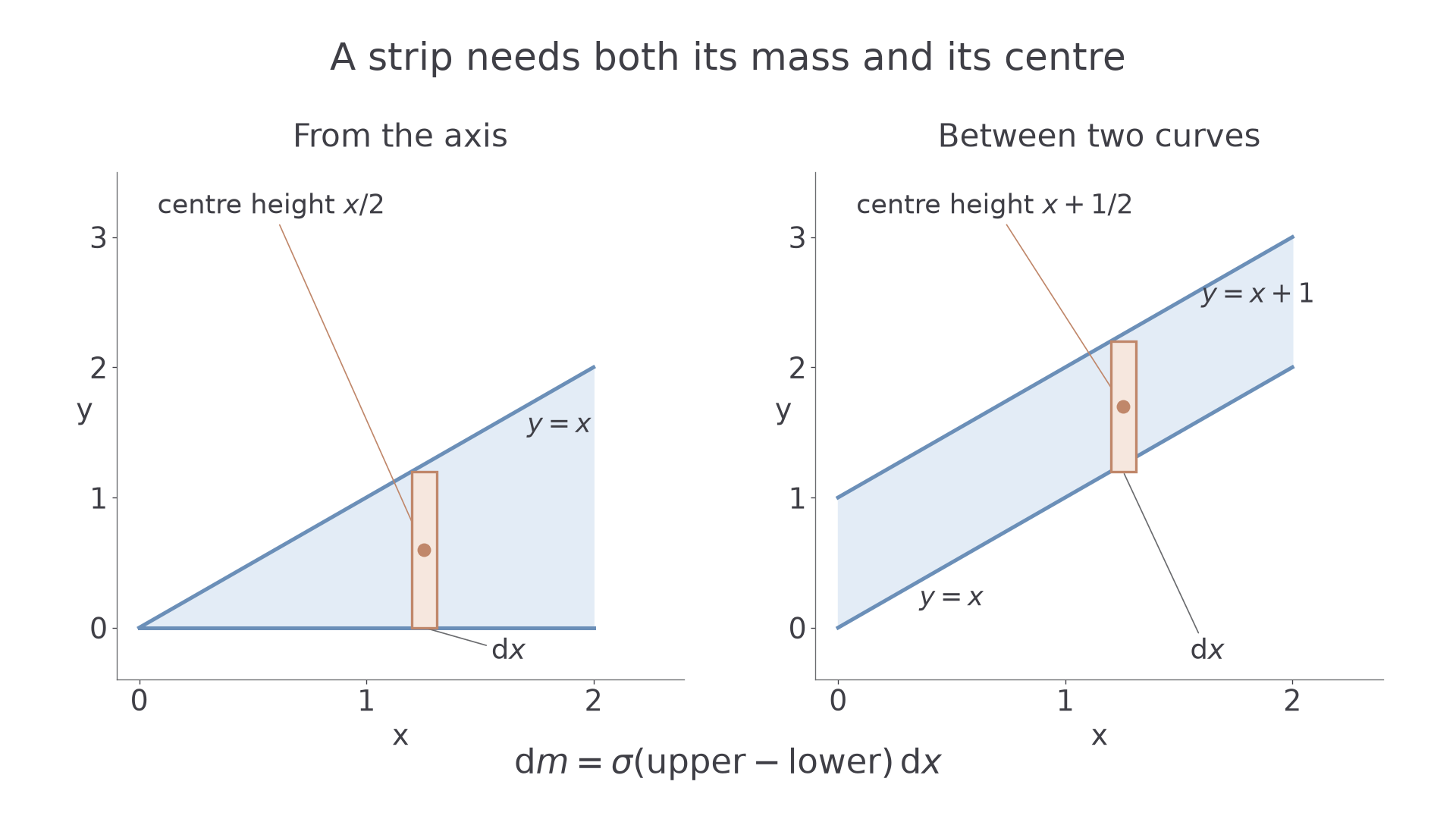
Start with a simpler sheet below , above , from to . A narrow vertical strip at has height , width , and area . If its constant area density is , its mass is . The curved-edge approximation becomes exact in the integral as strip widths tend to zero.
A strip model
For a uniform lamina between and , where for , a vertical strip has
Its limiting centre is . Here is mass per unit area; the region must have finite positive area.
The midpoint is halfway between the two boundaries, even when the strip does not reach the axis. If boundaries cross, split the interval and identify upper and lower afresh. If a vertical slice contains separated pieces, treat each separately rather than including the gap.
[DIAGRAM: asset_name: Mass and centre of a vertical strip; asset_slug: aqa7367-lamina-strips; caption: Strip height is upper minus lower and its centre is halfway between the boundaries; description: Two coordinate panels show the region below y equals x from zero to two, and the region between y equals x and y equals x plus one over the same interval. Each has a narrow highlighted vertical strip at x equals 1.2. Their centres lie at heights x over two and x plus one half respectively; width dx and the upper and lower boundaries are labelled.]
Worked example 1: strips starting on the axis
Question. A uniform lamina occupies , , with lengths in metres and area density . Find its mass and the centre height of the strip at .
Plan. Use strip area times density, then integrate mass across the region.
The strip runs from height 0 to height , so its centre height is .
Answer. ; strip centre .
Check. The lamina is a triangle of base 2 and height 2, with area 2 square metres. Area times density gives kg.
Keep the interval, sloping line and density, but take a band of constant vertical height 1 above that line instead of the region below it. This isolates the importance of upper minus lower.
Worked example 2: strips away from the axis
Question. A uniform lamina occupies , , with the same units and density. Find its mass and the centre height of the strip at .
Plan. Subtract boundaries to get strip height; average boundaries to locate its centre.
Answer. ; strip centre .
Check. The region is a parallelogram with vertical side 1 and horizontal separation 2, hence area 2. Its two sloping edges are equally far above and below the line .
Mass and area are different quantities, even when a constant density later cancels.
Watch out
Wrong: for boundaries and , use . This includes material below the lamina. Correct: .
Build a strip before integrating the next region.
Moment integrals
A first moment is mass multiplied by its coordinate, added across the whole sheet. Multiplying each strip mass by finds the horizontal first moment; multiplying it by its centre height finds the vertical first moment.
For the strip between and , the vertical contribution is
This is a difference of squares, not the square of the strip height. Coordinates below the axis make signed contributions; mass remains positive.
Uniform-lamina moment integrals
For on , finite positive area and constant density ,
The common density cancels after division. With horizontal strips interchange the coordinate roles and use right boundary minus left boundary.
Not in the formula booklet: learn it.
For a sheet starting on the axis, set . The two coordinate moments then share the same mass denominator but have different numerators.
Worked example 3: the centre below a straight line
Question. Find the centre of the uniform lamina , .
Plan. Calculate total mass and both strip moments with constant area density .
Divide each first moment by the same total mass.
Answer. .
Check. The triangle has vertices . Its median from ends at ; two-thirds along gives , agreeing with integration.
Continue this lesson.
You’re previewing NovaLearn without an account. Create a free account to read the rest.
Create free account