B2 - Introducing complex numbers
Can two numbers that are not real multiply to give an ordinary positive number? You will meet a number whose square is negative, then learn to read, add, subtract and multiply complex numbers. You will see how familiar algebra works in a larger number system.
A number whose square is negative
Can two numbers that are not real multiply to give a positive real number? First we need to make sense of a number outside the real number line.
Try to solve using real numbers. A positive number squared is positive. A negative number squared is also positive, and zero squared is zero. None works. On the graph, never reaches .
[DIAGRAM: asset_name: Why no real number squares to minus one; asset_slug: aqa7367-real-square; caption: For real x, the curve y equals x squared never meets the line y equals minus one; description: A coordinate graph with a blue parabola y equals x squared, its vertex at the origin, and a horizontal dashed clay line y equals minus one below the horizontal axis. The two graphs do not intersect. A right-hand note states that x squared is at least zero for real x and that x squared equals minus one has no real solution.]
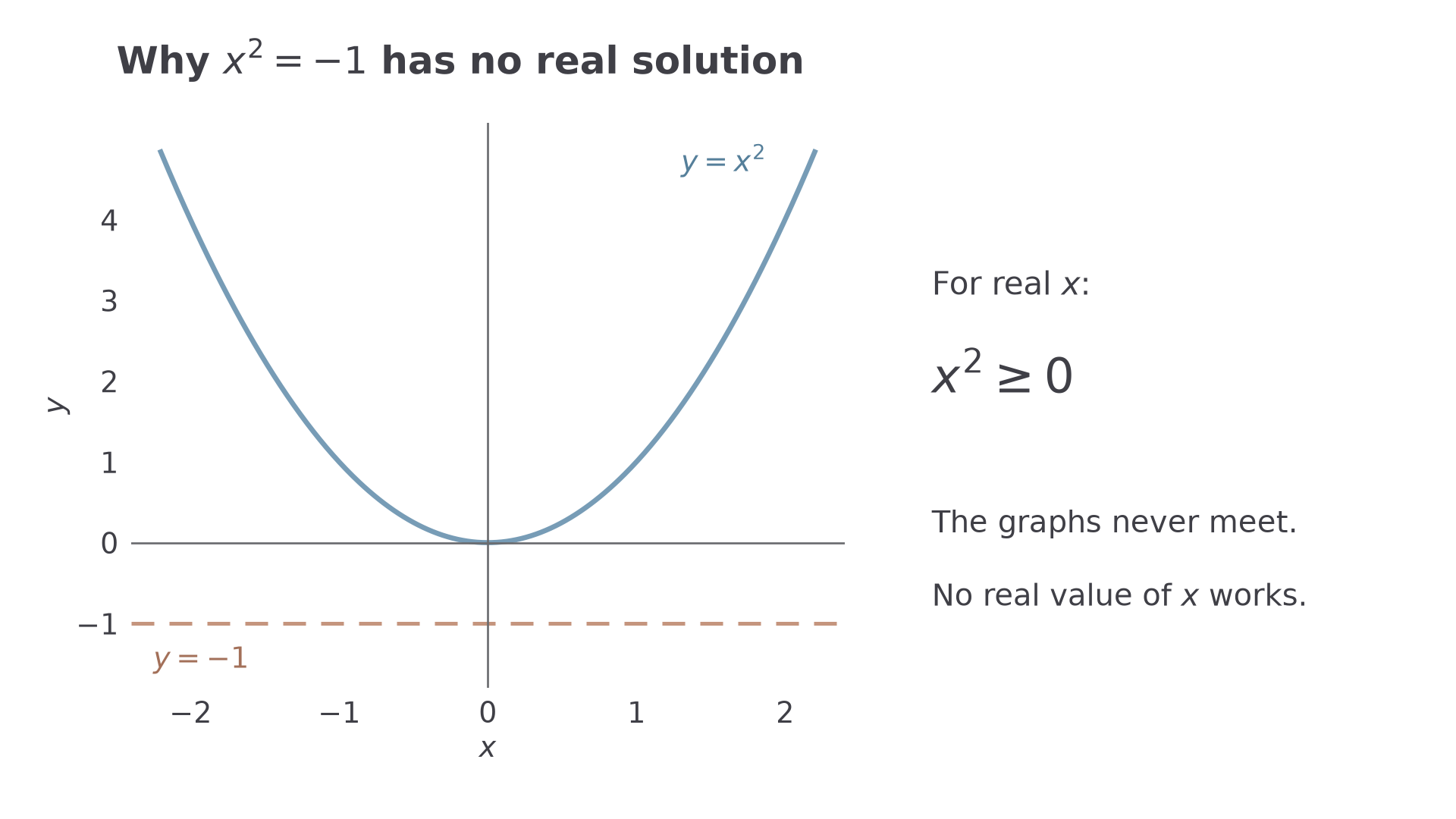
We extend the number system by introducing the imaginary unit, written . It follows the usual rules of addition and multiplication, with one new rule.
Imaginary unit
The imaginary unit satisfies . It is not a real number. In particular, is not , because .
The new rule makes both and solutions of the equation:
It also makes other negative squares possible. For example, . The coefficient is squared too: is not .
Key idea
A real number cannot have a negative square. A number containing can: simplify its square using .
Use that rule to distinguish the following candidates.
Real and imaginary parts
The number combines a real number, , with a real multiple of , namely . Keeping those two contributions separate makes the arithmetic manageable.
Complex number
A complex number has the form , where and are real numbers. Its real part is ; its imaginary part is . The imaginary part is the real coefficient of , not the whole term containing .
For , the real part is and the imaginary part is . You may also write : multiplication allows the coefficient on either side of .
| Number | Real part | Imaginary part |
|---|---|---|
Every real number is also a complex number: write . Here, “complex” names the larger number system; it does not mean that an imaginary part must be present.
Two complex numbers are equal exactly when their real parts agree and their imaginary parts agree. For instance, if with real, then and .
Watch out
Wrong: . The imaginary part is the coefficient, so the correct statement is .
Check that distinction with a new number.
Adding and subtracting complex numbers
Collect the real terms together and the terms containing together, just as you collect like terms in algebra. Neither kind can absorb the other: cannot be shortened to .
Worked example 1: adding two complex numbers
Question. Express in the form , where and are real.
Plan. Add the real parts and add the imaginary parts separately.
Answer. , so and .
Check. Undo the addition: , which recovers the first number.
Now keep both numbers the same and change only addition to subtraction. The minus sign must act on both terms in the second bracket.
Worked example 2: subtracting the same number
Question. Express in the form , where and are real.
Plan. Remove the second bracket by changing both signs, then collect like terms.
Why does become ? Subtracting a negative term adds its opposite, exactly as it does with real numbers.
Answer. .
Check. Add the subtracted number back: .
The new arithmetic still uses your familiar bracket rules.
Watch out
Wrong: . That changes only one sign. Correct: .
For your turn, use the same subtraction method with a new pair of numbers.
Multiplying complex numbers
Expand the brackets as usual. Then replace by before collecting the real terms. This is the only new step in multiplication.
Worked example 3: multiplying matching brackets
Question. Express in the form , where and are real.
Plan. Form all four products, simplify the squared imaginary unit, then collect terms.
Answer. .
Check. The square identity gives , the same result.
Change just one sign in the second bracket. The imaginary cross terms will now cancel: this answers the question that opened the lesson.
Worked example 4: a product that becomes real
Question. Express in the form , where and are real.
Plan. Expand, replace , and see which terms remain.
Why does the final term become positive? It is , not .
Answer. , or . Both factors are non-real, but their product is a positive real number.
Check. The difference-of-squares identity gives .
The multiplication grid makes the cancellation visible. Its four cells are the four terms of the expansion.
[DIAGRAM: asset_name: Four products and a cancellation; asset_slug: aqa7367-product-grid; caption: The two imaginary cross terms cancel and minus nine i squared becomes plus nine; description: A multiplication grid for (2 plus 3i) times (2 minus 3i), with row headings 2 and 3i and column headings 2 and minus 3i. Cells show 4, minus 6i, 6i and minus 9i squared equals 9. The two imaginary cells share a pale lavender fill. A note beside the grid shows minus 6i plus 6i equals zero, then 4 plus 9 equals 13.]
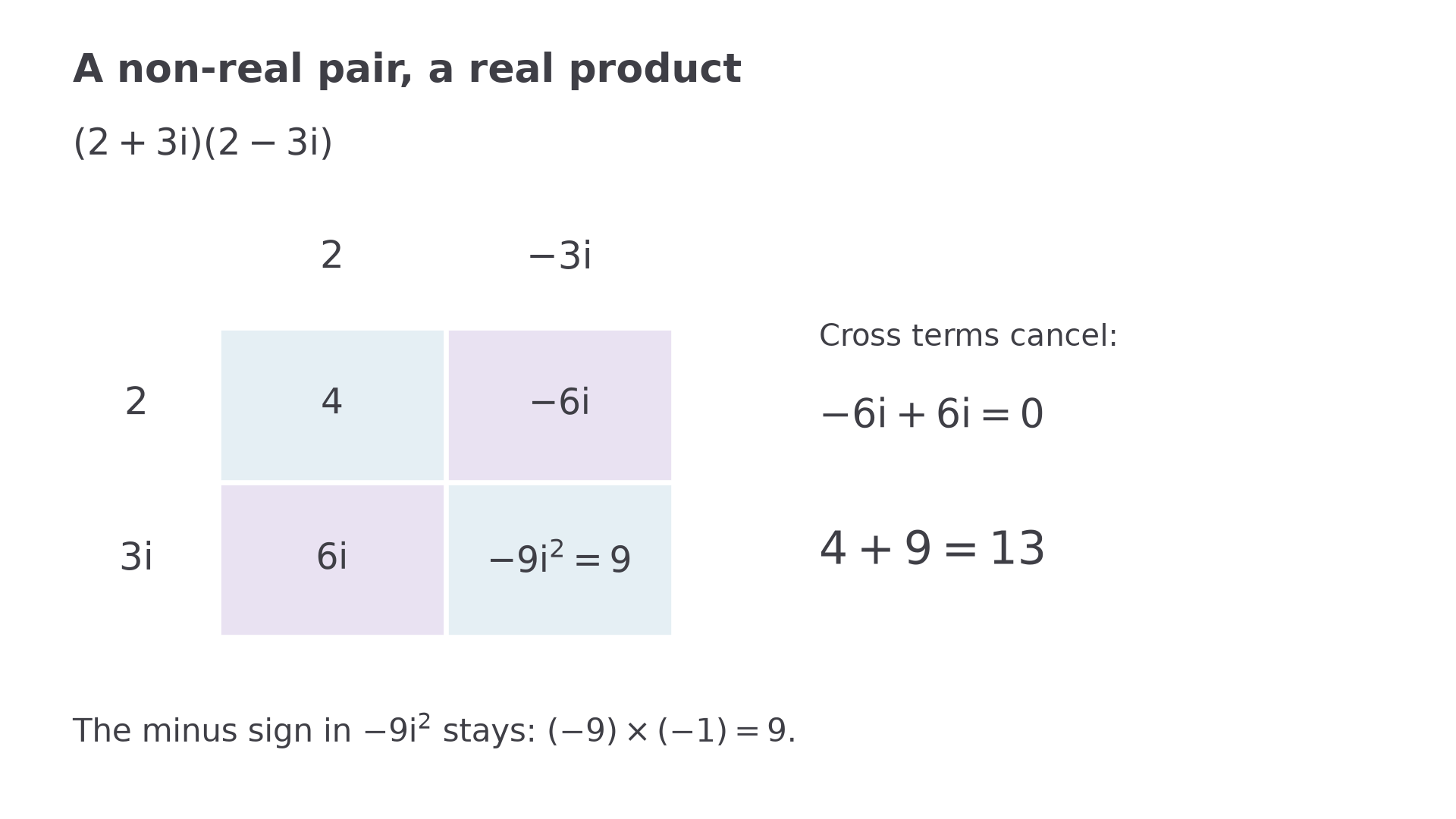
That cancellation is a useful surprise, not a rule that every product is real: Worked example 3 gave a non-real product. You will explore sign-changing pairs further in the next lesson.
Watch out
Wrong: . Replacing means multiplying its coefficient by : .
Show the expansion when practising: it makes a sign slip easy to locate. AQA's paper instructions ask for all necessary working so that method can receive credit.
Quick Recap
- : use this after expanding products.
- In , the real and imaginary parts are the real numbers and .
- Every real number is also complex; its imaginary part is zero.
- Add or subtract matching parts. In a product, expand first and simplify before collecting terms.
Yes: two non-real numbers can have a positive real product. We found .