E3 - Mean value of a function
A changing quantity can be replaced by one constant with the same accumulated total. You will calculate that constant using an integral, explain the equal-area idea, and see why the value halfway through an interval is not generally the average.
Integral divided by interval length
If a temperature is modelled by degrees Celsius for hours, is its average the temperature halfway through? The halfway temperature is . An average must take account of the whole interval, including its rapidly rising end.
For equally spaced readings, an arithmetic mean gives equal weight to equal portions of time. As the spacing becomes finer, the sum becomes an integral. You divide the accumulated total by the length of the interval, rather than by the upper endpoint alone.
Mean value of a function
For an integrable function on a finite interval , with , its mean value is
The integral is signed. The mean has the same units as . Not in the formula booklet: learn it.
Worked example 1: an average temperature
Question. Find the mean value of on .
Plan. Integrate the temperature, then divide by the three-hour interval.
Answer. The mean temperature is .
Check. The accumulated total has units ; dividing by hours recovers temperature. The result lies between the minimum 20 and maximum 29, and differentiating the primitive recovers .
Keep the model and change only the interval's upper endpoint. Both the integral and its divisor change.
Worked example 2: a longer interval
Question. Find the mean value of the same model on .
Plan. Accumulate over six hours, then divide by 6.
Answer. The mean is .
Check. Write . The quadratic contribution over this interval has four times the mean of on , so the mean is , agreeing independently.
The average of the two endpoint temperatures in Worked example 2 is 38, and the midpoint temperature is 29. Neither equals 32: different averaging procedures need not agree.
Watch out
Wrong: . This works only when . The interval length is .
Move the interval away from zero in this fresh calculation.
Why the average gives an equal-area rectangle
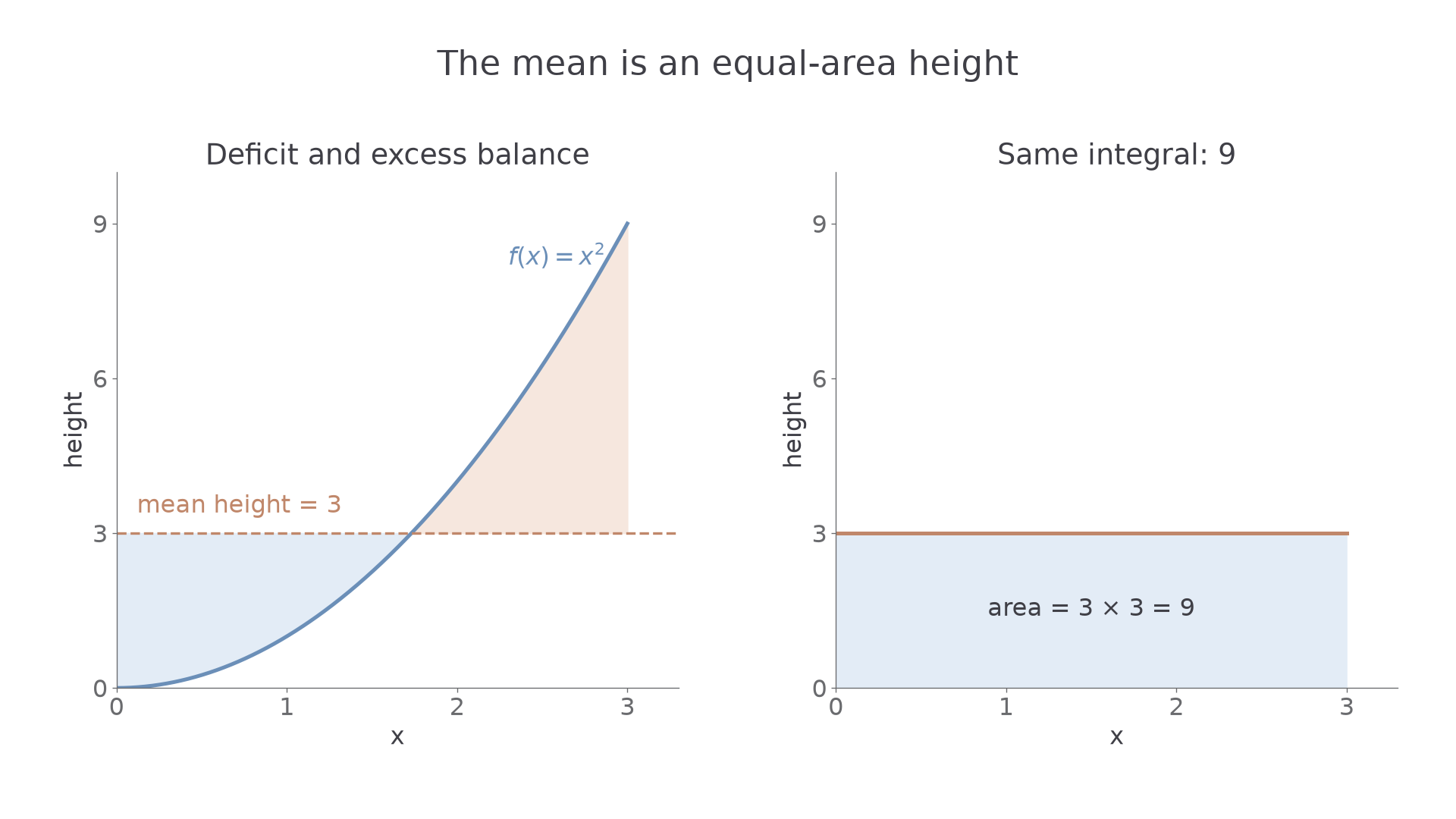
The mean value is the height of a rectangle whose signed area equals the signed area under the graph over the same interval. In Worked example 1, a rectangle of width 3 and height 23 has area 69, the same as the integral of the temperature.
[DIAGRAM: asset_name: A rectangle with the same integral; asset_slug: aqa7367-mean-rectangle; caption: The constant mean height balances the excess and deficit relative to the curve; description: Graph of f of x equals x squared on zero to three, with a horizontal line at height three. The region between the curve and this line below height three is shaded pale blue, and the region above it is shaded pale clay. A separate pale rectangle of width three and height three has the same area nine as the area under the curve. Labels state integral equals nine and mean equals three.]
Continue this lesson.
You’re previewing NovaLearn without an account. Create a free account to read the rest.
Create free account