4.9 - Models, Fields and Mathematical Relationships
Physics uses a small number of repeated ideas to explain many different situations. These ideas appear across the whole course, so they can be assessed in questions that link topics together. This lesson is about recognising the pattern behind the topic: models, causes, fields, differences, proportionality, and mathematical laws.
Why key ideas matter
A key idea is a general thinking tool that works in many areas of physics. It is not a separate topic like electricity or waves. Instead, it is a way of connecting topics.
For example, the idea of a model appears in the particle model of matter, the wave model of light and sound, and simple diagrams of atoms. The idea of cause and effect appears when a resultant force causes acceleration, or when a change inside an atomic nucleus leads to radiation being emitted.
[DIAGRAM: asset_name: key_ideas_summary_map - diagram 1; asset_slug: 118_4_9_key_ideas_in_physics_diagram1; file: diagram_assets/118_4_9_key_ideas_in_physics_diagram1.png; recommended_method: image_gen; description: Built-in Codex Image Gen summary map with central label "Key ideas in physics" and six clearly labelled branches: models; cause and effect; action at a distance and fields; differences drive change; proportionality; mathematical laws and models. Each branch includes one GCSE example: particle model/wave model; force causes acceleration; gravitational/electric/magnetic fields; pressure/temperature/potential differences; weight proportional to mass and force proportional to extension; equations express physical laws. Generated with built-in Codex Image Gen.]
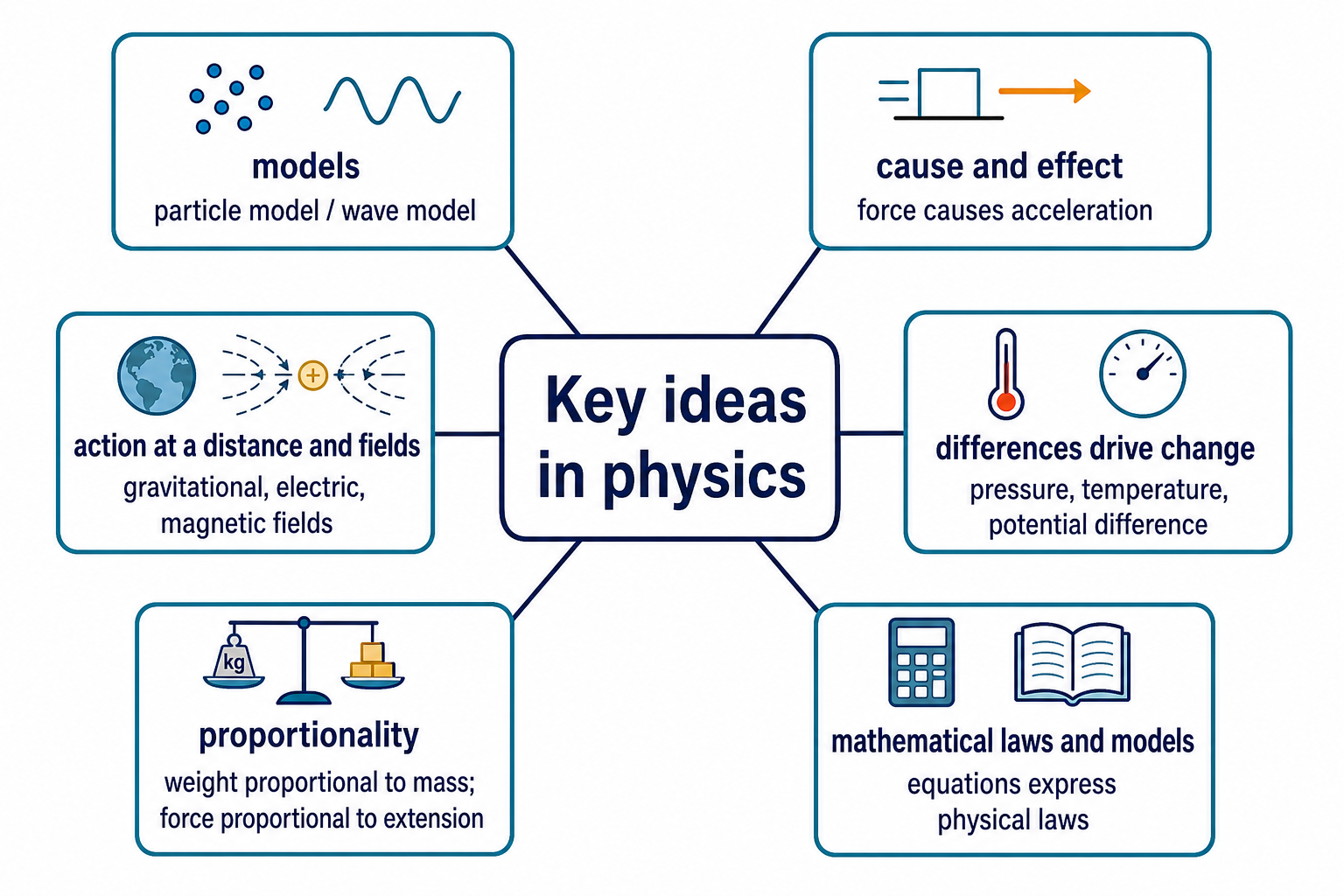
These key ideas help you avoid treating each lesson as a separate memory list. In a strong explanation, you often show a link: a model explains an observation, a difference drives a change, or an equation expresses a relationship.
Models and limits
A model is a simplified representation of something. Models are useful because some physical systems are too small, too large, too fast, too slow, or too complicated to show directly.
Scientific model
A scientific model is a simplified way of representing a system, process or relationship so that it can be explained, predicted or calculated.
The particle model is useful because it lets you explain solids, liquids, gases, density and changes of state using particles. The wave model is useful because it lets you describe reflection, refraction, sound and electromagnetic radiation using ideas such as wavelength, frequency and speed.
Every model has limits. A particle diagram might show particles as large solid circles, but real atoms and molecules are not simple classroom circles. A wave diagram might show a neat sine wave, but the actual situation may be three-dimensional. The model is still useful if you know what it is meant to explain and where it stops being accurate.
A good model answer does not just say "the model is wrong". It says what the model helps with, and then names a specific limitation.
Cause and effect
Cause and effect means linking what changes first to what happens because of that change. In physics, this is often stronger than just naming two quantities.
For example:
- if the resultant force on an object increases while its mass is unchanged, the acceleration increases
- if an unstable atomic nucleus changes, radiation may be emitted
- if a material absorbs electromagnetic radiation, energy is transferred to the material
The useful word is because. A clear physics explanation often follows this shape:
cause -> physics link -> effect
For example: "The resultant force is larger, so the same mass has a larger acceleration." That is stronger than only saying "force and acceleration are linked".
In cause-and-effect explanations, name the cause, then link it to the effect using the relevant physics idea.
The cause must be specific. "It changes" is not enough. Say what changes, such as force, temperature, pressure, potential difference, charge, field strength or energy transferred.
Fields and action at a distance
Some forces can act without objects touching. This is called action at a distance. The field model is the key idea used to analyse these effects.
Field
A field is a region where an object can experience a non-contact force.
GCSE Physics uses three important field examples:
| Field type | Object that experiences the force | Example effect |
|---|---|---|
| gravitational field | mass | a weight force acts on an object near Earth |
| electric field | charge | a charged object can attract or repel another charged object |
| magnetic field | magnetic material, magnet or current-carrying wire | magnets and electromagnets can exert forces |
Continue this lesson.
You’re previewing NovaLearn without an account. Create a free account to read the rest.
Create free account