4.5.6.3.2 - Reaction time
Reaction time is the delay between noticing something and beginning to respond. In driving, it is the time between seeing a hazard and starting to brake. During that time the vehicle is still moving, so a longer reaction time means a longer thinking distance.
Meaning and typical values
Reaction time is a time, not a distance. It is measured in seconds, s.
Reaction Time
Reaction time is the time between a stimulus being detected and the response beginning.
For a driver, the stimulus might be a child stepping into the road. The response begins when the driver starts to press the brake pedal.
AQA expects you to recall that typical human reaction times range from 0.2 s to 0.9 s. This range matters because people do not all react at the same speed, and the same person may react differently in different conditions.
Do not confuse reaction time with thinking distance:
- reaction time is the time taken to react
- thinking distance is the distance travelled during that reaction time
If the vehicle speed is the same, a longer reaction time gives a longer thinking distance.
Ruler drop method
One simple method for measuring human reaction time is the ruler drop test. It does not measure the time directly; it measures how far a ruler falls before it is caught.
[DIAGRAM: asset_name: ruler_drop_reaction_time_method - diagram 1; asset_slug: 077_4_5_6_3_2_reaction_time_diagram1; file: diagram_assets/077_4_5_6_3_2_reaction_time_diagram1.png; recommended_method: image_gen; description: Exact assessed apparatus diagram for a ruler drop reaction-time test. Show a vertical ruler held above an open thumb and finger, the zero mark initially aligned with the fingers, a second catch position after the drop, and a labelled arrow for the distance fallen before catching. Include labels "drop without warning", "catch point", "distance fallen", and "repeat and calculate a mean".]
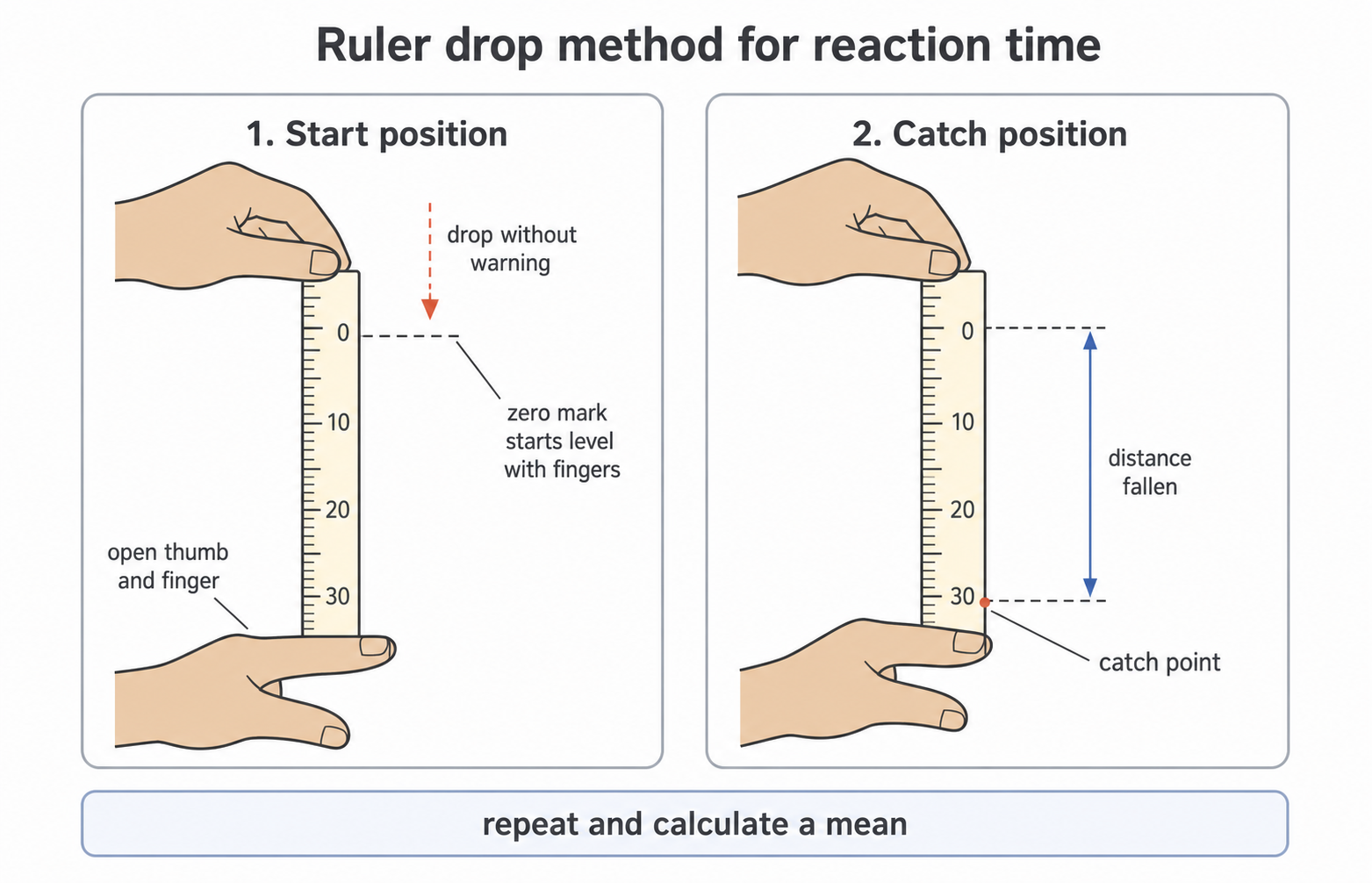
A typical method is:
- One student holds a ruler vertically so the zero mark is level with another student's open thumb and finger.
- The catcher keeps their hand still and watches the ruler.
- The ruler is dropped without warning.
- The catcher closes their thumb and finger as quickly as possible.
- The distance fallen is read from the ruler at the catch point.
- The test is repeated and a mean distance is calculated.
A shorter distance fallen means a shorter reaction time, because the catcher responded sooner. If exact reaction times are needed, a conversion chart can be used to convert the drop distance into seconds.
The method should be standardised. Use the same ruler, the same starting position, the same hand, the same instruction, and the same number of repeats for each student. The drop should be unpredictable so the catcher cannot simply guess when to close their fingers.
Interpreting measurements
Reaction-time data is often compared using means. This reduces the effect of random variation between trials.
For a ruler drop test:
- smaller distance fallen means shorter reaction time
- larger distance fallen means longer reaction time
- repeated readings help identify anomalous results
- a mean is more reliable if anomalous results are dealt with sensibly
Suppose two students collect this data:
| Student | Trial 1 distance in cm | Trial 2 distance in cm | Trial 3 distance in cm |
|---|---|---|---|
| Jamie | 14 | 15 | 16 |
| Priya | 8 | 9 | 10 |
Jamie's mean distance is 15 cm. Priya's mean distance is 9 cm. Priya has the shorter reaction time because the ruler did not fall as far before being caught.
Now look at this set:
| Trial | Distance in cm |
|---|---|
| 1 | 12 |
| 2 | 13 |
| 3 | 38 |
| 4 | 12 |
The 38 cm result is likely to be anomalous if the method was meant to be repeated under the same conditions. It should not be deleted automatically, but it should be checked. The student might have been distracted, missed the ruler, or the drop might not have been done in the same way.
Evaluating methods
Simple reaction-time methods are useful, but they are not perfect.
The ruler drop test is quick and cheap, but there are several sources of uncertainty:
- the catcher may anticipate the drop
- the ruler may not be released cleanly or vertically
- the catch point may be read incorrectly
- the starting position of the fingers may not be identical each time
- practice may improve the result during repeated trials
The method can be improved by using a random delay before the drop, using more repeats, calculating a mean, using the same operator each time, and giving each student a practice attempt before the recorded trials.
Continue this lesson.
You’re previewing NovaLearn without an account. Create a free account to read the rest.
Create free account