4.4.3.3 - Uses of Nuclear Radiation
Nuclear radiation can be harmful because it can ionise atoms in living cells, but that same ability can be useful in medicine when the dose is controlled. In this physics-only topic, the two GCSE uses are exploring internal organs and controlling or destroying unwanted tissue. The key exam skill is not just naming a use: it is evaluating whether the benefit is worth the radiation risk in a given situation.
Medical Uses And Trade-Offs
Medicine uses nuclear radiation when doctors need information or treatment that is difficult to get another way. A radioactive substance can be put into the body to show where it travels, or radiation can be directed at tissue that needs to be controlled or destroyed.
Nuclear Radiation In Medicine
Nuclear radiation in medicine means ionising radiation from radioactive materials or nuclear changes used in a controlled medical procedure.
The word controlled matters. Medical staff choose the type, activity, position, and timing of the source so that the useful effect is large enough, while unnecessary exposure to healthy tissue and other people is kept as low as practicable.
For this lesson, keep the boundary clear:
- exploration of internal organs means using radiation to find out what is happening inside the body
- control or destruction of unwanted tissue means using radiation to damage tissue such as cancer cells or overactive tissue
- evaluating risk means using the data in the question, not just saying that radiation is dangerous
Exploring Internal Organs
To explore an internal organ, a patient may be given a radioactive tracer. The tracer is chosen so that it is taken up by a particular organ, blood vessel, or tissue. As the tracer decays, radiation leaves the body and is detected outside the patient.
Radioactive Tracer
A radioactive tracer is a radioactive substance put into the body so its movement or concentration can be detected from the radiation it emits.
Gamma radiation is useful for many tracer scans because it can pass out of the body and be detected by a gamma camera. The scan can show how an organ is working, not just what shape it is. For example, a tracer may collect more in one region than another, giving doctors evidence about blood flow, organ function, or possible disease.
[DIAGRAM: asset_name: tracer-gamma-camera-imaging - diagram 1; asset_slug: 050_4_4_3_3_uses_of_nuclear_radiation_diagram1; file: diagram_assets/050_4_4_3_3_uses_of_nuclear_radiation_diagram1.png; recommended_method: image_gen; description: Assessed schematic showing a small amount of radioactive tracer concentrated in an internal organ, gamma radiation travelling out of the body, a gamma camera detecting it, and a simplified image highlighting the organ. Labels must include radioactive tracer, internal organ, gamma radiation, gamma camera, and image. Built-in Codex Image Gen raster diagram selected for a clean GCSE classroom visual.]
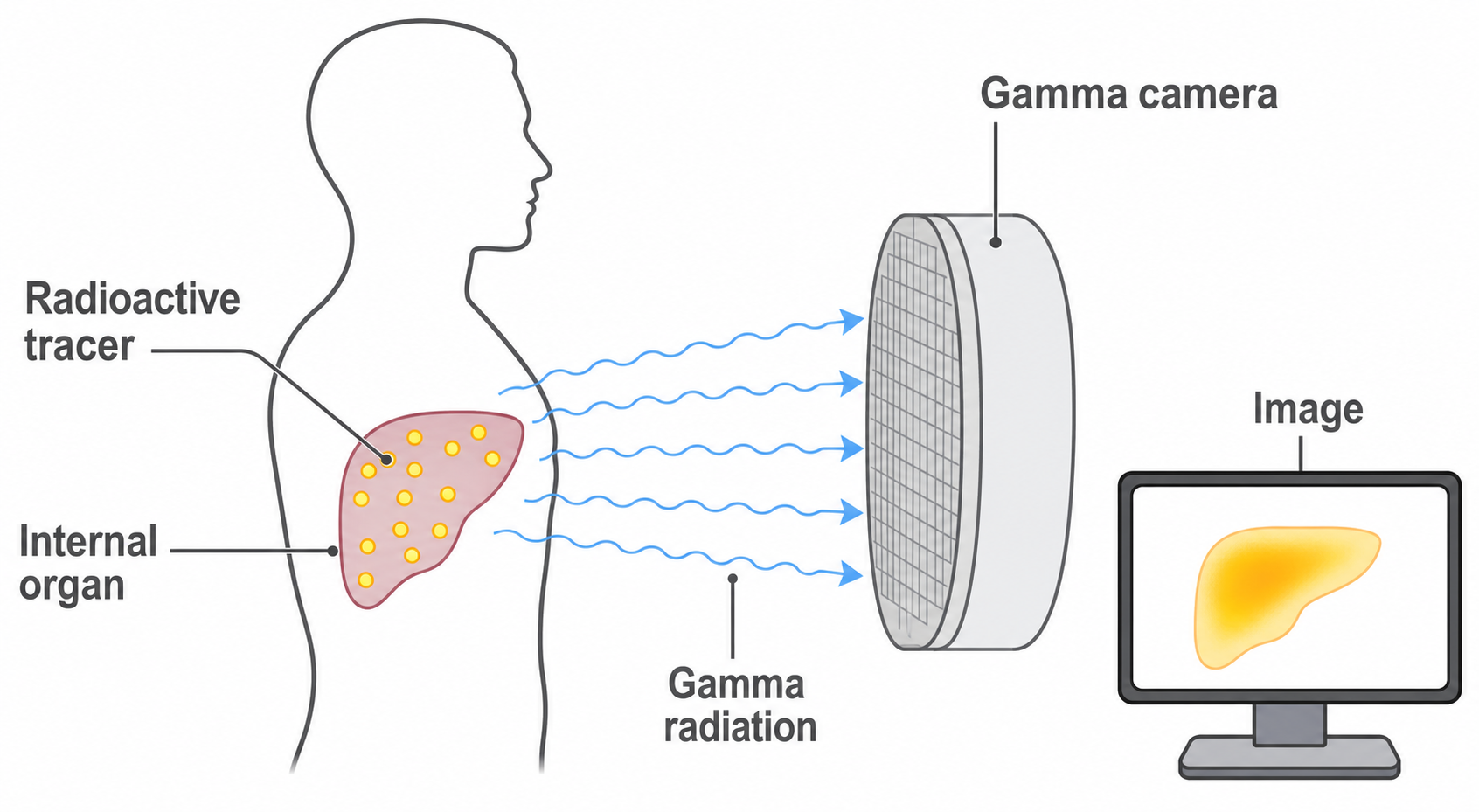
The benefit is that doctors can diagnose or monitor a condition without surgery. The risk is that the tracer exposes the patient to ionising radiation, which can damage cells and slightly increase the chance of cancer later in life. A good evaluation compares this small extra risk with the consequence of not finding a serious medical problem.
Destroying Unwanted Tissue
Radiation can also be used to control or destroy unwanted tissue. In cancer treatment, the target is often a tumour. In other cases, radioactive material may be used to reduce tissue that is behaving abnormally, such as some overactive thyroid tissue.
Radiotherapy
Radiotherapy is treatment that uses ionising radiation to damage cells in targeted tissue, often to kill cancer cells or stop them dividing.
Radiation damages DNA and other cell structures. This can stop cells from dividing, or kill them. Cancer cells are useful targets because they divide rapidly, but healthy cells can also be damaged, so treatment has to be planned carefully.
Nuclear radiation can be used in treatment in different ways. Gamma radiation from a source may be directed from outside the body so beams cross at the target, a radioactive source may be placed close to the unwanted tissue, or a radioactive medicine may collect in the tissue being treated. The aim is to give a high enough dose to the target while keeping the dose to healthy tissue and other people as low as possible.
Continue this lesson.
You’re previewing NovaLearn without an account. Create a free account to read the rest.
Create free account