4.5.6.2.2a - Newton's Second Law and Resultant Force
Newton's Second Law links the resultant force on an object to the acceleration it produces. The equation is short, but the exam skill is careful: use the resultant force, use mass in kilograms, and give acceleration in metres per second squared. This lesson focuses on the core law, calculations, direction, and estimates for road transport.
What the second law says
Newton's Second Law describes what happens when the forces on an object do not balance. A non-zero resultant force causes acceleration. The larger the resultant force, the larger the acceleration, as long as the mass stays the same.
Resultant Force
The resultant force is the single force that has the same effect as all the forces acting on an object together.
The law also says that mass matters. For the same resultant force, a larger mass has a smaller acceleration. A loaded trolley is harder to accelerate than an empty trolley if the same resultant force acts on each one.
Using proportionality symbols:
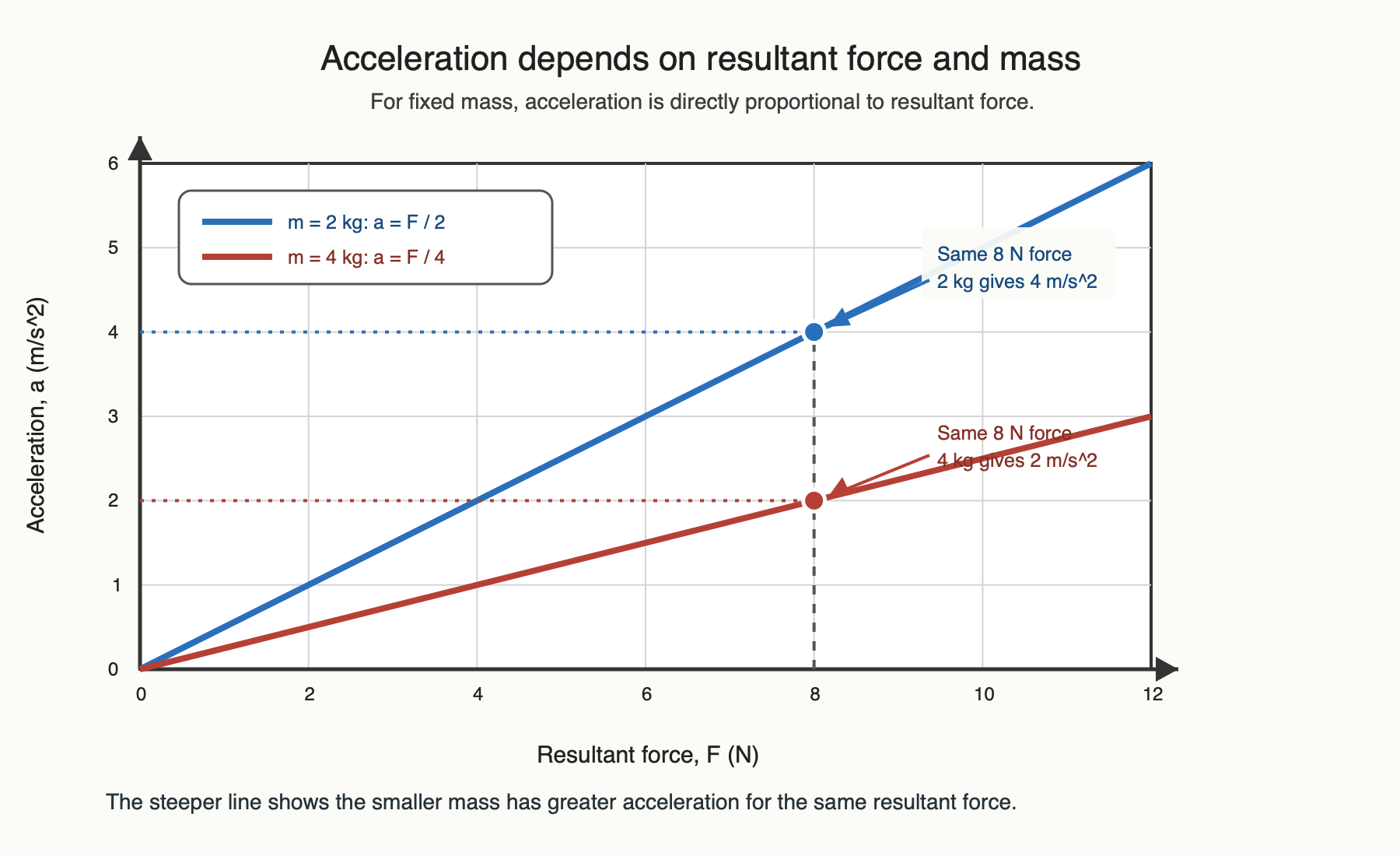
Here ∝ means "is proportional to". If two quantities are proportional, changing one by a scale factor changes the other in a predictable way. For example, if the mass is constant, doubling the resultant force doubles the acceleration.
[DIAGRAM: asset_name: Newton's Second Law and Resultant Force - diagram 1; asset_slug: 073_4_5_6_2_2a_newtons_second_law_and_resultant_force_diagram1; file: diagram_assets/073_4_5_6_2_2a_newtons_second_law_and_resultant_force_diagram1.png; recommended_method: image_gen; description: Exact force-and-motion schematic showing a 2 kg trolley with a 12 N forward driving force and a 5 N backward resistive force, giving a 7 N resultant force to the right and acceleration 3.5 m/s^2 to the right. This visual teaches that Newton's Second Law uses resultant force, not one selected force, so assessed values, labels and arrow directions require deterministic drawing.]
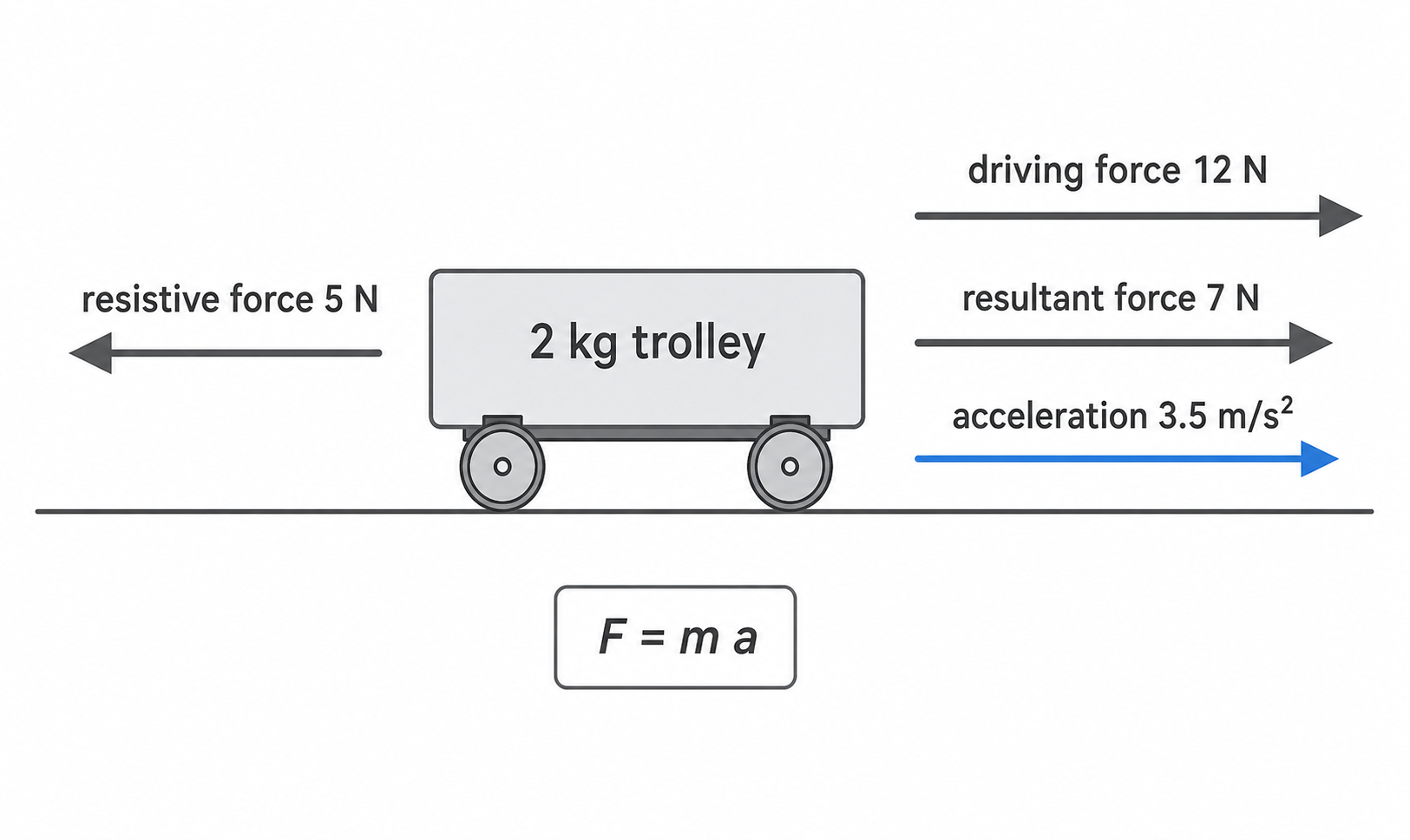
The forward force in the diagram is not the value to put into F = ma on its own. The force in the equation is the resultant force: the force left after all forces in that direction have been combined.
Using F = ma
Newton's Second Law is written as:
Newton's Second Law
In this equation:
| Symbol | Quantity | Unit |
|---|---|---|
F | resultant force | newtons, N |
m | mass | kilograms, kg |
a | acceleration | metres per second squared, m/s^2 |
For AQA GCSE Physics exams in 2026 and 2027, this equation is supplied on the Physics Equations Sheet. You still need to recognise when it applies and use it accurately.
The unit N fits the equation. A force of 1 N gives a mass of 1 kg an acceleration of 1 m/s^2, so:
Worked example: A 3.0 kg model car accelerates at 2.5 m/s^2. Calculate the resultant force.
Relationship:
Substitution:
Answer:
The answer is a force, so the unit is newtons.
Finding acceleration
The same equation can be rearranged if the question asks for acceleration:
This rearrangement matches the meaning of the law. A bigger resultant force gives a bigger acceleration; a bigger mass gives a smaller acceleration.
[DIAGRAM: asset_name: Newton's Second Law and Resultant Force - diagram 2; asset_slug: 073_4_5_6_2_2a_newtons_second_law_and_resultant_force_diagram2; file: diagram_assets/073_4_5_6_2_2a_newtons_second_law_and_resultant_force_diagram2.png; recommended_method: deterministic_drawn; description: Exact line graph of acceleration against resultant force for two fixed masses, 2 kg and 4 kg. Both lines pass through the origin; the 2 kg line has twice the gradient of the 4 kg line. The visual teaches direct proportionality to resultant force and inverse dependence on mass, with assessed axes, gradients and units, so deterministic drawing is required.]
Worked example: A cyclist and bicycle have a combined mass of 80 kg. The resultant forward force is 120 N. Calculate the acceleration.
Relationship:
Substitution:
Answer:
Continue this lesson.
You’re previewing NovaLearn without an account. Create a free account to read the rest.
Create free account