4.8.1.1 - Our Solar System and Star Formation
The solar system is not the whole Universe. It is one small system inside the Milky Way galaxy, held together by the Sun's gravity. This physics-only lesson also explains the start of the Sun's life: dust and gas were pulled together by gravity until fusion reactions began and a stable balance formed.
What is in the solar system
Our solar system contains one star: the Sun. The Sun is the central star, and its gravitational attraction keeps the main solar-system objects in orbit.
Around the Sun there are eight planets. There are also dwarf planets that orbit the Sun. Dwarf planets are part of the solar system, but at GCSE you do not need a detailed classification rule for them in this lesson; the key point is that they are not counted as the eight planets.
Natural satellites are also part of the solar system. A natural satellite is a moon that orbits a planet. For example, Earth's Moon is a natural satellite because it orbits Earth.
Natural satellite
A natural satellite is a moon that orbits a planet.
The orbit pattern matters. Planets and dwarf planets orbit the Sun. Natural satellites orbit planets. In a wider sense the whole planet-and-moon system travels around the Sun, but a moon is described as a natural satellite because its direct orbit is around a planet.
The Milky Way context
Our solar system is a small part of the Milky Way galaxy. A galaxy is a huge collection of stars, gas and dust held together by gravity. The Milky Way contains many stars; the Sun is just one of them.
[DIAGRAM: asset_name: solar_system_milky_way_context - diagram 1; asset_slug: 113_4_8_1_1_our_solar_system_and_star_formation_diagram1; file: diagram_assets/113_4_8_1_1_our_solar_system_and_star_formation_diagram1.png; recommended_method: image_gen; description: Image-generated membership and nesting visual showing the solar system as a small part of the Milky Way galaxy, and showing the Sun, eight planets, dwarf planets, and natural satellites/moons grouped by what they orbit. The image is not to scale, and nearby prose explains the same information for accessibility.]
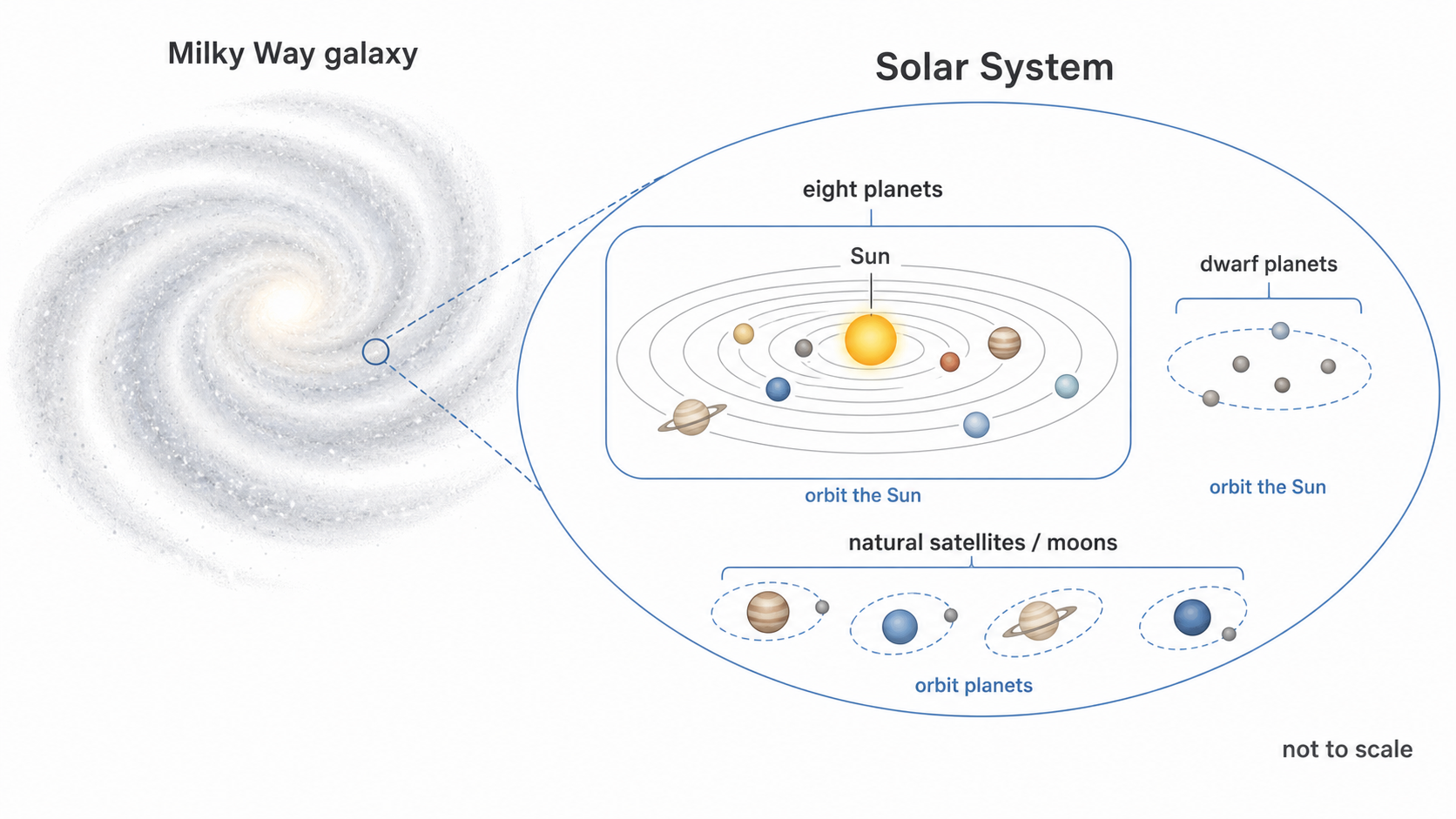
Do not confuse these scale levels:
- a moon is a natural satellite that orbits a planet
- a planet or dwarf planet orbits the Sun
- the solar system contains the Sun and the objects orbiting it
- the solar system is only a small part of the Milky Way
The solar system is a small part of the Milky Way, not another name for the Milky Way.
Nebula and gravity
The Sun was formed from a cloud of dust and gas called a nebula. The cloud was not pulled together by magnetism, burning, or an explosion. It was pulled together by gravitational attraction.
Nebula
A nebula is a cloud of dust and gas in space.
Every part of the cloud attracted every other part by gravity. In a large enough cloud, denser regions can pull in more dust and gas. The material becomes more concentrated, so the centre becomes hotter and denser as the cloud collapses.
[DIAGRAM: asset_name: nebula_to_protostar_concept - diagram 2; asset_slug: 113_4_8_1_1_our_solar_system_and_star_formation_diagram2; file: diagram_assets/113_4_8_1_1_our_solar_system_and_star_formation_diagram2.png; recommended_method: image_gen; description: Qualitative, non-assessed conceptual visual of a dusty nebula with material gathering toward a bright forming star. Image generation is appropriate because this is an illustrative star-formation scene with no assessed labels, axes, equations or exact geometry. Nearby prose carries the assessed explanation.]
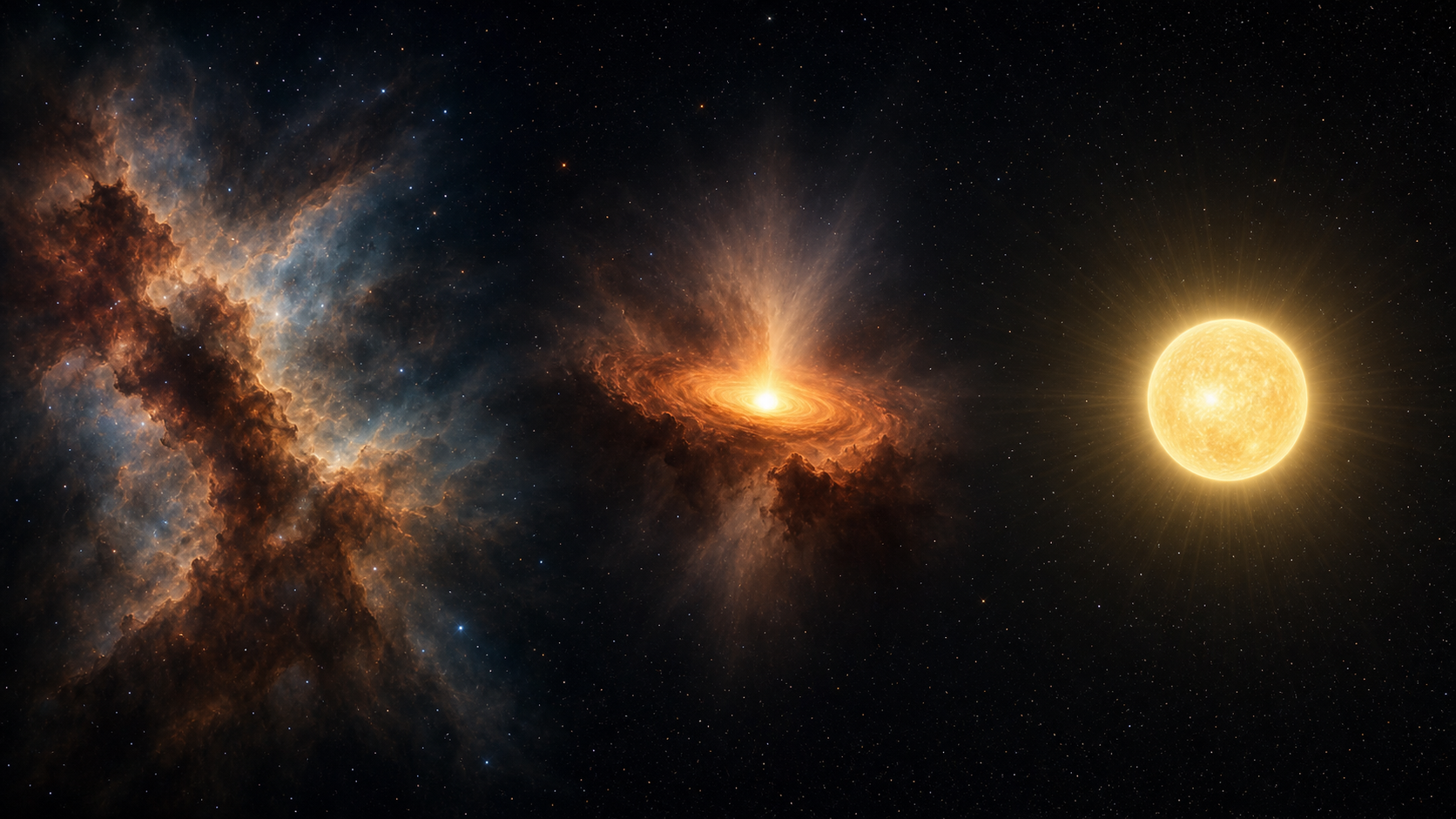
This collapse is the start of a star's life cycle. It is the part of the life cycle in scope for this lesson. Later stages of star evolution are handled separately.
Fusion begins
As the dust and gas are drawn together by gravity, the material at the centre becomes hotter and denser. Eventually the conditions in the core become suitable for fusion reactions.
Continue this lesson.
You’re previewing NovaLearn without an account. Create a free account to read the rest.
Create free account