4.7.3.3 - Microphones
This Physics-only Higher-tier lesson is about moving-coil microphones. A microphone uses the generator effect to convert pressure variations in a sound wave into variations in current in an electrical circuit. The exam skill is to explain that conversion as a clear chain of causes, not just to name the parts.
Sound pressure makes a diaphragm vibrate
A sound wave in air is a pattern of changing pressure. Compressions are regions of higher pressure, and rarefactions are regions of lower pressure.
When these pressure variations reach a thin flexible surface, they push and pull on it. In a moving-coil microphone, this thin flexible surface is called the diaphragm.
Diaphragm
The diaphragm is the thin flexible part of a microphone that vibrates when sound pressure variations reach it.
The diaphragm vibrates backwards and forwards in the direction the sound wave is travelling. This wording matters. In exam answers, "the diaphragm moves" is too vague because it does not say what causes the movement or that the movement is a vibration.
Generator effect reminder
The moving-coil microphone uses the generator effect. This is the same electromagnetic principle used whenever motion in a magnetic field produces an electrical output.
Generator effect
The generator effect is the induction of a potential difference across a conductor when it moves relative to a magnetic field, or when the magnetic field around it changes.
If the conductor is part of a complete circuit, the induced potential difference causes an induced current to flow. In a moving-coil microphone, the moving conductor is the coil of wire.
The microphone does not use the motor effect. The motor effect starts with a current and produces a force or movement. A microphone starts with sound-driven movement and produces a current, so it is a generator-effect device.
How the moving coil works
A moving-coil microphone contains:
- a diaphragm
- a coil of wire attached to the diaphragm
- a permanent magnet that provides a magnetic field
- an output circuit connected to the coil
When sound pressure variations make the diaphragm vibrate, the attached coil vibrates too. The coil moves backwards and forwards in the magnetic field of the permanent magnet.
[DIAGRAM: asset_name: Moving-coil microphone mechanism - diagram 1; asset_slug: 110_4_7_3_3_microphones_diagram1; file: diagram_assets/110_4_7_3_3_microphones_diagram1.png; recommended_method: image_gen; description: Labelled mechanism diagram of a moving-coil microphone. It shows pressure variations in a sound wave reaching a diaphragm, the diaphragm attached to a coil of wire, the coil vibrating backwards and forwards in the magnetic field of a permanent magnet, and the coil connected to an output circuit where an induced alternating current flows.]
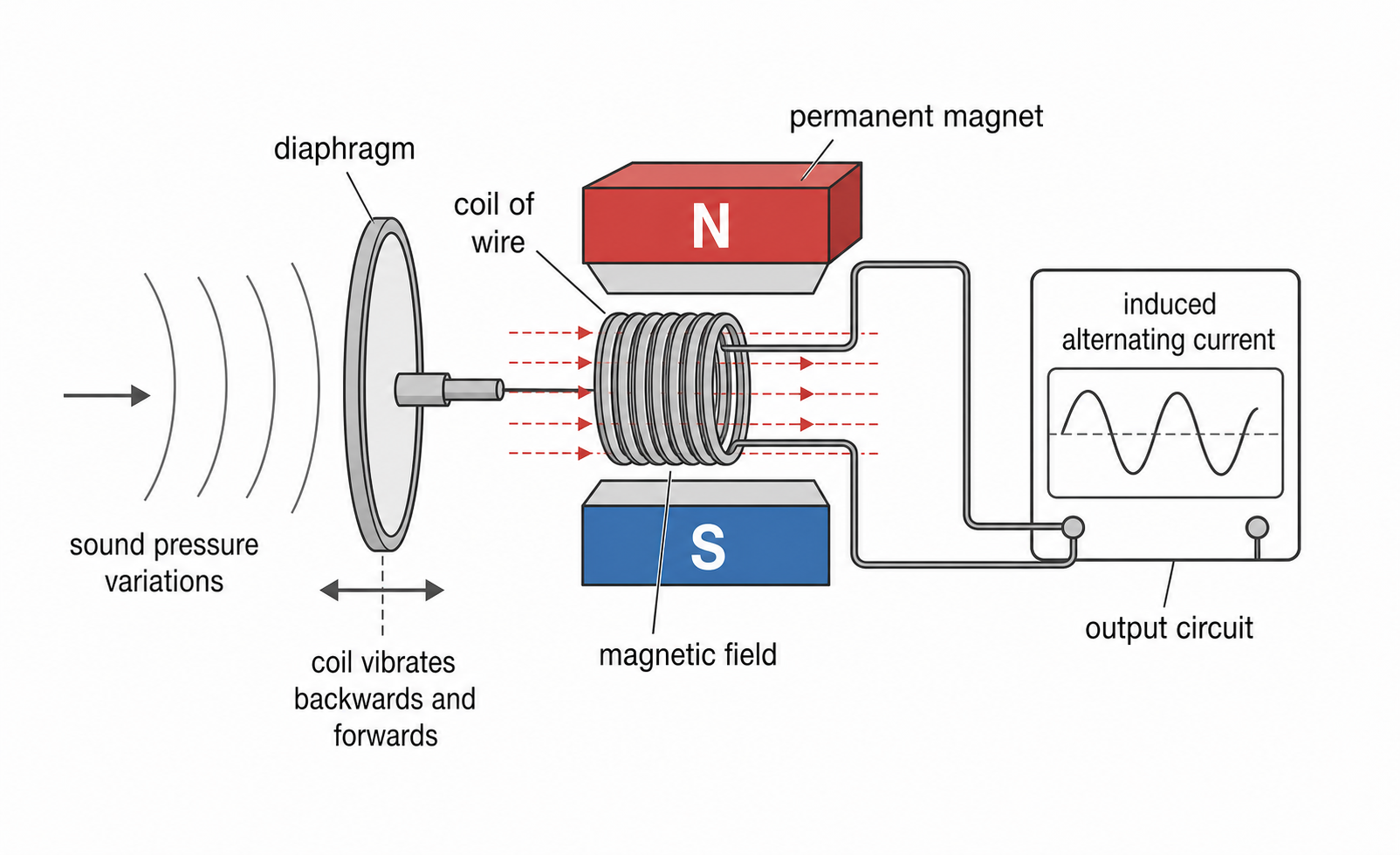
As the coil moves through the magnetic field, the wire in the coil cuts magnetic field lines. A potential difference is induced across the coil. Because the coil is connected in a complete circuit, an induced current flows in the circuit.
The chain is:
sound pressure variations -> diaphragm vibrates -> coil vibrates in magnetic field -> induced p.d. -> induced current
Continue this lesson.
You’re previewing NovaLearn without an account. Create a free account to read the rest.
Create free account