4.5.6.1.1 - Distance and Displacement
Distance and displacement both describe motion, but they answer different questions. Distance asks how much ground was covered. Displacement asks where the object finished compared with where it started.
Distance is how far an object moves
Distance is about the whole path taken by the object. If an object changes direction, every part of its movement still adds to the distance.
Distance
Distance is how far an object moves. Distance does not involve direction, so distance is a scalar quantity.
A complete distance answer needs a magnitude and a unit, such as 8 m, 120 m or 0.5 km. It does not need a direction. For example, if a student walks 6 m across a room and then 4 m back, the distance moved is:
The answer is 10 m, not 10 m left or 10 m right, because distance does not involve direction.
Displacement is a straight-line vector
Displacement compares the start point with the finish point. It does not follow every bend or turn in the route. Instead, it uses the straight line from the start point to the finish point.
Displacement
Displacement includes the distance an object moves, measured in a straight line from the start point to the finish point, and the direction of that straight line. Displacement is a vector quantity.
Because displacement is a vector, a complete answer must include both:
- the magnitude, with a unit
- the direction
For example, 12 m east is a complete displacement. The value 12 m alone is not complete because the direction is missing. The word east alone is not complete because the magnitude is missing.
Same journey, two answers
The same motion can have one value for distance and a different value for displacement.
[DIAGRAM: asset_name: distance_and_displacement_route - diagram 1; asset_slug: 066_4_5_6_1_1_distance_and_displacement_diagram1; file: diagram_assets/066_4_5_6_1_1_distance_and_displacement_diagram1.png; recommended_method: image_gen; description: Exact one-dimensional motion diagram showing an object starting at 0 m, moving 40 m east, then moving 30 m west to finish 10 m east of the start. Blue path arrows show the distance calculation, 40 m + 30 m = 70 m. An amber straight-line arrow from start to finish shows the displacement, 10 m east. Deterministic drawing is used because the measured route lengths, final position and direction labels carry assessed meaning.]
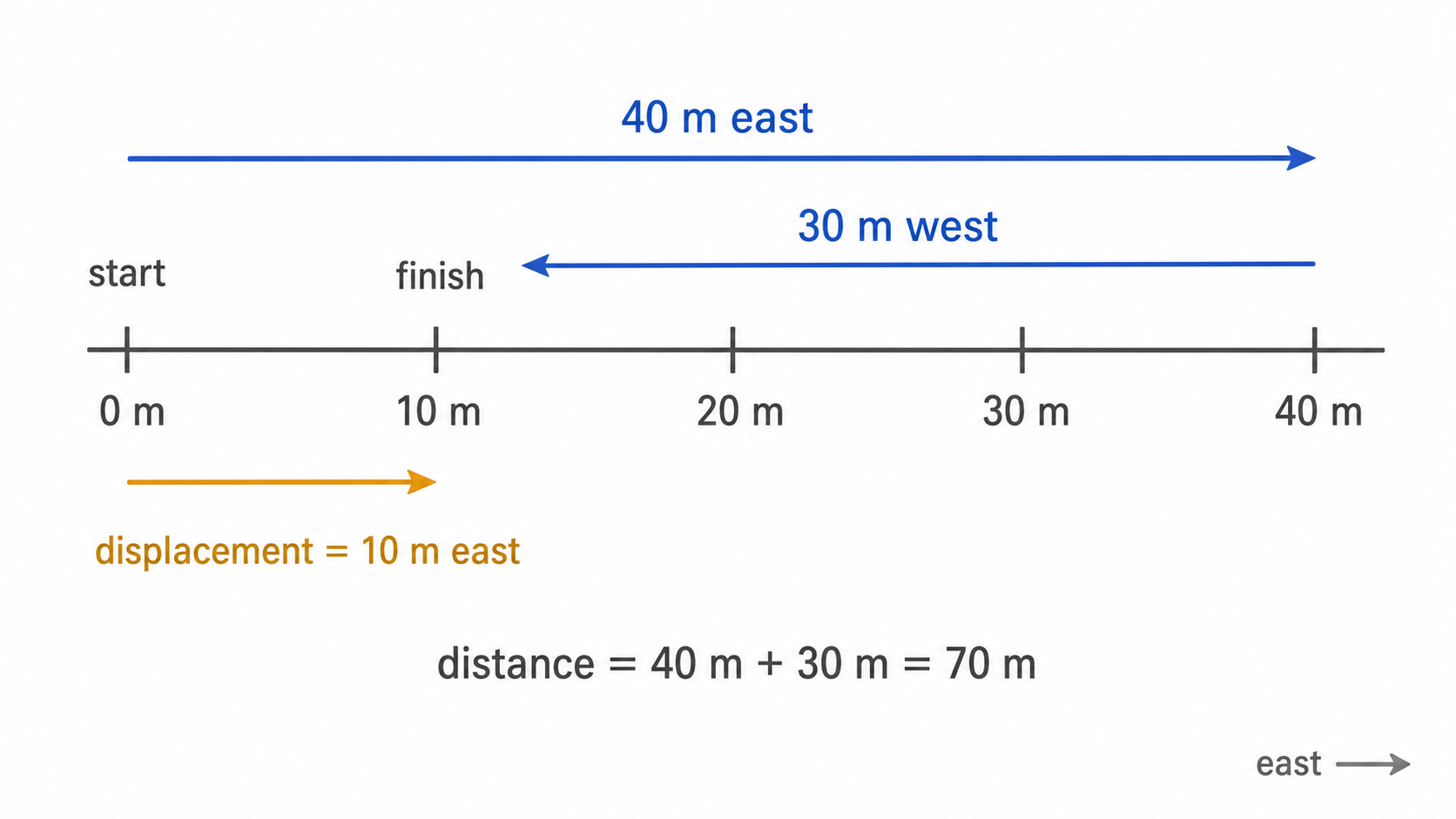
In the diagram, the object moves 40 m east and then 30 m west.
The distance moved is the whole path:
Continue this lesson.
You’re previewing NovaLearn without an account. Create a free account to read the rest.
Create free account