4.6.2.3a - Radio Waves and Electromagnetic Emission
Electromagnetic waves transfer energy from a source to an absorber. This lesson is about how electromagnetic waves can be generated and absorbed, rather than about their applications. For Higher tier, you need radio waves from oscillating electrical circuits; for all students, you need the idea that changes in atoms and nuclei can generate or absorb electromagnetic waves, with gamma rays coming from nuclear changes.
Emission and absorption
An electromagnetic wave has to be produced by something. It can also be absorbed by something. Those two words describe opposite directions of energy transfer.
Electromagnetic emission
Electromagnetic emission is the generation or release of an electromagnetic wave by a source.
When an electromagnetic wave is absorbed, energy is transferred from the wave to the absorber. The absorber might be a material, an electrical circuit, an atom or a nucleus, depending on the situation.
For this lesson, keep this simple chain in mind:
source changes -> electromagnetic wave travels -> absorber changes
The official specification gives three important examples:
- oscillations in electrical circuits can produce radio waves
- absorbed radio waves can induce oscillations in an electrical circuit
- changes in atoms and nuclei can generate or absorb electromagnetic waves over a wide frequency range
The first two radio-wave statements are Higher tier only. The atomic and nuclear emission statement is not marked Higher tier in the specification.
HT only: radio waves from oscillating circuits
An oscillation is a repeated change. In an electrical circuit, this can mean charges repeatedly moving backwards and forwards, or a current repeatedly changing direction. An alternating current is one example of an electrical oscillation.
Oscillation
An oscillation is one complete repeated cycle of a changing quantity or motion.
In a radio transmitter, an electrical circuit makes charge oscillate at a radio frequency. If the circuit is connected to a suitable aerial, the oscillating charges produce changing electric and magnetic fields. Those changing fields spread out from the aerial as a radio wave.
The frequency matters. If the circuit oscillates more times each second, the radio wave produced has a higher frequency. In GCSE language, the radio wave is produced by oscillations in the electrical circuit.
[DIAGRAM: asset_name: Radio-wave emission and absorption by oscillating circuits - diagram 1; asset_slug: 094_4_6_2_3a_radio_waves_and_electromagnetic_emission_diagram1; file: diagram_assets/094_4_6_2_3a_radio_waves_and_electromagnetic_emission_diagram1.png; recommended_method: image_gen; description: Exact assessed transmitter-and-receiver schematic. The left side shows an oscillator circuit driving a transmitting aerial with a current-time sine trace labelled oscillating current, frequency f. The middle shows labelled radio-wave fronts travelling to the right. The right side shows a receiving aerial and circuit with an induced alternating-current sine trace labelled same frequency f. Image generation must preserve the circuit/aerial layout, direction arrows, signal frequency match and labels because they are assessed. Nearby prose explains all symbols for accessibility.]
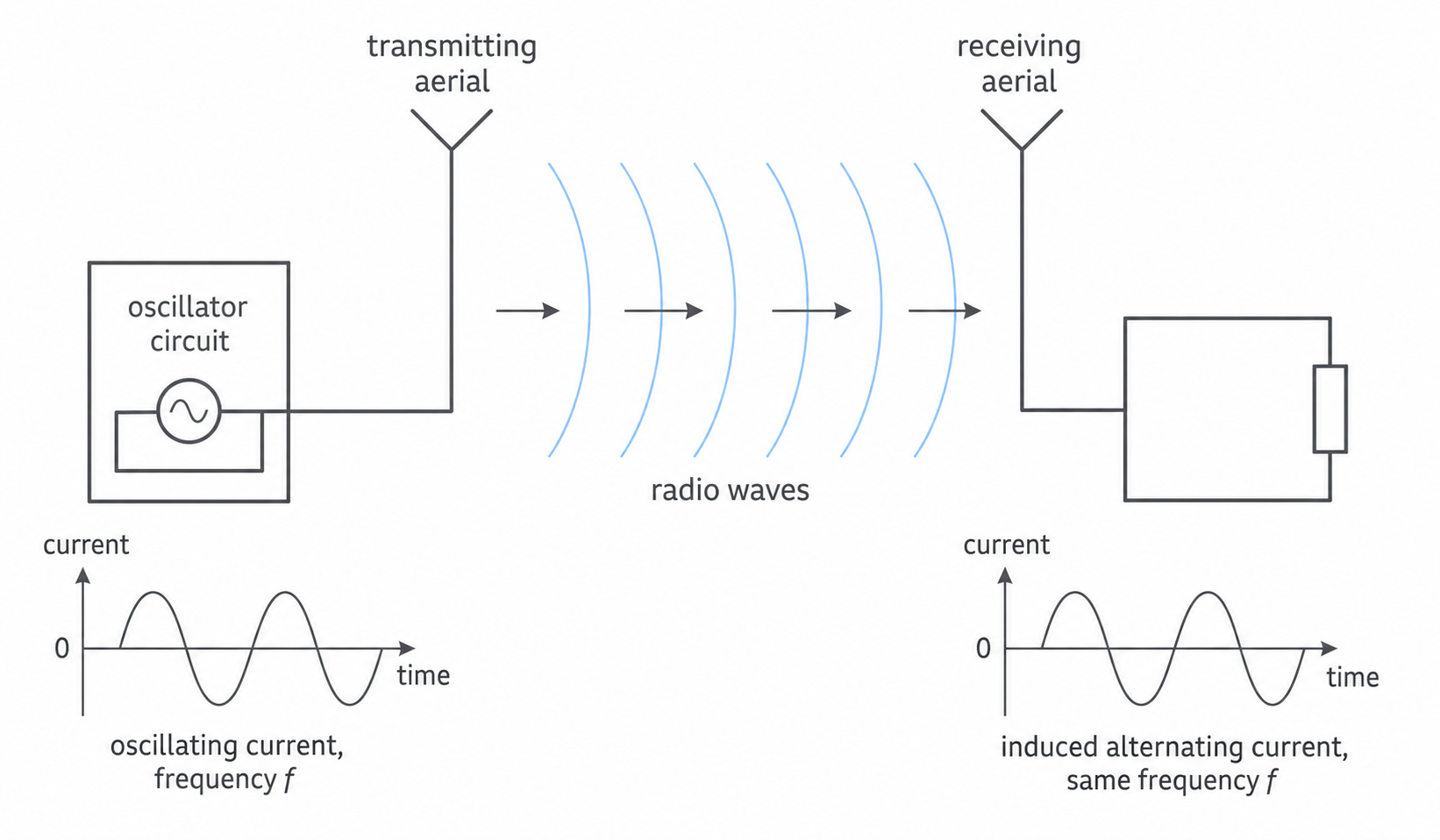
The diagram is not showing the detailed electronics inside a real transmitter. It is showing the assessed physics idea: oscillating current in a transmitting circuit produces a radio wave.
HT only: absorbing radio waves
A receiving aerial works in the reverse direction. When a radio wave reaches the aerial, the changing electric and magnetic fields of the wave act on the charges in the conductor. The charges are driven backwards and forwards.
If the aerial is part of a complete receiving circuit, this motion of charge can create an alternating current. The important AQA point is that the alternating current has the same frequency as the absorbed radio wave.
For example, if a radio wave has a frequency of 100 MHz, the induced alternating current in the receiving circuit also has a frequency of 100 MHz. The signal may be tiny and may need processing by the receiver, but its frequency matches the incoming radio wave.
This is why radio-wave communication can work as a chain:
oscillating transmitter current -> radio wave -> induced oscillating receiver current
The word induce means "create by causing an effect". Here, the absorbed radio wave induces oscillations in the receiving circuit.
Continue this lesson.
You’re previewing NovaLearn without an account. Create a free account to read the rest.
Create free account