4.5.6.3.1 - Stopping Distance
Stopping distance is the total distance a vehicle travels from the moment a driver needs to stop to the moment the vehicle is stationary. It has two parts: the distance travelled while the driver reacts, and the distance travelled while the brakes slow the vehicle down. This lesson focuses on the definition, the effect of speed, and the physics-only skill of estimating and interpreting stopping-distance graphs.
The two parts of stopping distance
A driver does not stop a vehicle at the exact instant a hazard appears. First, the driver has a reaction time. During that time the vehicle is still moving, so it travels a thinking distance. Then the brakes act. The vehicle travels a braking distance while the braking force slows it to rest.
Thinking distance
Thinking distance is the distance a vehicle travels during the driver's reaction time, before braking begins.
The detailed factors that affect reaction time are taught in the next stopping-distance lesson. Here, the key idea is simply that the vehicle keeps moving during the reaction time.
Braking distance
Braking distance is the distance a vehicle travels under the braking force, from when braking begins until the vehicle stops.
The stopping distance is the sum of those two distances:
Stopping distance
[DIAGRAM: asset_name: thinking_braking_stopping_distance - diagram 1; asset_slug: 076_4_5_6_3_1_stopping_distance_diagram1; file: diagram_assets/076_4_5_6_3_1_stopping_distance_diagram1.png; recommended_method: image_gen; description: Assessed deterministic road schematic showing a car moving left to right, a hazard at the start, the vehicle position when the driver begins braking, and the final stopped position. Label a blue arrow as thinking distance, a red arrow as braking distance, and a black bracket as total stopping distance = thinking distance + braking distance. Students should learn the sequence and the sum relationship; exact wording and arrow order are required.]
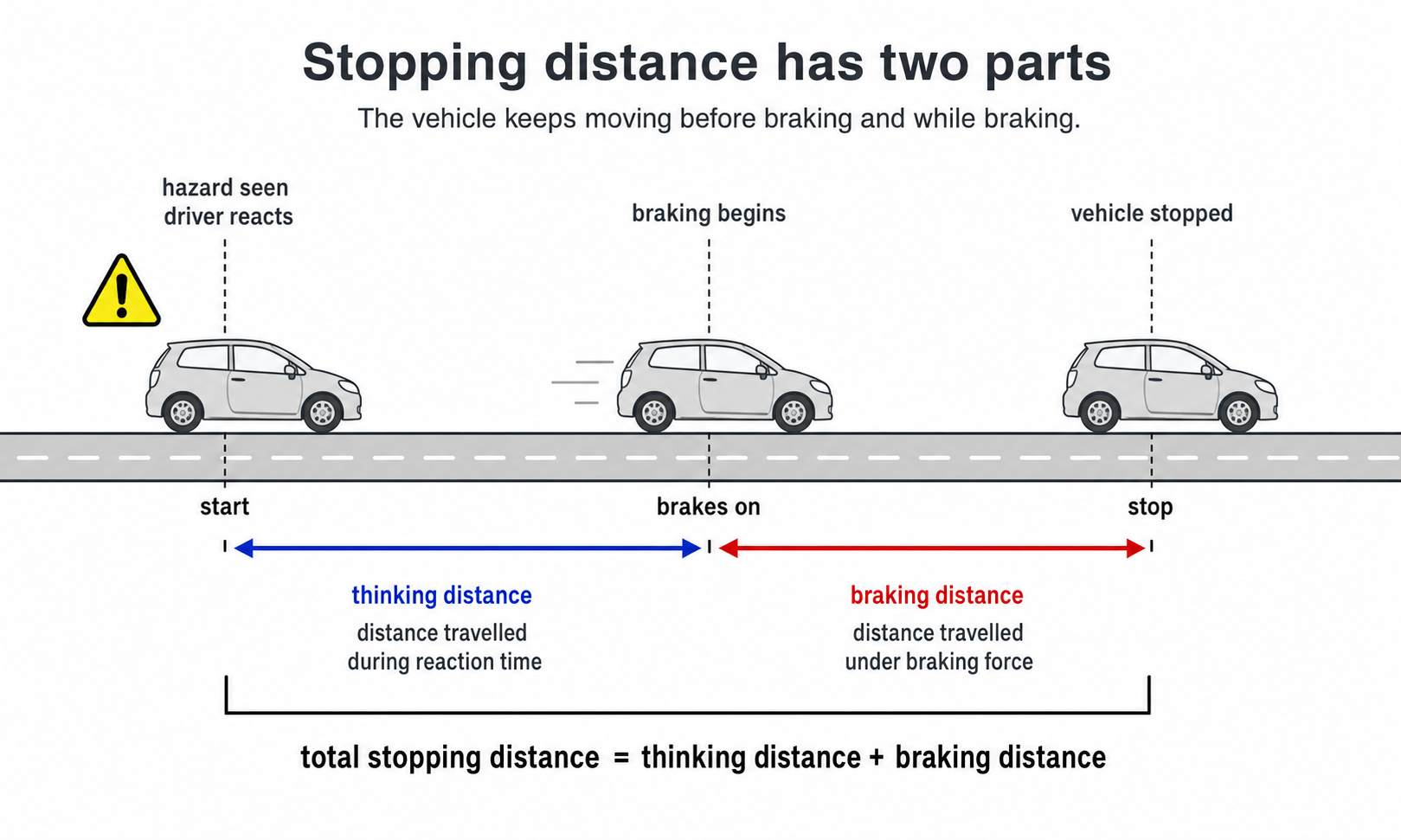
If a car travels while the driver reacts and then while braking, the stopping distance is:
Do not use "braking distance" as a shortcut for the whole stopping distance. Braking distance is only the second part.
Why speed matters
For a given braking force, the greater the speed of the vehicle, the greater the stopping distance. In this sentence, "given braking force" means the braking effect is being kept the same while the starting speed changes.
Speed affects both parts of stopping distance.
- During the same reaction time, a faster vehicle travels further before braking begins, so the thinking distance is greater.
- Once braking begins, a faster vehicle has more speed to lose, so it travels further while the same braking force slows it to rest.
That is why stopping distance does not just increase by a tiny amount when speed increases. The vehicle covers extra distance before braking and extra distance while braking.
If the braking force is kept the same, increasing the starting speed increases the stopping distance.
Worked example: a car at has a thinking distance of and a braking distance of in a set of typical data. Its stopping distance is:
At a higher speed, the thinking distance and braking distance are both larger, so the stopping distance is larger.
Estimating emergency-stop distances
In GCSE Physics, the emergency-stop estimate skill is physics only. You should be able to estimate how the distance needed to stop changes over a range of speeds typical for that vehicle.
One useful practice dataset is the UK Highway Code's typical stopping-distance guide for a car on a dry road:
| Speed | Thinking distance | Braking distance | Stopping distance |
|---|---|---|---|
You do not need to memorise this exact table for this specification point. Use it to learn the pattern:
- higher speed means longer stopping distance
- the increase becomes larger at higher speeds
- braking distance becomes a larger part of the total at higher speeds
For example, increasing speed from to doubles the speed, but the stopping distance increases from to , which is three times as large.
Continue this lesson.
You’re previewing NovaLearn without an account. Create a free account to read the rest.
Create free account