4.7.2.2 - Fleming's Left-Hand Rule
When a current-carrying conductor is placed in a magnetic field, the conductor and the magnet exert forces on each other. This is the motor effect. In this Higher Tier lesson, you will use Fleming's left-hand rule to link the directions of force, current and magnetic field, then apply the given equation for the size of the force.
The motor effect
A current in a conductor produces its own magnetic field. If that conductor is placed in another magnetic field, the two magnetic fields interact. The conductor and the magnet exert a force on each other.
Motor effect
The motor effect is the force on a current-carrying conductor placed in a magnetic field.
For this lesson, the conductor is usually a straight wire placed between the poles of a magnet. The field in the gap is from the north pole to the south pole. If a current flows through the wire, a force acts on the wire. The force is strongest when the current is at right angles to the magnetic field.
The force direction depends on two directions:
- the direction of the magnetic field
- the direction of the conventional current
Reversing either the current direction or the magnetic field direction reverses the force. Reversing both directions at the same time leaves the force in the original direction.
Using Fleming's left-hand rule
Fleming's left-hand rule is a direction rule. It does not calculate the size of the force. It shows the relative orientation of three perpendicular directions:
- thumb: force or motion of the conductor
- first finger: magnetic field, from north to south
- second finger: conventional current
[DIAGRAM: asset_name: flemings_left_hand_rule_orientation - diagram 1; asset_slug: 105_4_7_2_2_flemings_left_hand_rule_diagram1; file: diagram_assets/105_4_7_2_2_flemings_left_hand_rule_diagram1.png; recommended_method: image_gen; description: Assessed image-generated orientation guide for Fleming's left-hand rule. Show three mutually perpendicular directions with thumb labelled force/motion F upward, first finger labelled magnetic field B from N to S to the right, and second finger labelled conventional current I out of the page. Include a note to rotate the left hand until field and current match the question. Students should learn the exact mapping of thumb, first finger and second finger; labels and directions must be readable.]
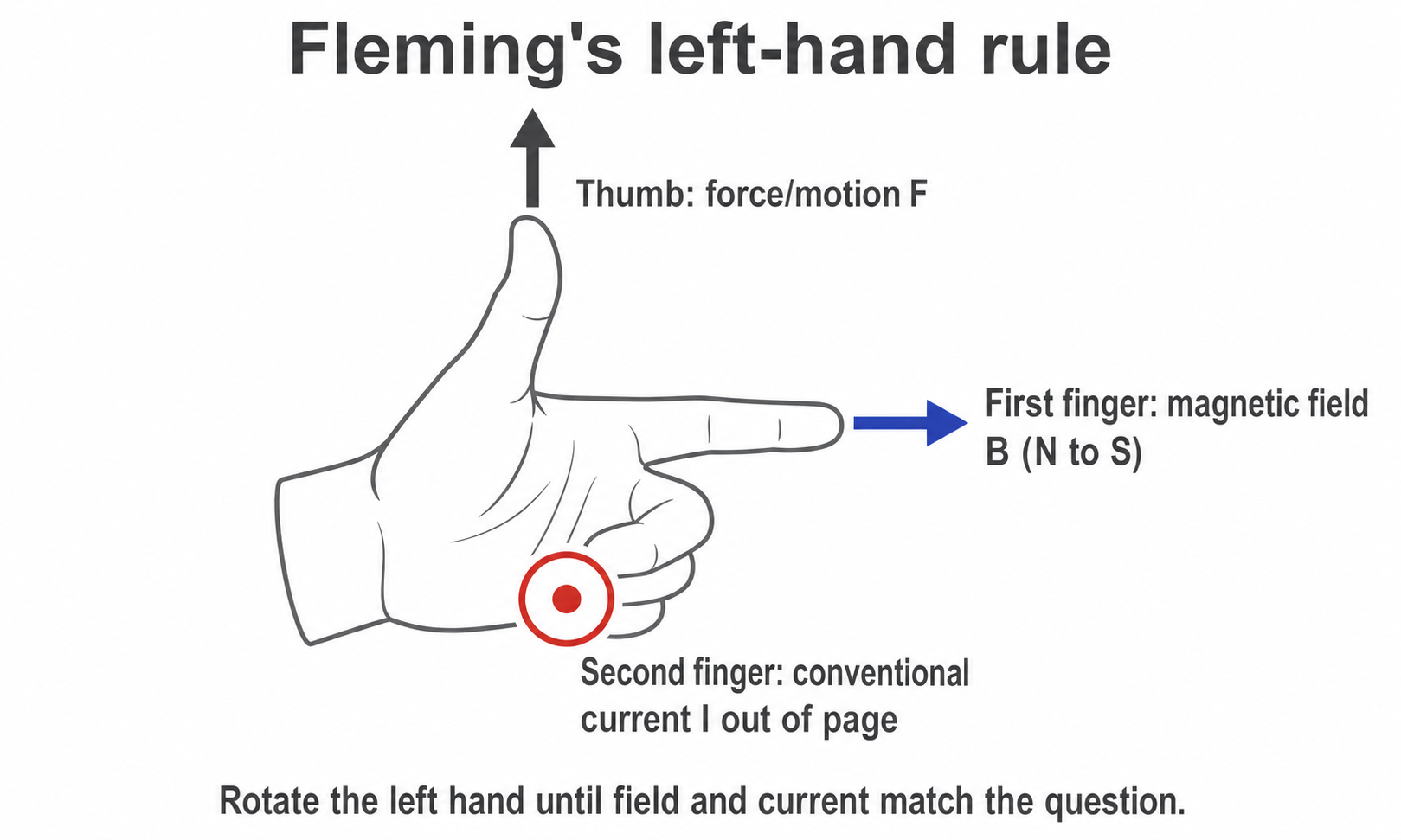
Use the left hand, not the right hand. Rotate the whole hand until the first finger points along the magnetic field and the second finger points along the conventional current. The thumb then shows the direction of the force on the conductor.
The word "conventional" matters. Conventional current is the direction a positive charge would move, from the positive terminal towards the negative terminal in a metal circuit. Electrons move the other way, but Fleming's left-hand rule for GCSE force-direction questions uses conventional current.
First finger = field, second finger = current, thumb = force. Match field and current first; the thumb gives the force direction.
Finding the force direction
Start with the magnetic field. Between two magnet poles, field lines go from north to south. Then add the current direction. In diagrams, current out of the page is often shown by a dot in a circle, as if you are looking at the tip of an arrow coming towards you. Current into the page is often shown by a cross, as if you are looking at the tail feathers of an arrow going away from you.
[DIAGRAM: asset_name: force_direction_between_magnet_poles - diagram 2; asset_slug: 105_4_7_2_2_flemings_left_hand_rule_diagram2; file: diagram_assets/105_4_7_2_2_flemings_left_hand_rule_diagram2.png; recommended_method: image_gen; description: Assessed image-generated force-direction diagram. Show a north pole on the left and south pole on the right, magnetic field arrows left to right, a circular cross-section of a wire in the gap carrying conventional current out of the page, and the resulting force on the wire upward. Include a small inset showing that reversing the current to into the page reverses the force downward. Students should learn how to apply Fleming's left-hand rule to a conductor in a magnetic field; exact directions are required.]
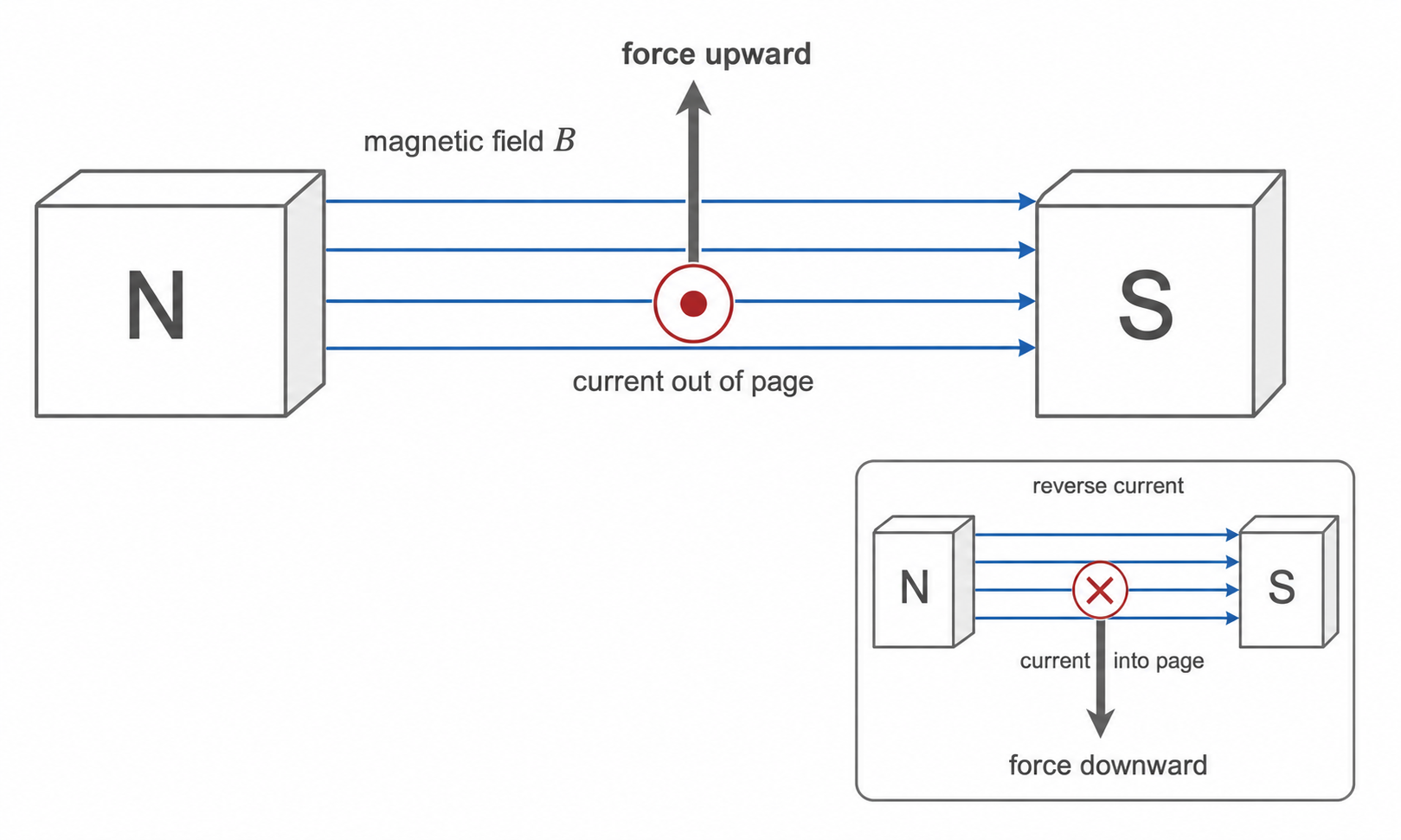
In the main example in the diagram:
- The magnetic field is from the north pole to the south pole, so it points to the right.
- The conventional current is out of the page.
- Fleming's left-hand rule gives a force upwards on the wire.
If the current were reversed so that it went into the page, the force would act downwards. If the magnetic poles were swapped, the magnetic field would reverse, so the force would also reverse.
Continue this lesson.
You’re previewing NovaLearn without an account. Create a free account to read the rest.
Create free account